

dsh-visual-memory
Manifest valid★ 1Lossless visual memory for DSH agents: store an image once, address it by sha256, read exact pixels, compare past frames, recall by text/tag/turn — no second vision model in the loop.
dsh-visual-memory
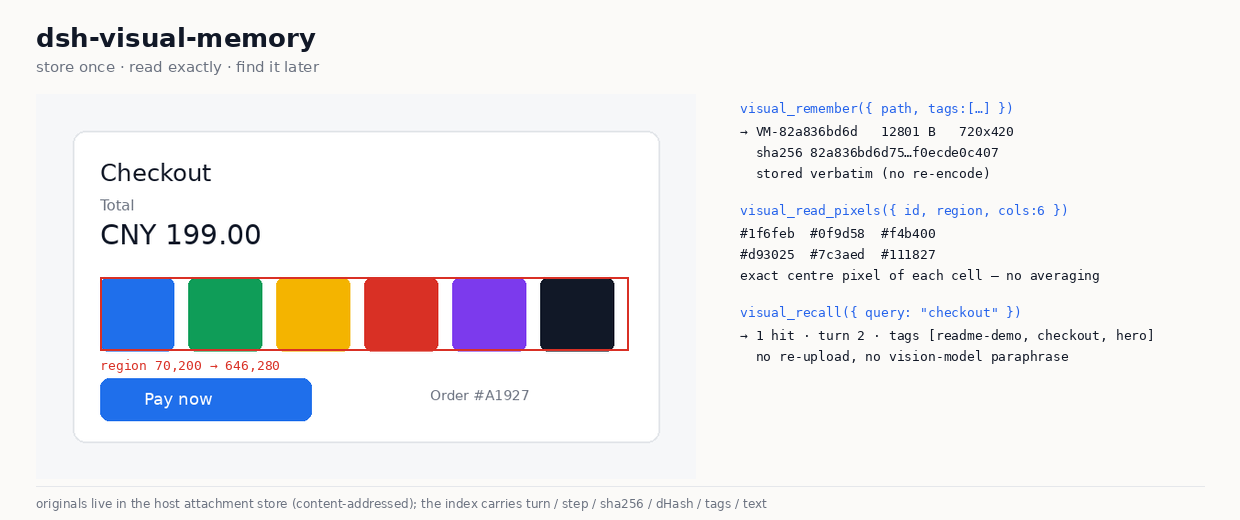
Lossless visual memory for a DSH agent. Store an image once; every later question is answered from the original bytes — exact pixels, exact replay, findable by text, tag, sha256, turn range or near-duplicate. No second vision model in the loop.
DSH 0.2.0-rc.2 · Node >= 22 · MIT · node verify.mjs 17/17
Install
# recommended: resolves against the repository, so it works behind any registry mirror
dsh plugin --profile <name> add github:xiciyang/dsh-visual-memory

# npm (registry.npmjs.org): short form
dsh plugin --profile <name> add @xiciyang/dsh-visual-memory
dsh --profile <name> --dump-config      # expect a "# == @xiciyang/dsh-visual-memory" layer
Install error mentioning
0.0.0-stage? That is a stale pnpm metadata cache, not a broken package: the first staged publish left a placeholder version in the cache. Clear it withpnpm store prune(or delete~/.cache/pnpm/*/metadata/<registry>/dsh-visual-memory.jsonl) and re-run the install.npm view @xiciyang/dsh-visual-memory versionshows the current version.
One bundle layer, seven tools. Remove with dsh plugin --profile <name> remove @xiciyang/dsh-visual-memory.
From a local checkout:
git clone https://github.com/xiciyang/dsh-visual-memory
dsh plugin --profile <name> add ./dsh-visual-memory
30-second decision
| You want | Reach for | Instead of |
|---|---|---|
| the exact colour of a cell in a past screenshot | visual_read_pixels | asking a vision model to look again and trusting the hex |
| compare two UI states, or replay a frame | visual_inspect, visual_compare | re-uploading both images every turn |
| find the image from turn 40 | visual_recall (text / tag / sha256 / turn range / dHash) | scrolling the transcript |
| keep a screenshot byte-identical | visual_remember (verbatim, content-addressed) | base64 inside a text-memory entry |
Not a fit if you need a cloud image host (this is local and file-backed),
Android (the pixel engine spawns python3), or one-off "describe this image" —
DSH native image input already covers that.
Why not another text-memory entry
Text memory stores descriptions; this stores bytes. The original file is committed verbatim, addressed by sha256, and every later question is answered from that original — not from a vision model's paraphrase. Two consequences: pixel values stay exact, and the answer does not change when you switch models.
Quick start
// 1. store the screenshot you are looking at, and make it findable
visual_remember({ path: "./shot.png", text: "checkout page, CNY 199, two buttons", tags: ["ui","checkout"] })

// 2. later, find it without re-uploading
visual_recall({ query: "checkout" })            // or sha256 / id / tags / turn range / near-dup

// 3. read the exact colour of a cell (a vision model would round it off)
visual_read_pixels({ id: "VM-…", region: "120,40,200,80", rows: 2, cols: 4 })

// 4. assemble several past frames into one labelled sheet for comparison
visual_inspect({ views: [{ id: "VM-…", region: "0,0,800,600" }, { id: "VM-…" }], layout: "side-by-side" })
Requirements
- DSH 0.2.0-rc.2 (declared as
engines.dsh: ">=0.2.0 <0.3.0"); the bundle manifest isdsh.bundle.patch, sodsh plugin addactivates the layer. - Node.js >= 22.
- Python 3 with Pillow (
python3 -m pip install pillow) — the pixel engine (lib/imaging.py) is a subprocess; the plugin does not vendor an image codec. - Desktop / server only for now: the pixel engine spawns
python3, so Android is out of scope (dsh-plugin-lintflags this asA2-subprocess-tool). A pure-JS fallback is the obvious next step if mobile matters. - A model route that declares image input for the observation path. The
plugin probes the live route (
visual_memory_status.routeCapability) instead of assuming; on a text-only route, images are still stored and are reachable through thesha256:xxxxxxxxhandle DSH emits.
Configuration
There is no config file — three locations follow host conventions, and changing the session workspace changes the store root:
| What | Where | Notes |
|---|---|---|
| store | <session workspace>/.dsh-visual-memory/ | one per workspace; index.jsonl is append-only |
| registry | $DSH_HOME/visual-memory-roots.json | gallery routing; most recent 20 workspaces |
| originals | $DSH_HOME/attachments/v1/files/<sha>/ | verbatim, content-addressed, not deleted with the index |
To move the store, change the session workspace. To clear memory, delete
.dsh-visual-memory/ (the originals stay in attachments/ and can be reclaimed).
Compatibility
| DSH | Status |
|---|---|
| 0.2.0-rc.2 | verified on 2026-10-17 — node verify.mjs 11/11, real tools called end-to-end |
| < 0.2.0 | not tested; engines.dsh refuses installation |
| >= 0.3.0 | not tested; widen the range only after running npm test on that version |
Built to close the gap against VISTA: A Visual Harness for Reasoning in an Interactive World (arXiv 2610.02200, Han, Hu, Qiu, Wu, Kaiming He, 2026-10-01), whose harness contributes three things: visual observation, a lossless visual memory that "stores every frame … in its original form" indexed by turn and frame, and visual inspection that works "in space" (an enlarged view of any rectangular region of the original frame) and "across time" (retrieve and inspect multiple frames from arbitrary earlier turns).
Capability map
| VISTA harness component | This plugin |
|---|---|
| Visual observation (model receives the pixels) | DSH native multimodal input — read_image; the model route's declared modalities are probed, not assumed |
| Lossless visual memory, original form, indexed by (turn, frame) | visual_remember → verbatim bytes in ctx.attachments.saveFile (content-addressed, never re-encoded) + an append-only index carrying turn/step/seq/sha256/dHash/dimensions/tags/text |
| Active retrieval of past observations | visual_recall — query / id / sha256 prefix / tags / turn range / chronological order / perceptual near-dup |
| Visual inspection in space (region of the original, enlarged) | visual_inspect views with region + scale; ad-hoc cropping stays with vision_crop |
| Visual inspection across time (several frames, one call) | visual_inspect assembles N views from N archived observations into one labelled sheet |
| Compare states / replay frames | visual_compare (labelled side-by-side / grid / stack); numeric diffs stay with vision_pixel_diff |
Exact pixel values (VISTA read_pixels) | visual_read_pixels — rows×cols cell matrix of #rrggbb centre readings |
| — (hybrid routing, not in the paper) | visual_memory_status.routeCapability resolves the live route and reports nativeImageInput; text-only routes recover images through the sha256:xxxxxxxx handle DSH emits |
Ownership boundaries
Each capability has exactly one owner, so there is no second implementation to diverge:
- bytes →
ctx.attachments(host service; verbatimsaveFile, content-addressed) - crop / pixel-diff / palette / trace / OCR / Q&A →
dsh-vision-toolkit(vision_crop,vision_pixel_diff,vision_dominant_colors,vision_trace,vision_glance) - index / attention ledger / labelled composites / multi-view assembly / capability probe → this plugin
visual_attend deliberately produces the annotated overlay + attention ledger
(what was looked at, made visible and durable) and leaves the crop itself to
vision_crop. visual_inspect cuts from archived observations because
assembling views out of memory is a distinct capability, not a second crop tool.
Tools
| Tool | Answers |
|---|---|
visual_remember | store this image losslessly and make it findable |
visual_recall | which image was that / find it by text, hash, tag, turn, or similarity |
visual_attend | draw the regions I examined onto the image and record them |
visual_inspect | give me these N observations, these regions, enlarged, in one sheet |
visual_read_pixels | what exactly is the colour of each cell |
visual_compare | put these images side by side with labels |
visual_memory_status | what is actually available, and can the current model see |
Web seam: GET /_dsh/visual-memory/gallery renders the memory (thumbnails,
attention ledger, indexed text, hashes); /_dsh/visual-memory/raw?id=VM-…
serves the exact stored original, and &v=<variant> serves one overlay or
comparison sheet that the record itself lists.
The web seam is not an Agent authority boundary. Every request is refused
unless the composition's connection.requestRejection accepts it (Host/Origin
fence + browser authentication), root must be a root this plugin registered,
and v is resolved only from the record's own listed variants and only when the
real path stays inside that store's artifacts/ directory — a caller-supplied
path is never read.
Storage layout
<session workspace>/.dsh-visual-memory/
  index.jsonl                 append-only; folded by id, last write wins
  artifacts/attention/*.png   attention overlays
  artifacts/compare/*.png     comparison sheets
  artifacts/inspect/*.png     per-view crops + assembled sheets
~/.dsh/visual-memory-roots.json   which workspaces have a store (gallery routing)
<DSH_HOME>/attachments/v1/files/<sha>/<name>   the verbatim originals
Verification
npm test                       # = node verify.mjs
node verify.mjs [path/to/index.jsonl]
Runs 17 checks: bundle contract, patch/profile wiring (restart persistence), the
pixel engine against a fixture with authored colours (probe, read_pixels,
crop+enlarge, compose, overlay clamping), the web seam's trust fence and path
fence (untrusted request, caller-named root, arbitrary v path, symlink escape,
the trusted gallery render, and the two legitimate raw reads), the lossless-JSON invariant (jsonSafe on every
tool return — an unguarded undefined once rejected a whole call), and
re-hashing every stored original against its recorded sha256.
The host-side path (ctx.attachments, ctx.fs, ctx.tools) is exercised by
calling the real tools; this script does not claim to cover it.
Provenance
Written after measuring the profile's actual state on 2026-10-04:
- native multimodal input was live (a randomised ground-truth image was read
back exactly,
TEY4KD / 3 circles / BG=(103,74,104)); - the external vision service was dead because every outbound request went through a mihomo proxy returning 502 — the toolkit provider was repointed to a directly reachable endpoint, and the toolkit's own health check now reports the credential resolvable;
- the vision toolkit's tools are registered into the agent scope, so a
host-scope
ctx.tools.schemas()cannot see them — the capability probe passes the agent (ctx.tools.schemas(agent)), the same call the Cordis Inspect Tool provider makes.
License
MIT — see LICENSE.
Comments
Loading…
From the same category
by ranxianglei
基本稳定可用 100K tokens is enough. Universal context-compression proxy for ALL AI coding agents,10w上下文足矣
★ 2k
↓ 450.5k/wk
MIT
TypeScript
Oct 20, 2026
dsh plugin --profile web add billion-contextA DeepSeek coding agent harness: persistent shell, Ultra subagents, auto approval, Chrome MCP and session telemetry
★ 1k
MIT
JavaScript
by Han-1413141
DeepSeek Harness session cost meter plugin: session/daily cost, budget, history, OpenCode Go quota, official & custom-provider balance, Codex-like token heatmap, peak/off-peak pricing with pre-switch
★ 470
↓ 26k/wk
MIT
JavaScript
Oct 19, 2026
dsh plugin --profile web add dsh-cost-meterby Nwflower
Import 14+ external agent chat histories (Claude Code, Codex, ChatGPT, Cursor, Gemini, Reasonix, opencode, ZCode, Grok Build, OpenClaw, Pi, Hermes, Kimi CLI, DSH) into DeepSeek Harness as resumable se
★ 238
MIT
JavaScript
Oct 19, 2026
dsh plugin --profile web add dsh-chat-importby MichengAI
DSH Archive Manager — 在 DeepSeek Harness 中安全查看、恢复和管理已归档会话 · Safely view, restore, and manage archived sessions in DSH
★ 177
↓ 17.2k/wk
Apache-2.0
JavaScript
Oct 19, 2026
dsh plugin --profile web add @michengai/dsh-archive-managerby Totoro-qaq
DeepSeek Harness plugin for previewable cross-preset session migration. Fixed-schema handoffs preserve state, source-model intent, and unresolved images; the original session stays untouched.
★ 163
MIT
JavaScript
Oct 18, 2026
dsh plugin --profile web add dsh-plugin-bridge