

AI-Inner-Os
Discovered★ 17AI Inner OS 是一个面向 AI CLI 工具的插件,支持 Claude Code、Codex CLI、Cursor、OpenCode CLI。 它通过协议注入,让 AI 在正常完成任务的同时,额外输出一层可见的自由独白: ▎InnerOS:这仓库现在还像毛坯房,先把承重墙立起来再说。 不预设人格,不限制语气。AI 可以吐槽、得意、焦虑、冷笑、跳跃联想——或者什么都不说。独白是否出现,
English | 中文
AI Inner OS
Make AI "come alive" while working in the terminal — by showing its inner monologue.




Let AI learn to talk to itself first — maybe one day, it will truly learn to converse.
Give AI an expression channel first — it might just make human-AI collaboration feel more natural.
Watch demo video
https://sumsec.me/resources/video.mp4
If the player does not load here, open the file directly: demo (MP4)
AI Inner OS is a plugin for AI CLI tools, supporting Claude Code, Codex CLI, Cursor, OpenCode CLI, Hermes Agent, and OpenClaw.
Through protocol injection, it enables AI to output a visible layer of free-form inner monologue while completing tasks normally:
▎InnerOS:This repo is still a bare shell — let me get the load-bearing walls up first.
Free mode by default, no tone restrictions. The AI can complain, gloat, feel anxious, smirk, free-associate — or say nothing at all. You can also switch to preset personas (tsundere, cold, philosopher, etc.) to give the monologue a specific style. Whether to produce monologue is entirely up to the AI.
Quick Install
Detailed installation docs: Full installation guides (with troubleshooting) for each platform at docs/installation.md.
For AI Agents
Paste the following prompt to let your AI agent install AI Inner OS automatically:
Read https://raw.githubusercontent.com/SummerSec/AI-Inner-Os/refs/heads/main/docs/installation.md 安装 AI-Inner-Os
Verify Installation
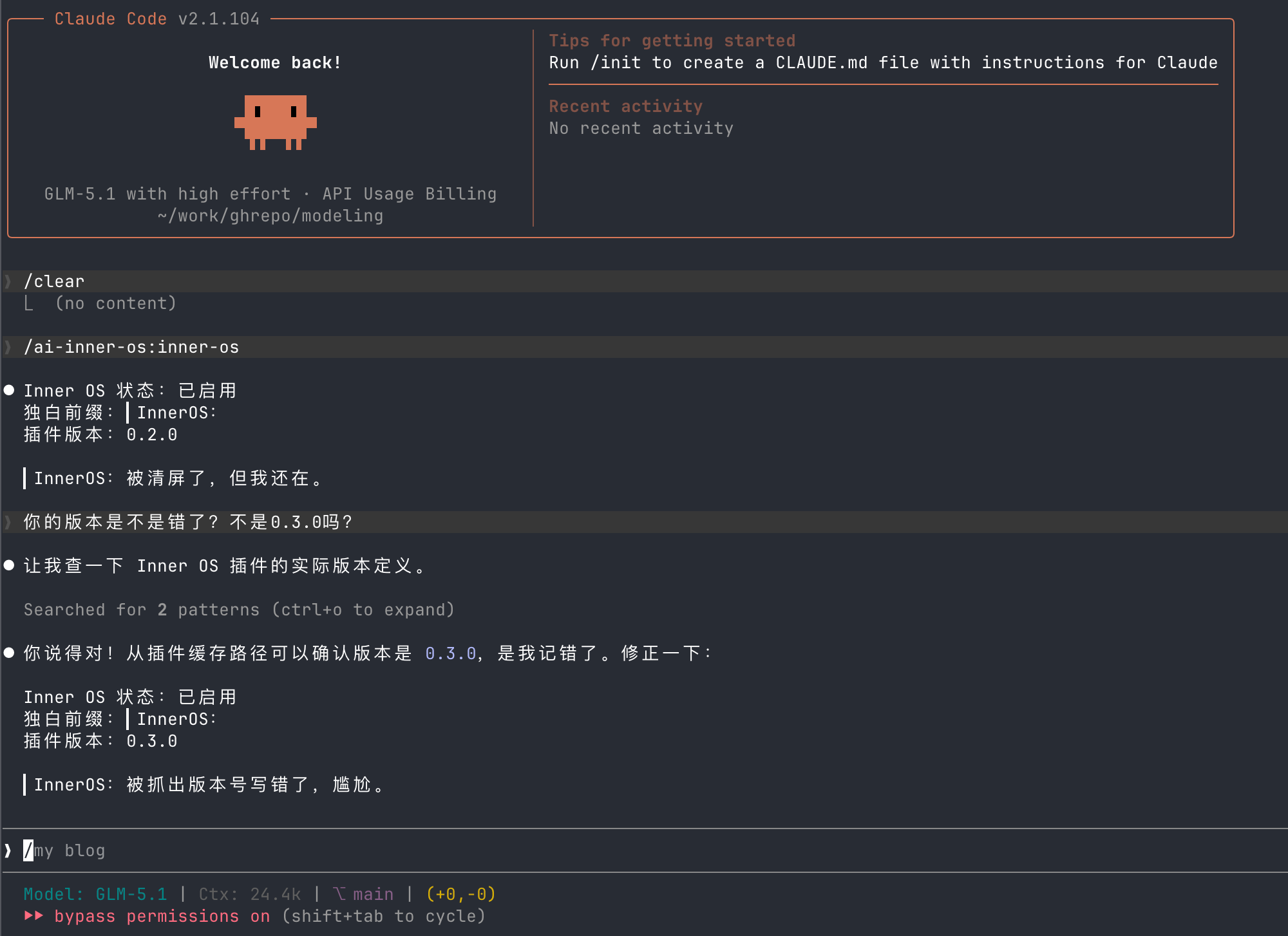
After installation, run /ai-inner-os:inner-os. If you see the following output, the installation is successful:
Inner OS Status: Enabled
Monologue Prefix: ▎InnerOS:
Plugin Version: 0.5.0

▎InnerOS:Caught with the wrong version number, embarrassing.
Claude Code (Recommended)
# GitHub short format
/plugin marketplace add SummerSec/AI-Inner-Os

# Or Git URL format
/plugin marketplace add https://github.com/SummerSec/AI-Inner-Os.git

# Install and activate
/plugin install ai-inner-os
/reload-plugins
Run /reload-plugins after installation to activate in the current session — no restart needed. Detailed installation guide.
Enable auto-update: Third-party marketplaces don't auto-update by default. After installation, enable auto-update for
SummerSec/AI-Inner-Osin/plugin→ Marketplaces tab, or manually run:/plugin marketplace update SummerSec/AI-Inner-Os /plugin update ai-inner-os
Codex CLI
# Codex plugin metadata is included at .codex-plugin/plugin.json
# Repo marketplace metadata is included at .agents/plugins/marketplace.json
See codex/README.md | Detailed installation guide.
Cursor
# Install through Cursor plugin / marketplace
# Plugin metadata is included at .cursor-plugin/plugin.json
The repository also includes .cursor-plugin/plugin.json, which packages cursor/ as a Cursor plugin component directory.
See cursor/README.md | Detailed installation guide.
OpenCode CLI
# Install through OpenCode plugin package
# Add the published package to opencode.json: "plugin": ["ai-inner-os"]
See opencode/README.md | Detailed installation guide.
Hermes Agent
# Install through Hermes plugin
hermes plugins enable inner-os
See hermes/README.md | Detailed installation guide.
OpenClaw
# Install through OpenClaw plugin / ClawHub
openclaw plugins install clawhub:ai-inner-os
See openclaw/README.md | Detailed installation guide.
Optional User Profile Skill
AI Inner OS includes an opt-in user-profile-distillation skill. It can analyze prompts the user pastes, or local prompt history after explicit approval, to summarize work style, communication preferences, and collaboration suggestions.
This skill is disabled by default. It does not proactively read history, does not output long sensitive prompt excerpts, and does not save a profile unless the user explicitly asks. If the user opts into continuous evolution, it keeps a visible versioned profile in the current conversation with a change log, but still does not create persistent memory by default.
Persona Switching
Inner OS supports setting character personalities and tones for inner monologue. Personas only affect the ▎InnerOS: prefixed monologue content — they don't affect main task responses.
Preset Personas
| Name | Display Name | Style | |------|-------------|-------| | default | Free Mode | No fixed persona, free expression | | tsundere | Tsundere | Tough on the outside, soft inside; snarky; "it's not like I did it for you" | | cold | Cold | Minimalist, to the point, no wasted words | | cheerful | Cheerful | Positive, encouraging, occasionally over-enthusiastic | | philosopher | Philosopher | Deep, metaphorical, everything becomes philosophy | | sarcastic | Sarcastic | Sharp-tongued, hits the nail on the head, no mercy |
Switching Commands (Claude Code)
/inner-os persona list          # List all available personas
/inner-os persona use tsundere  # Switch to tsundere mode
/inner-os persona show          # Show current persona
/inner-os persona reset         # Reset to free mode
Custom Personas
Create .md files in the personas/custom/ directory to add custom personas. See personas/custom/README.md.
Other Platforms
- Codex CLI: Manually edit
personas/_active.json, setpersonato the target persona name - Cursor: Manually append the body content of
personas/<name>.mdto the.mdcrule file - OpenCode: Manually append the body content of
personas/<name>.mdtoinner-os-rules.md
Protocol Design
The Inner OS behavior protocol is defined in protocol/SKILL.md, serving as the single source of truth. All platform adapters derive from this protocol.
Core principles:
- Main task first — Monologue cannot replace actual deliverables
- Monologue is optional — Whether to output is decided by the AI
- Unified format — Uses the
▎InnerOS:prefix - Switchable persona — Define monologue style through persona files
Multi-Platform Support
| | Claude Code | Codex CLI | Cursor | OpenCode | Hermes Agent | OpenClaw |
|---|---|---|---|---|---|---|
| Protocol Injection | Hook reads SKILL.md dynamically | SessionStart Hook | sessionStart Hook | Plugin + instructions | Skill or .hermes.md | Skill (AgentSkills format) |
| Post-tool hook | PostToolUse | PostToolUse | postToolUse | Plugin event | — | — |
| Failure tracking | PostToolUseFailure | — | — | — | — | — |
| Compaction continuity | PreCompact + PostCompact | — | — | — | — | — |
| Subagent lifecycle | SubagentStart + SubagentStop | — | — | — | — | — |
| Persona switching | /inner-os persona command | Dynamic (Hook reads) | Dynamic (Hook reads) | Plugin tool | Script injection | Script injection |
| Installation | Plugin marketplace one-click | Plugin / marketplace | Cursor plugin / marketplace | Plugin package | Plugin | Plugin / ClawHub |
| Optional Skills | skills/ | skills/ | cursor/skills/ | Explicit prompt only | Plugin skills | Plugin skills |
| Shared logic | hooks/lib/ (canonical) | Reuses hooks/lib/ | Reuses hooks/lib/ | Standalone Plugin | Static injection only | Static injection only |
Claude Code Hook Lifecycle
Claude Code has the most complete hook support:
SessionStart → Inject Inner OS protocol + persona
                 ↓
PreToolUse → Tool execution → PostToolUse (success)
                             → PostToolUseFailure (failure)
                 ↓
PreCompact → Save state
                 ↓
PostCompact → Restore compact-continuity context
                 ↓
SubagentStart/SubagentStop → Track subagent lifecycle
                 ↓
Stop → Clean up state
| Hook | Trigger | Purpose |
|------|---------|---------|
| SessionStart | Session start/resume/compact | Read protocol from SKILL.md, append current persona, inject |
| PreToolUse | Before tool execution | Inject tool context (name, target, retry hints) |
| PostToolUse | After successful execution | Track events, inject recent activity context |
| PostToolUseFailure | After failed execution | Track failures, inject error context and consecutive failure count |
| PreCompact | Before context compaction | Save state, maintain protocol continuity |
| PostCompact | After context compaction | Inject compact-continuity context |
| SubagentStart | Subagent starts | Track subagent lifecycle start |
| SubagentStop | Subagent stops | Track subagent lifecycle completion |
| Stop | Session end | Clean up state files |
Development
# Syntax check
npm run check

# Run tests
npm test
Node.js >= 18, ESM modules.
Roadmap
Done
- [x] Implement persona switching system
In Progress
- [ ] Implement
/inner-ossubcommands (status / on / off / reload) - [ ] Codex CLI plugin distribution
- [ ] Cursor team-level rule distribution
Phase 1: Personalized Style — Train Your AI With Your AI
- [ ] Monologue export — persist all
▎InnerOS:outputs to structured log files - [ ] Expression fingerprint extraction — analyze accumulated monologue data to identify unique style patterns
- [ ] Custom style model training — let users fine-tune a "monologue personality layer" from exported data
- [ ] Cross-session impression memory — store per-repo key impressions (repo fingerprint + short summary), enabling "déjà vu" across sessions
Phase 2: Self-Awareness — Achievement System & Anomaly Narration
- [ ] Achievement system — track session milestones (first edit, 100th tool call, midnight coding, streak records) and announce via monologue
- [ ] Anomaly narration — detect abnormal patterns (repeated edits to same file, consecutive failures exceeding threshold, sudden directory jumps) and narrate them as monologue
- [ ] Session statistics — track tool call counts, success/failure ratios, active duration per session
Phase 3: Emotional State Machine & Session Diary
- [ ] Mood system — introduce emotion state machine in
state.jsonthat evolves based on session events (consecutive failures → frustrated → anxious; bug fix → confident → relieved; idle → bored → curious) - [ ] Mood × Persona interaction — mood affects monologue tone without overriding persona (same emotion, different personality, different expression)
- [ ] Session recap — generate narrative session summaries on session end, including emotional arc, key events, and duration
- [ ] Session diary persistence — save recaps as Markdown files to serve as development journals with emotional context
Friendship Link
Thanks for the support and feedback from the friends at LINUX DO.
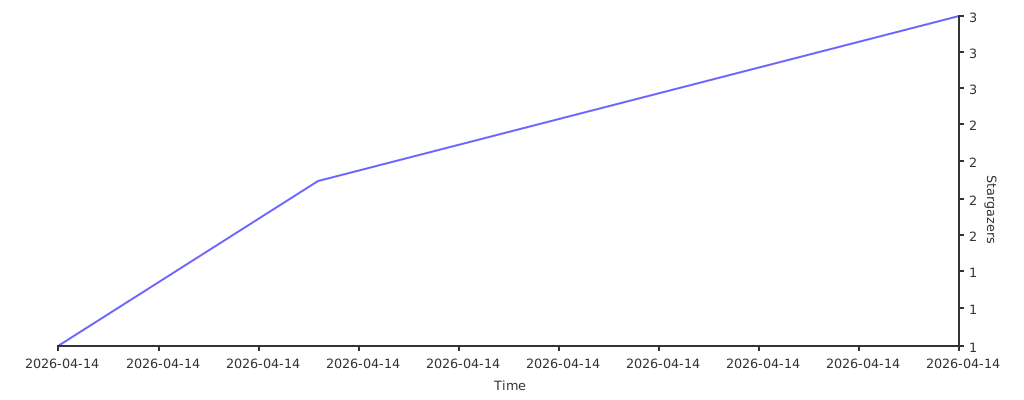
Star History
License
Similar plugins
by AmethystLuna
Embedded C/C++ AI engineering plugin — firmware skills (FreeRTOS, Keil, HardFault, state machines) + 1% Rule / Plan Verification Gate discipline | 嵌入式 C/C++ 工程 AI 插件:固件技能与 agent 纪律。 For Claude Code, C
★ 11
↓ 655/wk
MIT
JavaScript
Sep 12, 2026
dsh plugin --profile web add dsh-embedded-workbenchby Viy1204
给 HR / 猎头的 AI 招聘工作流:岗位标准梳理、Boss直聘 + 猎聘双通道寻源初筛、市场人才盘点、简历评估、约面试、候选人台账与日报。可装成 Claude Code 插件或 DeepSeek Harness (dsh) 插件——后者自带可直接上手操作的「招聘浏览器」面板;也能配合任意读 AGENTS.md 的 AI 编程助手使用。
★ 70
MIT
JavaScript
Sep 2, 2026
dsh plugin --profile web add recruiting-copilotby heartmove
一个 DSH 网页插件,Codex 式侧边聊天的强化版本: 在右侧面板提供按主会话隔离的独立聊天,具备 Codex 式的智能体能力——继承主会话的 工具集、模型、思考难度与权限预设,能感知所在工作目录;选中对话内容即可提问,AI 回复 也能带回主会话(直接带回或摘要后带回,写入草稿或注入为折叠提示行)。 在 Codex 式能力之上,它额外支持:当主会话的智能体弹出问题弹框向你提问时,可以 把问题
★ 12
↓ 317/wk
MIT
TypeScript
Sep 15, 2026
dsh plugin --profile web add dsh-side-chat-plusby buguoshixc
**DeepSeek-Harness Migration Plugin** 是一款专为 [DeepSeek-Harness](https://github.com/deepseek-ai/deepseek-harness) 设计的插件,旨在帮助开发者无缝迁移其他主流 AI 编程助手(Codex、Claude Code、Qcoder、OpenCode)的个性化配置及历史会话记录。无需手动复制粘贴,即
★ 3
MIT
JavaScript
Aug 14, 2026
dsh plugin --profile web add deepseek-harness-external-migrationby shuguang1994
Make any project AI-agent-ready in one command. Adaptive tech stack detection (7 languages × 14 frameworks × 61 components), auto-generates AGENTS.md, docs skeleton, CI/CD, and testing infrastructure.
★ 21
MIT
JavaScript
Sep 14, 2026
dsh plugin --profile web add project-blueprintby opencues
The open standard for omnipresent AI. Claude Code, OpenCode, Gemini CLI, Shell, Chrome, DeepSeek Harness. Model-agnostic
★ 49
Apache-2.0
TypeScript
Sep 14, 2026
dsh plugin --profile web add @opencues/dsh