

dsh-jev-mode
Manifest valid★ 1Optional JEV decision mode for DeepSeek Harness Desktop: deterministic reads, bounded semantic selection, native authorization and credential UI.
JEV decision mode for DeepSeek Harness Desktop
中文说明 · Installation · Validation and measurements · Releases
An optional preset that combines the standard Desktop tool capabilities with deterministic project reads, bounded JEV semantic selection, and a separate authorization gate. Independently developed and maintained by QI-seven33; this is an unofficial community plugin.
Install
In Harness Desktop, open Plugins, install and enable:
github:QI-seven33/dsh-jev-mode#v0.4.2
Alternatively, download dsh-jev-mode-0.4.2.tgz and enter its absolute local path in the same installer. Restart Harness completely, then choose JEV decision mode in a new session. Cloning the repository alone does not activate the plugin.
Tested against DeepSeek Harness Desktop 0.2.0-rc.2. Other host versions and operating systems need separate validation. Ready-to-run JavaScript is included; there are no runtime dependencies or build/install lifecycle scripts.
Enter your own key
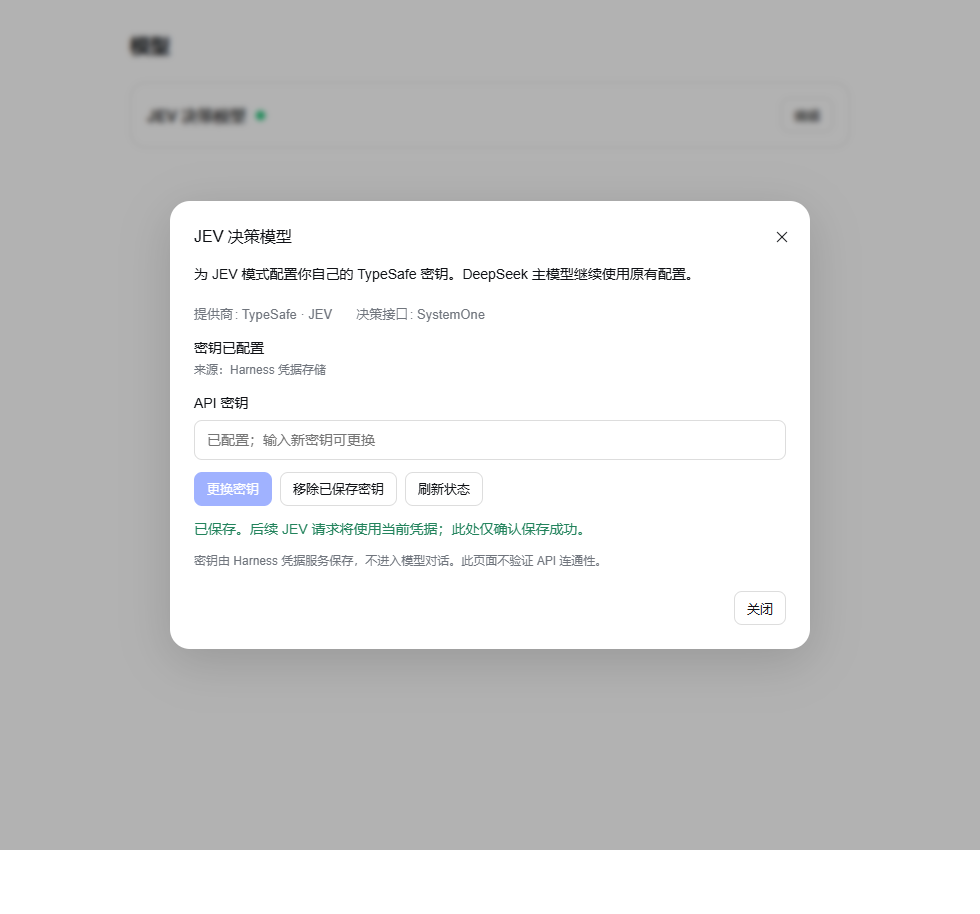
Open Settings → Models → JEV decision model → Edit. Enter your personal TypeSafe API key and save. The plugin uses Harness's write-only credentials service under TYPESAFE_API_KEY. No shared key is included, and saved values are never returned to the browser or model conversation. Keep your existing DeepSeek main-model configuration.
The collapsed card opens the host modal on Edit. It supports save, replacement, removal and status refresh. The dot indicates a configured credential, not API connectivity. Environment-provided credentials are read-only; removing a stored key can expose an existing .env fallback.
These images are component-test previews using the actual host React/Modal with a stubbed credentials remote; they do not depict a live authenticated Desktop session.

What the mode does
| Task | Behavior |
|---|---|
| Explicit root package.json / README.md query | Code chooses the file; native read and permissions run; zero JEV selection calls. |
| Eligible short contrastive request, both fixed files available | JEV may select one fixed read. Valid confidence and selected probability must both reach 0.9; otherwise ordinary planning continues. |
| Risky operation | Hard rules run first. Risk 2+ operations use real human instruction history for semantic authorization. Host permission vetoes remain authoritative. |
| Ordinary code or document task | Standard planning and tools; no automatic advisory JEV calls. Quoted commands in document content are not treated as executions. |
Without a TypeSafe key, explicit reads still work, semantic reads fall back, and failed dangerous authorization checks escalate or deny. Manual jev_decide and jev_gate tools remain available for human-requested diagnostics; jev_status reports version and counters.
The system prompt section and complete tool catalog remain fixed within a session. Runtime notices append after retained history using the host's producer-owned V4 message contract. Dynamic tool pruning and status-prefix rewrites are avoided to preserve DeepSeek prefix reuse. Cache hits remain best-effort and are not guaranteed. The ledger stores metadata and hashes, not command bodies, reasons or credentials.
Evidence and limits
The decision implementation is unchanged from 0.4.0; 0.4.2 adds desktop credential UI and separates global settings from preset behavior. The earlier controlled standard-vs-hybrid comparison achieved 28/28 scripted task successes in both arms and fewer main-model requests, but JEV-mode P95 was worse. These are small local measurements, not universal speed or accuracy claims. See VALIDATION.md for exact scope.
Authorization thresholds 0.85 / 0.55 have not been calibrated for this domain. Real-world false-allow/false-block rates are unmeasured. An automatic grounded/sufficient verification loop and per-decision client badges are not shipped.
Development
npm install --no-save --no-package-lock yaml@2
npm test
Native-host checks require Node 24 and the host module locations via DSH_HOST_NODE_MODULES / DSH_HOST_NATIVE_NODE_MODULES. CI runs offline checks on Node 20, 22 and 24 and explicitly reports absent-host skips. Live benchmark scripts are opt-in; see bench/COMPARE.md. Do not commit credentials, profiles or raw conversation traces.
Acceptance steps · Source attribution · Release procedure
MIT License · Copyright 2026 QI-seven33.
Comments
Loading…
From the same category
by ranxianglei
基本稳定可用 100K tokens is enough. Universal context-compression proxy for ALL AI coding agents,10w上下文足矣
★ 814
↓ 423.4k/wk
MIT
TypeScript
Oct 11, 2026
dsh plugin --profile web add billion-contextby Han-1413141
DeepSeek Harness session cost meter plugin: session/daily cost, budget, history, OpenCode Go quota, official & custom-provider balance, Codex-like token heatmap, peak/off-peak pricing with pre-switch
★ 388
↓ 23k/wk
MIT
JavaScript
Oct 10, 2026
dsh plugin --profile web add dsh-cost-meterby Nwflower
Import 14+ external agent chat histories (Claude Code, Codex, ChatGPT, Cursor, Gemini, Reasonix, opencode, ZCode, Grok Build, OpenClaw, Pi, Hermes, Kimi CLI, DSH) into DeepSeek Harness as resumable se
★ 224
MIT
JavaScript
Oct 7, 2026
dsh plugin --profile web add dsh-chat-importby Totoro-qaq
DeepSeek Harness plugin for previewable cross-preset session migration. Fixed-schema handoffs preserve state, source-model intent, and unresolved images; the original session stays untouched.
★ 165
MIT
JavaScript
Oct 11, 2026
dsh plugin --profile web add dsh-plugin-bridgeby Anionex
deepseek harness对话和代码状态回退插件 | DSH — rewind conversation and workspace state, powered by a persistent Change Ledger
★ 131
BSD-3-Clause
JavaScript
Oct 1, 2026
dsh plugin --profile web add @anionex/dsh-turn-rewindby SiriLee
DSH 插件:真正便捷无感的同窗口内对话回退,从不新建分支;自带轻量工作区备份,可一并还原文件(完整 Claude Code /rewind 语义)。 · DSH plugin: genuinely effortless in-window conversation rewind — never forking a new session; ships a lightweight workspac
★ 123
↓ 5.5k/wk
MIT
TypeScript
Oct 9, 2026
dsh plugin --profile web add dsh-rewind-plugin