

dsh-onto
DiscoveredBusiness ontology modeling + AI-assisted decision platform for DeepSeek Harness — judgment in the rule engine, determination by humans
dsh-onto
Business ontology modeling + AI-assisted decision platform built on DeepSeek Harness (dsh).
Turn expert business criteria into machine-validatable, issuable, derivable structures — O1 objects / O2 behavior rules / O3 scenario cards. One line to remember:
Judgment lives in the rule engine; determination lives with humans.
Overview
Universal pipeline: Knowledge → Ontology → Platform assembly → Decision support. Any domain swaps package content only — the skeleton stays the same.
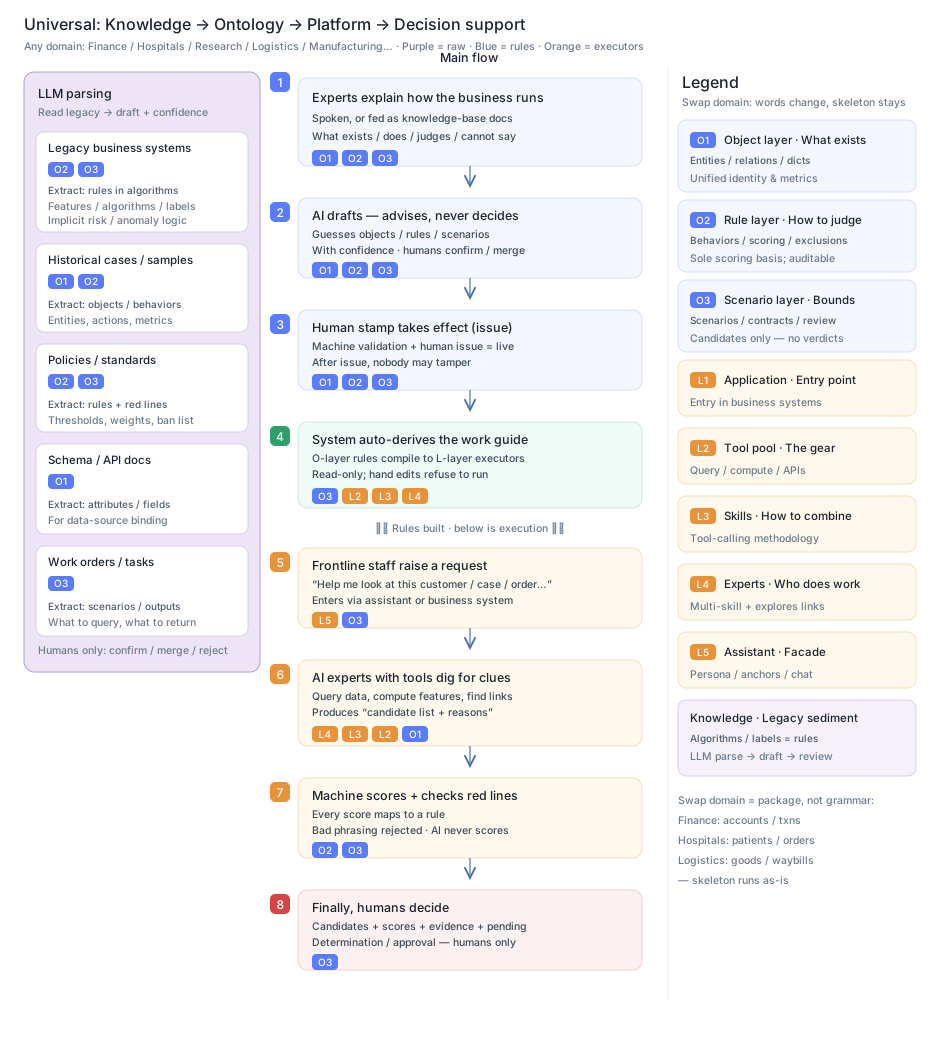
Chinese original: README.zh.md · docs/overview-pipeline.zh.svg

Why
Business judgment criteria usually scatter across code, configs, and individual experts' heads: every AI capability re-aligns the same semantics, thresholds drift between releases, and compliance boundaries get bolted on after the fact. dsh-onto makes the criteria the product: they are modeled as versioned YAML packages, validated by a rule engine, issued through human review, and derived into fingerprinted runtime contracts — while the LLM is kept on a short leash (drafting only, never scoring, never issuing verdicts).
Features
| Capability | Entry point |
|---|---|
| Package management: create / import / export / version fork / issue state machine (DRAFT → IN_REVIEW → ISSUED; ISSUED is read-only) | dsh-onto package * · Web · Packages tab |
| Modeling: structured O1/O2/O3 editing + YAML import | Web · Modeling tab · ontoModel.writeSource |
| Knowledge pipeline: 5 source types → LLM parsing (heuristic fallback) → candidate queue → human review | dsh-onto knowledge * · Web · Knowledge tab |
| Validator: reference closure / weights sum to 1.0 / dictionaries / event discipline / attribute resolution + quality score | dsh-onto validate · Web · Validate tab |
Deriver: derived/** + manifest fingerprints + load gate (DERIVED_DRIFT) | dsh-onto derive · dsh-onto gate |
| Rule engine: exclusions (before-scoring) → weighted scoring (weights come from O2); every score points back to a rule ID | core engine |
| Scenario execution: minimal-step pipeline dispatch + three-layer audit closure + human-review fields | dsh-onto run · Web · Scenarios tab |
| Multi-domain by design: AML (anti-money-laundering) + MED (clinical) ship as package content only — zero engine changes | packages/ |
Repository layout
dsh-onto/
  core/       @dsh-onto/core — pure engine library + CLI (zero harness deps; 117 node --test acceptance tests)
  backend/    @dsh-onto/backend — dsh bundle: onto* wire services (single backend landing point)
  workbench/  @dsh-onto/workbench — dsh bundle: Web UI (five tabs)
  packages/   example business ontology packages (first-class deliverables): aml/1.0.0, med/1.0.0
  examples/   scenario run fixtures (aml-run.json / med-run.json)
  scripts/    setup-profile.ps1 / dev-web.ps1 / dump-config.ps1
  docs/       architecture.md — self-contained concepts & rules (Chinese)
              overview-pipeline.{zh,en}.svg — end-to-end pipeline diagrams
Requirements
- Node.js ≥ 22.19 and pnpm 11.x
- A deepseek-harness checkout as a sibling
directory (
../deepseek-harness), already run throughpnpm install && pnpm run build. The harness is a read-only dependency — dsh-onto never modifies it.
Quick start
# 1. Create the `dsh-onto` profile, install both bundles, seed the example packages
dsh-onto\scripts\setup-profile.ps1
# 2. Assert the composed profile contains both @dsh-onto/* bundles
dsh-onto\scripts\dump-config.ps1
# 3. Launch the Web UI (open the printed dsh web URL) → sidebar entry "dsh-onto"
dsh-onto\scripts\dev-web.ps1
The workbench exposes five tabs: Packages · Modeling · Knowledge · Validate & Derive · Scenarios.
CLI (no browser needed)
cd dsh-onto\core
pnpm install; pnpm run build

node dist\cli.js package create --name demo --version 1.0.0 --domain DEMO --root ..\workspace
node dist\cli.js validate ..\packages\aml\1.0.0
node dist\cli.js derive   ..\packages\aml\1.0.0
node dist\cli.js gate     ..\packages\aml\1.0.0
node dist\cli.js run      ..\packages\aml\1.0.0 SCN-AML-FIND-CLUES --data ..\examples\aml-run.json --out result.json
node dist\cli.js knowledge upload --package demo --type LEGACY_SYS --name algo --file algo.txt --root ..\workspace
node dist\cli.js knowledge parse --source <id> --root ..\workspace
node dist\cli.js knowledge queue --root ..\workspace
Product discipline (hard rules)
- Business judgment content lives only in O2/O3; the rule engine is the single scoring path — LLMs never score.
- The LLM only drafts candidates (with confidence). Raw material never writes into a package directly; materialization happens only after human approval.
- Verdict-style phrasing ("认定…", "guilty of…", …) may only land in a scenario's
forbiddenPhrasesred lines — never in the output contract. - Determination is always human: every run returns
humanReviewRequired = true; the issue endpoint requires a human identity (issuedBy). - Derived artifacts are read-only but regenerable; hand-editing one →
DERIVED_DRIFTrefuses to load; re-deriving restores service. - Every output must include: candidate list, risk score, hit rule IDs, evidence chains, and pending checks — with a zero-tolerance scan for forbidden phrases.
Testing
core/tests/ ships 117 acceptance tests (node --test tests/*.test.mjs) covering:
validator interceptions, six-source knowledge parsing, conclusion phrases kept out of O3,
forced review for low confidence, ISSUED read-only + fork, derived-drift refusal and
recovery, end-to-end scenario output contract, rule-ID/evidence-chain/forbidden-phrase
guarantees, and a second domain running on the untouched engine.
Boundaries (stated honestly)
- Knowledge parsing defaults to a deterministic lexical heuristic; the DeepSeek API path
needs
DEEPSEEK_API_KEY(e.g. in~/.dsh/.env). - The modeling surface is structured editing + YAML import — not a free-form canvas (explicitly out of scope).
- Runtime verdicts are out of scope by design: the platform screens candidates and assembles evidence; humans decide.
License
Comments
Loading…
Similar plugins
by AGSQ11
Role-driven enterprise AI council for DeepSeek Harness with editable corporate personas, multi-round deliberation, dynamic model assignment, consensus gates and failover.
★ 0
MIT
JavaScript
Aug 19, 2026
dsh plugin --profile web add dsh-ai-councilby fly1989
Primary-controlled deliberation and opt-in reasoning-masked review for DeepSeek Harness.
★ 0
MIT
TypeScript
Aug 31, 2026
dsh plugin --profile web add dsh-deliberationby zcx369658780
Policy-enforced, evidence-first governed workflows for DeepSeek Harness agents.
★ 3
MIT
TypeScript
Aug 20, 2026
dsh plugin --profile web add dsh-governed-workflowby KasenRi
Deterministic engineering orchestration runtime for DeepSeek Harness: the orbit_controller tool and OrbitService run Commander, Executor and Smart Watchdog children through PLAN, EXECUTE, EVALUATE, bo
★ 0
MIT
JavaScript
Sep 18, 2026
dsh plugin --profile web add @kasenri/dsh-orbitby staff-os
An enterprise workbench for the DeepSeek Harness: AI employees, knowledge bases, skills, MCP servers and DSH plugins, all manageable from a running session.
★ 4
MIT
JavaScript
Aug 25, 2026
dsh plugin --profile web add @staff-os/dsh-workbenchby gjjkbssg
Structured cross-model peer review for DeepSeek Harness — blind reasoning, anonymous critique, revision, and deterministic verdicts.
★ 0
MIT
TypeScript
Aug 31, 2026
dsh plugin --profile web add dsh-model-jury