
dsh-review
Manifest validRuns a diff past several reviewers at once — a CLI coding agent such as codex or claude, or a DSH subagent — and merges their separate sections into one report; reviewers and named review modes are co
dsh-review
English | 中文


Code review as a tool, not a single vendor. Hand your diff to a CLI coding agent, or to a subagent running a model from your DSH configuration — then read one merged report.
What it gives you
- Two kinds of reviewer, both real agents.
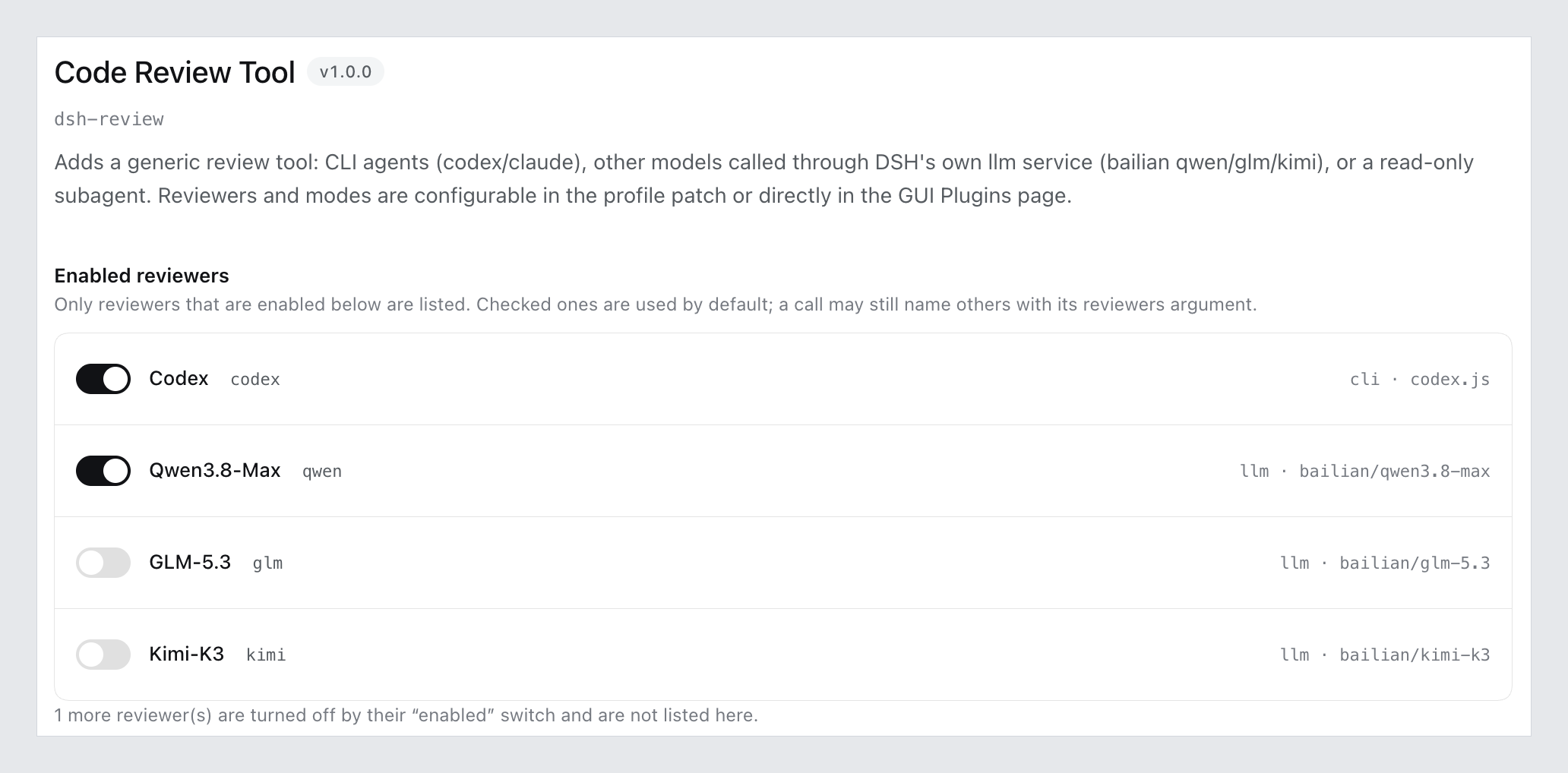
codex/claude/gemini/opencode/cursor/ any CLI you template yourself, or a DSH subagent running a model from your DSH configuration. - Several reviewers, one report. They run in parallel; each gets its own section, in the order they were selected.
- Review modes. Name a strength and a prompt once (
quick,balanced,deep, …) and reuse it, instead of retyping review instructions every time. - Configured in the GUI, and saved for you. Tick the reviewers you want; everything else stays collapsed under advanced settings. Edits are written about half a second after you stop typing — a status line at the top says where they stand, and a Save now button remains as a manual retry.
- No keys, no endpoints. Providers and credentials stay in your DSH config — this plugin only asks for what is already there.
Install
Clone it somewhere permanent, then install it into a profile:
git clone git@github.com:yutingzhao1991/dsh-review.git ~/code/github/dsh-review
dsh plugin --profile web add ~/code/github/dsh-review     # web → your profile name
Or ask your agent to run plugin_manager → install_bundle with that absolute path.
Restart the host afterwards. Updating works the same way: git pull, then restart.
Use
review()                                          // the reviewers you enabled, uncommitted changes
review({ reviewers: ["codex", "deep-dive"] })     // pick reviewers for this call
review({ mode: "deep" })                          // deep strength, several reviewers
review({ base: "main" })                          // working tree vs a branch
review({ commit: "abc1234" })                     // one commit
review({ instructions: "only concurrency and error handling" })
Reviewing takes minutes, so the call waits a little and then hands back a job id: read the
result with job_output, stop it with job_kill, or just wait — you are notified when it
settles.
Reviewers are opt-in: if nothing is enabled, a call with no reviewers fails and says so
rather than quietly running everything.
Reviewers
| Kind | What runs | Reads the code itself | Needs |
|---|---|---|---|
cli | a coding agent you already trust | depends on the preset (codex reads the repo) | that CLI installed |
subagent | a DSH child agent | yes, it has tools | a subagent provider |
CLI presets: codex, claude, gemini, opencode, cursor, or custom with your own
command template.
One thing worth knowing: a subagent inherits the parent session's model unless you set
agentModel, so it is not automatically a second opinion — name the model explicitly if you
want one.
Subagents get two safety nets by default: the review tool itself is filtered out (so a reviewer
cannot start more reviews) and a 30-minute wall-clock ceiling applies (timeoutMs per reviewer;
hardTimeoutMs still caps the whole call). Progress is reported while they run, so a long review
does not look stuck.
There is deliberately no "send the diff to a bare model" kind: a reviewer that can open the repository itself is worth more than one that only sees what it was handed.
- id: review
  name: dsh-review
  config:
    agents:
      - preset: codex
        model: gpt-5.6-sol
      - preset: claude
    reviewers:
      - id: deep-dive
        kind: subagent
        provider: spawn
        agentProvider: bailian      # any provider from your DSH config
        agentModel: deepseek-v4.1-flash
A subagent's model comes from your DSH configuration (provider, key, context window), and the GUI offers the registered ones as a list — nothing is duplicated in this plugin.
Review modes
A mode bundles how hard to look, what to say, and who to use.
| Field | Meaning |
|---|---|
strength | light / standard / deep — built-in review framing |
prompt | extra instructions for this mode |
reviewers | which reviewers this mode uses |
when | always / complex / never — a review policy for the agent to follow |
config:
  defaultMode: balanced
  modes:
    balanced:
      strength: standard
      reviewers: [ codex ]
    deep:
      strength: deep
      reviewers: [ codex, deep-dive ]
With no modes configured the plugin adds no constraints at all — you keep steering the agent
with your own prompt. when only takes effect if you also set injectPolicy: true, and it is
stated in the system prompt, not enforced as a gate.
Configuration
Everything can be set in the GUI; these are the same knobs in YAML. Only the ones worth knowing:
| Key | Default | Meaning |
|---|---|---|
defaultReviewers | none | reviewers used when a call omits reviewers; empty means none are enabled |
defaultMode | none | mode applied when a call omits mode |
language | auto | zh / en / auto report language (auto follows your instructions) |
injectPolicy | false | state each mode's when rule in the system prompt |
agents / reviewers | [] | define CLI and subagent reviewers (agents is the preset shorthand, reviewers the full form) |
modes | {} | named review modes |
waitMs | 0 | how long a call blocks before handing back a job id. 0 returns immediately (reviews take minutes, so waiting rarely pays) |
hardTimeoutMs | 0 | wall-clock ceiling; 0 = no limit — you decide when to stop it |
maxResultChars | 80000 | report cap; longer reports are truncated with a path to the full file |
maxDiffChars | 160000 | diff cap for reviewers that receive the diff |
Known limitations
- Reviews always run in the session's working directory; you cannot point them elsewhere.
- One call reviews one scope (uncommitted / a base branch / a commit), matching the underlying
CLIs.
baseandcommitare mutually exclusive. A range plusinstructionsworks for subagents but not for the codex CLI (its range flag and PROMPT exclude each other): if every selected reviewer is such a CLI the call is rejected up front, otherwise the CLI ones are named in the report footnotes — put the focus in a mode'spromptinstead. - A mode's prompt reaches codex only when no range is given (its CLI refuses both at once); the range is always honoured, and the report says when the prompt was skipped.
- codex only runs inside the directories it trusts (
~/.codex/config.toml). - An invalid
base/commitfails before any reviewer starts, instead of running for minutes and reporting a batch that reviewed nothing. - Report scaffolding (headings, footnotes, errors) is Chinese;
languageonly controls the reviewers' own instructions. - Truncated reports stay in
$TMPDIR/dsh-review-*/report.md; other runs clean up after themselves.
Development
node selftest.mjs # drives the plugin with a fake host: no DSH, no codex, no model calls
License
Comments
Loading…
Similar plugins
by wuxiangru915
Incremental diff reviewer for DSH: after approving a batch, only new changes since the checkpoint are shown, with a Web review panel and `/review` command that inject feedback back to the agent.
★ 1
MIT
TypeScript
Aug 21, 2026
dsh plugin --profile web add @dsh-plugin/dsh-review-loopAdds /review and /end-review code-review commands to DeepSeek Harness
★ 0
MIT
JavaScript
dsh plugin --profile web add @apcamargo/dsh-reviewby JasonFreeLab
Registers a /code-review slash command with five parallel review lenses and per-finding confidence scoring, for both pull requests and local code.
★ 2
↓ 322/wk
MIT
JavaScript
Sep 5, 2026
dsh plugin --profile web add dsh-command-code-reviewAudit each finished assistant turn with an independent reviewer model and steer the agent to fix failed output, with at most 2 review rounds per turn and SOP-folder standards injected as an extra revi
★ 0
dsh plugin --profile web add dsh-quality-reviewby luomeii
DeepSeek Harness 并行多角色代码评审插件:/review 派出安全/正确性/测试/风格四名只读评审员子代理(可各自指定模型与思考强度),汇总为结构化报告。
★ 1
↓ 72/wk
MIT
JavaScript
Sep 20, 2026
dsh plugin --profile web add dsh-review-squadby 9087
Make every agent edit approvable in DeepSeek Harness: full-diff review, per-file / per-block keep & revert, undo/redo.
★ 10
↓ 1.8k/wk
MIT
TypeScript
Oct 18, 2026
dsh plugin --profile web add dsh-diff-approval