

dsh-open-code-review
Manifest validCode Review Plugin (DeepSeek Harness × Alibaba OpenCodeReview): Non-intrusive by default — at the end of a turn, a single button or a simple "run a review" command is all it takes. Results are reported line by line as file:line [severity] issue. It can also function as an automated review and standalone review agent.
dsh-open-code-review

Code review for DSH (DeepSeek Harness), powered by Alibaba OpenCodeReview (ocr).
The four lines you actually need:
- What it is — a code review that the model can run on demand: the review spec (rules + file list + unified diff) comes from
ocr, findings come back per file aspath:line [severity] message, and you can also let it run automatically or gate the test command behind it. - What it does not do — it does not install
ocrfor you, it does not run your tests, it does not send anything anywhere except the LLM you configured, and it does not replace CI: one full-file scan measured 176–600 s per file and about $0.16. - What it costs — by default (
engine = delegate) nothing extra: the review runs in the current session’s context.engine = ocr/autodo call an LLM and are billed by tokens — that is an explicit opt-in since 0.8.0. - What you need — Node ≥ 20, the
ocrCLI (on Windows a real.exe, not a.cmdshim), DSH with the plugin installed, and a model (withllmMode = dshDSH’s own model is enough — nothing to fill in).
The plugin registers two model tools — ocr_review (run a review) and ocr_status (diagnostics) — plus the /ocr-review command, and it can review automatically at the end of a turn that wrote files. The review spec (rules + file list + unified diff) always comes from ocr; what changes is who executes it:
delegate— the default engine since 0.8.0: the plugin hands the current model the ocr-parsed rules + file list + diff, and the model reviews against those rules (no LLM call inside ocr, no extra token cost, seconds instead of minutes);ocr— ocr's own LLM pipeline (withllm.mode = dsh, DSH lends it the models, keys and quota); on real projects this measured 176–600 s per file and is billed by tokens;auto— tryocr, fall back todelegatewhen ocr has no LLM endpoint. Bothocrandautoare now an explicit choice: paying tokens for a review should be your decision, not the factory default;reviewer.agent = spawn— each round spawns an independent read-only reviewer subagent (its own context and model, onlyread/grep/glob); it returns structured findings, the coding agent fixes them or explains why not, and the next round starts automatically.
Quick start (5 minutes)
For a machine that has never had ocr installed. Budget: ~1 min Node, ~2 min ocr, ~1 min install + verify, ~1 min for the first review.
| Step | Do | You are done when |
|---|---|---|
| 1 | node -v → need ≥ 20 | it prints v20.x / v22.x / v24.x |
| 2 | npm i -g @alibaba-group/open-code-review | opencodereview --version prints a version |
| 3 | Give ocr a model. With llmMode = dsh (the default) there is nothing to fill in — DSH lends it its model, key and quota. Otherwise pick endpoint and set llmBaseUrl + llmApiKeyRef (the name of a DSH credential). | ocr_status shows an LLM route and does not say no valid LLM endpoint configured |
| 4 | dsh plugin --profile <profile> add github:xinyangGL/dsh-open-code-review, then restart DSH | ocr_status reports the executable + version, the LLM route and where the config came from |
| 5 | /ocr-review — or click Start code review at the end of a turn that wrote files | findings, or an explicit “no issues” |
Read this before you start (the honest limits):
ocris an external prerequisite the plugin cannot install for you, and every code path shells out to that binary — includingdelegate, which only skips the LLM call insideocr. “The plugin has no runtime dependencies” means npm packages, not the CLI.- On Windows point
ocrPathat the nativeopencodereview.exe..cmd/.bat/.ps1shims fail withEINVAL, because the host spawns without a shell. engine = delegate(default) spends no review tokens and returns the spec in seconds.engine = ocr/autorun OCR's own pipeline: 176–600 s per file, billed by tokens (≈ $0.16 for one scanned file). Do not wire those two into CI as-is.ocr_statusprints platform-specific install steps when it printsOCR_NOT_FOUND— follow those instead of guessing.
Requirements
| What | Detail |
|---|---|
| DSH host | The plugin is loaded by dsh plugin ... add (or from the plugin manager in the GUI) and runs inside the host process. |
| Node.js ≥ 20 | package.json engines; CI exercises 20 / 22 / 24 on Ubuntu and Windows. |
Alibaba ocr CLI | npm i -g @alibaba-group/open-code-review. It is an external prerequisite — the plugin cannot install it for you. The plugin itself has no npm runtime dependencies, but every path through it (including engine: "delegate") runs the ocr binary. |
Windows: a real opencodereview.exe | Point ocrPath at the native executable, e.g. Volta %LOCALAPPDATA%\Volta\tools\image\node\<version>\node_modules\@alibaba-group\open-code-review\node_modules\@alibaba-group\ocr-win32-x64\bin\opencodereview.exe, or the global npm location %APPDATA%\npm\node_modules\.... Never .cmd / .bat / .ps1: those are script shims, and the host spawns without cmd.exe, which fails with EINVAL. |
| macOS / Linux | Point ocrPath at the real path from which opencodereview (not at a wrapper script). |
| Or no config at all | Leave ocrPath empty and put opencodereview on PATH, or set OCR_EXECUTABLE / OPENCODEREVIEW_BIN. |
Executable lookup order (lib/ocr-cli.js): ocrPath → ocrCandidates → OCR_EXECUTABLE → OPENCODEREVIEW_BIN → well-known Volta / global-npm locations (native .exe first) → PATH (opencodereview, opencodereview.exe). Script shims are rejected with the reason spelled out.
Install
dsh plugin --profile <profile> add github:xinyangGL/dsh-open-code-review
# the https form is equivalent
dsh plugin --profile <profile> add https://github.com/xinyangGL/dsh-open-code-review
Restart the DSH host afterwards, then verify:
ocr_status
It reports the resolved executable and its version, the LLM route in force, and where the configuration came from (configSource / configPath). When ocr cannot be found it prints platform-specific install steps (global npm install, Node ≥ 20, and the Windows “real .exe, not the shim” warning) — you do not need this README for that.
Changing config / taking effect
| What you changed | How it takes effect |
|---|---|
| Any field in the settings page | Immediately. The host writes the value into the current profile’s patch YAML and broadcasts it; the plugin re-reads the config — no restart. |
| An external config file | Immediately. Re-read by mtime. |
lib/*.js (host side) | Restart the DSH host (ESM module cache). |
lib/client.js, or dsh.client in package.json | Restart the host and reload the page (the client bundle is built and served by the host). |
cordis.patch.yml / package.json | Re-run dsh plugin --profile <profile> add ... (or disable → enable it in the plugin manager), then restart. |
Configuration
Settings page
Two entries lead to the same form:
- Settings → Code review — the plugin’s own settings page (the nav title is 「代码评审」).
- Settings → Plugins → dsh-open-code-review — the plugin card shows a read-only summary plus a pointer to the settings page; values are edited on the settings page, not on the card.
Layout of the page:
- Basics — 6 rows, expanded:
enabled(master switch),engine,autoReview,reviewerAgent,llmMode,llmModel. - Dependent rows appear with their parent:
reviewerProvider/reviewerModel/reviewerRoundswhenreviewerAgent = spawn;llmBaseUrl/llmProtocol/llmApiKeyRefwhenllmMode = endpoint;llmProvider(an advanced row) only indshmode. - 「Advanced settings」— 13 items, folded by default. Tuning:
autoScope,autoMaxPerSession,autoMinReviewableFiles,autoMinIntervalMs,autoSkipSubagents,autoIncludeDiff,preTest. Runtime & diagnostics:audience,ocrPath,timeoutMinutes,progress,llmProvider,verbose. The fold title reads 「高级设置(13 项)」; if it holds edited-but-unsaved rows it also shows 「N 项待保存」. autoMinIntervalMsis a preset dropdown (30 seconds / 1 minute / 5 minutes / 10 minutes / Custom…) but is stored in milliseconds — pick 「自定义…」 to type a millisecond value (default60000).- Rows the settings page has touched carry a 「设置页已改」 badge.
- Values are stored per profile (they do not follow you to another profile or machine).
ocr_statusshows where each key actually came from.
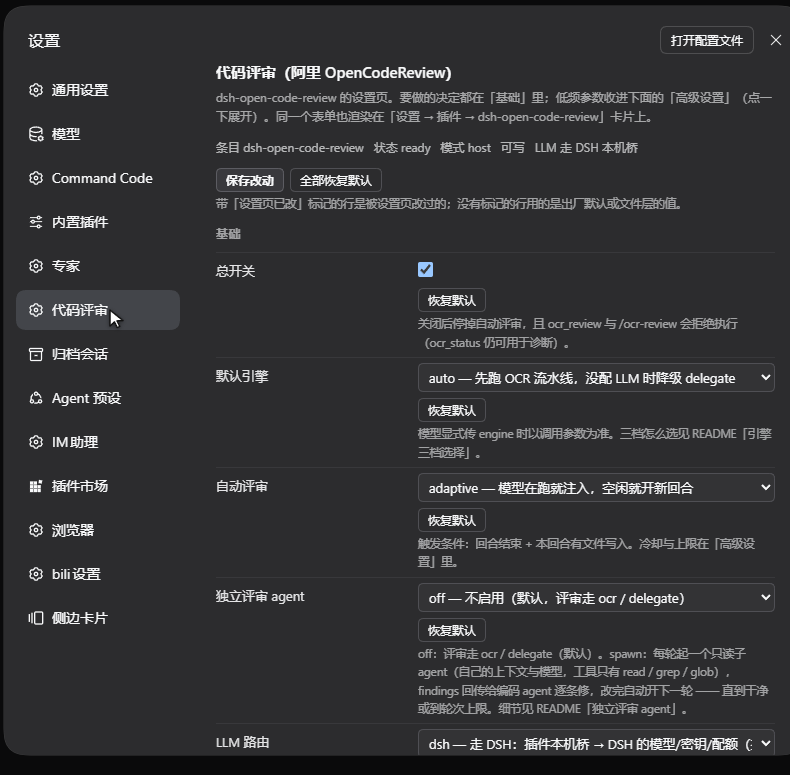
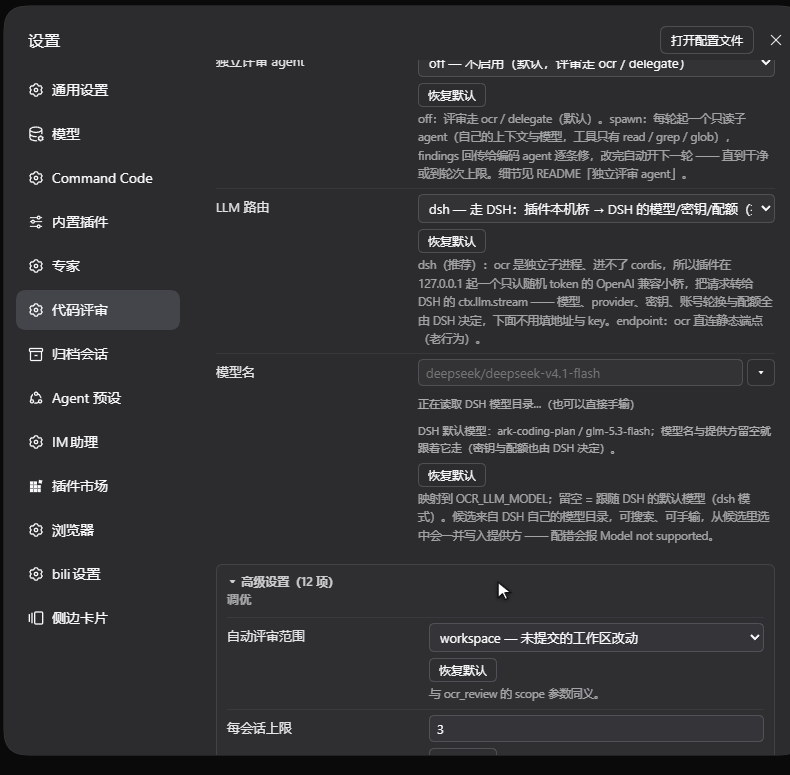
Real screenshots (DSH on Windows, sidebar cropped out): the basics group, and the advanced section after expanding it.
Config sources
resolveConfigFile() (lib/config.js) reads one file — the first that exists:
- the path in
DSH_OPEN_CODE_REVIEW_CONFIG; <DSH_HOME>/dsh-open-code-review.json— recommended (DSH_HOMEdefaults to~/.dsh);<plugin dir>/config.json— only meaningful for a source / local checkout: a GitHub (git) install lives undernode_modulesand is overwritten on upgrade.
That file layer holds the keys the settings page does not have (ocrCandidates, extraArgs, env, llm.apiKey, a larger maxTimeoutMinutes, …). Precedence is settings page > config file > factory defaults, and ocr_status.fileValues lists the keys the file actually provided.
ocr’s own configuration (~/.opencodereview/config.json) is separate; ocr_status.ocrHomeConfig reports what was found there.
Key reference
Where says which settings-page row exposes the key (or file only). Defaults are the factory values in lib/config.js.
| Key | Default | Where | Notes |
|---|---|---|---|
enabled | true | Basics | Master switch. false stops automatic review and makes ocr_review / /ocr-review refuse to run (ocr_status still works). |
engine | "delegate" | Basics | Default engine: delegate (the factory default since 0.8.0) / ocr / auto. A tool call can override it. Only ocr and auto call an LLM and cost tokens. |
auto | "off" | Basics (autoReview) | Settings-page key autoReview writes here. off (the default since 0.5.0) / adaptive / inject / followup. |
onDemand | true | Basics (onDemand) | On-demand review: a Start code review button at the end of every completed turn, plus the runtime skill ocr-on-demand-review (so the model itself can start a review when you ask it to verify something). |
reviewer.agent | "off" | Basics (reviewerAgent) | off / spawn — run reviews through an independent read-only reviewer subagent. |
llm.mode | "dsh" | Basics (llmMode) | dsh / endpoint — see LLM routing. |
llm.model | "" | Basics (llmModel) | → OCR_LLM_MODEL; empty = follow DSH’s default model. |
reviewer.provider | "spawn" | dependent (spawn) | Subagent provider. A wrong name fails with OCR_REVIEWER_UNAVAILABLE and lists the available ones. |
reviewer.model | "" | dependent (spawn) | Empty = that provider’s default model. |
reviewer.rounds | 3 | dependent (spawn) | 1–10 round trips before automatic re-review stops. |
llm.baseUrl | "https://api.commandcode.ai/provider/v1" | dependent (endpoint) | → OCR_LLM_URL. |
llm.protocol | "openai" | dependent (endpoint) | openai / anthropic → OCR_LLM_PROTOCOL. |
llm.apiKeyRef | "COMMANDCODE_API_KEY" | dependent (endpoint) | → OCR_LLM_TOKEN, resolved from the DSH credential store (no plaintext on disk). |
autoScope | "workspace" | Advanced · tuning | Scope used by automatic reviews: workspace / range / commit / scan. |
autoMaxPerSession | 3 | Advanced · tuning | Max automatic reviews per session (0 = none; manual reviews still work). |
autoMinReviewableFiles | 1 | Advanced · tuning | Skip the automatic review when fewer files are reviewable. |
autoMinIntervalMs | 60000 | Advanced · tuning | Cooldown between two automatic reviews, in ms. |
autoSkipSubagents | true | Advanced · tuning | Turns of subagents (delegationDepth > 0) do not trigger automatic review. |
autoIncludeDiff | true | Advanced · tuning | Include the unified diff when an automatic review falls back to delegate. |
preTest | "off" | Advanced · tuning | Review before tests: off / remind / gate — see Review before tests. |
audience | "agent" | Advanced · runtime | → ocr --audience; agent = summary only, human = the fuller report. |
ocrPath | "" | Advanced · runtime | Absolute path to the real ocr executable; empty = auto-discovery. |
timeoutMinutes | 15 | Advanced · runtime | → ocr --timeout and the plugin-side hard timeout. The settings page caps it at the factory 60. |
progress | true | Advanced · runtime | Register each review as a background job (Jobs panel) and show the in-session progress row. |
llm.provider | "" | Advanced · runtime (dsh) | Provider id the bridge forwards to; empty = follow DSH’s default model. |
verbose | false | Advanced · runtime | Log the ocr command line, env and timings to the DSH log. |
autoEngine | "" | file only | Engine used by automatic reviews; empty = follow engine. |
ocrCandidates | [] | file only | Extra candidate paths tried after ocrPath ([] clears the layer). |
extraArgs | [] | file only | Raw extra arguments appended to the ocr command line. |
env | {} | file only | Extra environment variables for the ocr child process ("" deletes one). |
includeDiffMaxBytes | 120000 | file only | Cap (characters) on the diff embedded in the generated spec. |
maxIssuesInText | 40 | file only | Max issues listed in the text summary (the full data stays in issues / rawJson). |
maxTimeoutMinutes | 60 | file only | Hard upper bound for timeoutMinutes; itself clamped to 24 h (1440 min) in code. |
llm.apiKey | "" | file only | Literal key for the endpoint route. Prefer llm.apiKeyRef: a literal ends up on disk in a config file — and keep that file out of any repository (this repo ships only config.example.json). |
reviewer.persona | "" | file only | Extra persona / instructions for the reviewer subagent. |
Choosing an engine
The spec always comes from ocr, so all three engines review against the same rules; you can switch per call.
| Engine | What actually runs | Cost | Pick it when |
|---|---|---|---|
ocr | ocr’s own pipeline: deterministic engineering + its LLM reviewer, parsed back into issues | Needs an LLM for ocr — with llm.mode = dsh that is DSH’s model, key and quota | You want OCR’s own review pipeline and are fine with the cost — 176–600 s per file, billed by tokens. Explicit opt-in since 0.8.0. |
delegate | No LLM call inside ocr: the plugin returns the ocr-parsed rules + file list + unified diff, and the current model reviews by those rules | Uses the current session’s model/quota only | The default since 0.8.0 — you have no LLM key/quota to spare, or you want the review in seconds rather than minutes. engine = auto falls back to this automatically. |
reviewer.agent = spawn | Each round spawns an independent read-only subagent (own context + model, tools limited to read/grep/glob) that returns structured findings; the coding agent fixes them or explains why not, then the next round starts automatically until clean or the round limit | The most expensive, and the closest to a human review | High-risk changes where “the author reviews their own work” is not enough. |
Which one? Start with ocr (or delegate if you want reviews without spending anything extra), and switch on reviewer.agent = spawn for the changes that really matter.
LLM routing
| Mode | Behaviour |
|---|---|
dsh (default, recommended) | ocr is a separate subprocess and cannot reach cordis, so the plugin starts a small OpenAI-compatible bridge on 127.0.0.1 that accepts only a random per-run token and forwards requests to DSH’s ctx.llm.stream. Models, provider, keys, account rotation and quota stay inside DSH — nothing to configure beyond optionally pinning llm.provider / llm.model. |
endpoint | ocr talks straight to a static endpoint: llm.baseUrl + llm.protocol (openai / anthropic) + a key — llm.apiKeyRef names a DSH credential (recommended), or llm.apiKey holds a literal key in the config file. |
The plugin maps these onto the environment ocr understands: OCR_LLM_URL, OCR_LLM_PROTOCOL, OCR_LLM_TOKEN, OCR_LLM_MODEL (config.env can override or add more).
ocr_status.bridge shows the dsh bridge live: url, the masked token, requests, failed, rejected + lastReject (since 0.6.1: requests that reached the bridge but were never forwarded — bad token, invalid body, empty messages, missing route — counted separately so failed only means "forwarded upstream and failed"), retries, retrySkips + retrySkipReason (why a request was not retried automatically; cleared at the start of every forwarded request since 0.6.1 so one request's reason never leaks into another's diagnostics), cumulative tokens (prompt_tokens, completion_tokens, total_tokens, cache_read_tokens, cache_write_tokens, partial), lastError, lastProvider, lastModel, inflight and uptimeMs. If the host has no llm service, the plugin still works and the dsh route falls back to the static endpoint.
Usage
Tool ocr_review
| Parameter | Type | Meaning |
|---|---|---|
scope | workspace | range | commit | scan | workspace (default) = uncommitted changes, equivalent to ocr review; range uses from/to; commit uses commit; scan scans paths and needs no diff. |
from / to | string | Start / end ref of scope = range, e.g. main, feature-x (to omitted = up to the working tree). |
commit | string | Commit hash or tag for scope = commit. |
paths | string[] | Files/directories to scan for scope = scan; also filters the git diff in delegate mode. |
engine | delegate | ocr | auto | Defaults to the configured engine (factory default delegate since 0.8.0). auto = try ocr, fall back to delegate when ocr has no LLM. ocr / auto cost LLM tokens; delegate does not. |
reviewer | boolean | true = force the independent reviewer subagent (fails with OCR_REVIEWER_UNAVAILABLE instead of falling back); false = force ocr/delegate; omitted = follow reviewer.agent. |
preview | boolean | Only list the files that would be reviewed and the exclusions; no LLM call (like ocr review -p). |
effort | low | medium | high | Review effort preset (ocr’s --effort). |
model / provider | string | Override the model / provider for this run. |
exclude | string[] | gitignore-style exclusion patterns (joined with commas for --exclude). |
rulePath | string | Path to a custom system-rule JSON file (ocr’s --rule). |
timeoutMinutes | number | Timeout for this run; defaults to the plugin config. |
repo | string | Git repository root; defaults to the session working directory. |
includeDiff | boolean | delegate mode only: embed the unified diff in the spec (default true). |
extraArgs | string[] | Raw extra arguments for ocr (advanced). |
Unknown parameters are rejected (additionalProperties: false), so a typo fails loudly instead of silently doing nothing.
The result carries: ok, code (empty on success), engine (the one that actually ran: ocr / delegate / agent), reviewer (provider, model, round, rounds, childId, stopReason, verdict = clean / issues / uncertain), scope, repository, command (the ocr command line that ran), exitCode, durationMs, reviewableFiles[] (path, status, insertions, deletions), excludedFiles[], issues[] (file, line, severity, message), summary, reviewSpec (the delegate payload), configHint, notes[], rawJson (ocr’s stdout, up to 100 000 characters), stderr, lostOutput, spillPath, llmMissing, usage (prompt_tokens, completion_tokens, total_tokens, cache_read_tokens, cache_write_tokens, partial, requests — accumulated through the bridge on the dsh route), timedOut, aborted, nextStep (empty on success; on failure it is the concrete next action for that code — the failure text renders it as a 下一步:… line).
Long reviews no longer look stuck (since 0.8.0): while ocr runs, the job progress row gets a heartbeat every 30 s — ocr 运行中 2m10s · 还没有任何输出(超时 15 分钟;等不及可以改用 engine=delegate,几秒出规格), switching to …最近一次输出在 4.0s 前 once output starts. When a run that would call an LLM starts, the first note is a cost hint: 成本提示:engine=ocr 走 OCR 的 LLM 流水线 —— 真机历史 176~600s/文件、按 tokens 计费(scan 单文件约 $0.16)…想省钱用 engine=delegate. delegate runs get no cost hint, because they cost nothing.
Tool ocr_status
Diagnostics for one call: resolved executable + version, configPath / configSource / fileValues[], installHint, settingsPage, the effective enabled / engine / auto / llmMode / llmRoute / llmEndpoint, the bridge counters (above), reviewer availability (providers[], ready, error), credentialRef / credentialSource, ocrHomeConfig, llmEnv[], a minimal llmTest, hooks (which event listeners actually registered), host (per-capability probe of what this host provides), preTest, stats.byEntry (per-entry review counts, 0.9.0), and notes[]. Start here whenever a review fails.
Command /ocr-review
Runs a review from the input box: it injects a follow-up instruction into the current session, which then calls ocr_review (default scope = workspace) and works through the findings one by one. It accepts optional free text after the command — extra requirements such as “only review changes under src/, focus on concurrency and error handling”. If the plugin is switched off (enabled = false), the command returns an error pointing at the settings page; ocr_status still works.
On-demand review (the default since 0.5.0)
Nothing runs on its own. Two ways to start a review when you decide the change is ready:
- The button at the end of a turn. Every completed turn gets a Start code review button in the conversation tail. One click runs the same thing as
/ocr-reviewfor that session; while a review for that session is running the button turns into Reviewing… and is disabled (so double-clicking cannot stack two reviews), and a failure shows the reason inline and can be retried. It is rendered bylib/client.js(conversation.chat.turnTail); if the host does not expose the remote-command service the button simply is not there, and everything else keeps working. - The runtime skill
ocr-on-demand-review. WithonDemand = truethe plugin registers it with the host, so when you say “review this”, “verify the change” or “跑一次评审” the model can callocr_reviewitself and report file-by-file findings.ocr_statusreportsonDemandandskill.registered, which is how you confirm the registration.
The button and a typed /ocr-review both execute the same slash command on the host, so ocr_status also reports command: { name: "ocr-review", registered, reason } (added in 0.5.4). If registered is false the host refused the registration — the button and the command cannot work, and the status note says so instead of failing silently.
Turn both off (onDemand = false, or enabled = false) and the plugin is reduced to the tools plus the /ocr-review command — nothing is ever injected or auto-started. onDemand = false also removes the skill registration; the tail button disappears with it.
Since 0.9.0 the plugin also keeps a per-entry tally (this process only, cleared by a restart) so “is the button actually used?” stops being a guess: ocr_status.stats.byEntry has four honest buckets — tool (the model called ocr_review, whether you asked in prose or the skill told it to), command (you typed /ocr-review), button (the tail button — the client appends --entry=button, which the plugin strips before the model ever sees it) and auto (automatic review). The rendered status text points at a button count of zero, and RELEASING.md documents the 14-day rule built on it. There is deliberately no skill bucket: from the tool's point of view a model-initiated call and a skill-guided call are the same call, so claiming to tell them apart would be inventing a number.
Review before tests (preTest, since 0.5.7)
“Can the review be wired into the standard flow — start it before the agent runs unit tests?”
Yes, and it is off by default. Three modes (preTest, settings page → Advanced → Tuning →
Review before tests, or preTest in the config file):
| Mode | What happens when a shell tool looks like a test command |
|---|---|
off (default) | Nothing. Test commands are untouched. |
remind | The test runs; when its result comes back the model gets one reminder that this batch has not been reviewed yet. |
gate | The command is refused until one successful ocr_review covers the current changes. The model receives the refusal as that tool's result, so it can review first and then re-run the test. |
How it is implemented (worth knowing if you write plugins yourself): DSH has no
tools/before-call event, but a tool call passes through the tools/pre-execute waterfall, so the
plugin registers one scoped listener there: non-shell tools hit a single Set lookup and call
next() immediately (the config is not even read for them), off and non-test commands call next(),
remind only records the pending flag, and only gate without a covering review returns
{ kind: "deny", reason }. ocr_status.preTest.mechanism tells you whether it is armed
(pre-execute) or not (none — the host has no such event, or the plugin is disabled).
Why the gate never registers a global guard, and the 0.5.10 incident. 0.5.7 – 0.5.9 additionally
registered a global ctx.tools.guard() (monotonic, applies to every tool in the app) and used
return "" for “allow”. The host contract is “a returned string denies the execution” and the
implementation is guardReason(exec) { … if (reason !== void 0) return reason } — an empty string is
still a denial reason, which the pipeline renders as Error: ${denialReason}, so every tool call in
the app came back as an empty Error: — a purely optional feature taking down the whole tool surface.
0.5.10 fixed the boundary; 0.6.0 removed the global guard entirely (0.5.7's mechanism is gone, and
mechanism can no longer be guard), and any failure inside the gate itself is now fail-open and
counted: ocr_status.preTest exposes failOpen, lastError and lastDecision { tool, kind, at }, and
the log line is rate-limited to once per 30 s (or per changed message).
docs/pretest-gate-safety-design.md records the incident, the options that were weighed and the rule it
encodes: an optional feature must never own a failure mode that disables everything else.
Coverage is tracked per agent in memory: a successful ocr_review marks the batch reviewed, any
successful write tool clears that mark, and neither a failed review nor a preview: true call (which
only lists files and never calls the LLM) counts (fail-closed). remind arms the same hook so it can set
the pending flag — it just never returns a denial. Detection only inspects shell tools (pwsh /
powershell / bash / sh / zsh / shell / cmd / run_command / terminal) and matches common
entry points at the start of a command (npm|pnpm|yarn|bun test, node --test, npx vitest,
vitest|jest|pytest|phpunit|ctest|rspec|tox, python -m pytest|unittest,
go|cargo|dotnet|gradle|mvn|make test|verify), splitting on && / || / ; / | / newline first so
cd lib && npm test counts while git commit -m "fix jest tests" does not. The plugin never runs
anything itself, only allows or refuses. gate can be noisy while you are iterating — remind is the
gentler middle ground.
Automatic review (opt-in, off by default)
Trigger: the end of a turn and that turn wrote at least one file — and you turned it back on (autoReview set to adaptive / inject / followup; the factory default is off since 0.5.0). Before running, the plugin checks, in order:
enabledis notfalseandauto(the settings-pageautoReview) is notoff;- the session has had fewer than
autoMaxPerSessionautomatic reviews (0= never); - at least
autoMinReviewableFilesfiles are reviewable in the chosenautoScope; - at least
autoMinIntervalMshas passed since the last automatic review in this session; - with
autoSkipSubagents, turns of subagents (delegationDepth > 0) are skipped.
The mode decides how the result arrives: adaptive injects while the model is still running and opens a new turn when it is idle, inject only injects into the current context, followup always opens a new turn. autoScope picks what is reviewed (workspace by default), autoEngine (file only) or engine picks the engine, and autoIncludeDiff controls whether the delegate fallback carries the unified diff. Failed automatic reviews are retried automatically, capped by AUTO_RETRY_LIMIT = 2 in lib/index.js; after that the session is left alone until you ask again.
Progress visibility
With progress = true (default) every review is registered as a background job named ocr-review-N: the Jobs panel (session title bar) shows a live progress line and the expandable ocr output, and a progress row above the input box can stop the run. Turning progress off hides all of it; reviews still run.
Result codes (fail-closed)
code is a stable string on failure and empty on success. From lib/review.js (CODES):
| Code | Meaning |
|---|---|
OCR_INVALID_ARGS | Invalid scope/ref combination, or a ref that starts with -, or whitespace/shell characters in commit. |
OCR_DISABLED | enabled = false: the tool, the command and automatic review refuse to run. |
OCR_NOT_GIT_REPO | The target is not a git repository (workspace / range / commit scopes). |
OCR_NOT_FOUND | No ocr executable found; the result carries installHint and the list of paths tried. |
OCR_TIMEOUT | The review exceeded timeoutMinutes (plugin-side hard timeout); timedOut = true. |
OCR_ABORTED | The run was cancelled — tool call interrupted, stop button, or plugin unload. |
OCR_RUN_FAILED | ocr exited non-zero, or the spawn itself failed. |
OCR_LLM_MISSING | ocr has no LLM endpoint/key configured (llmMissing = true); with engine = auto the plugin falls back to delegate. |
OCR_OUTPUT_UNPARSABLE | ocr’s stdout is not valid JSON. |
OCR_OUTPUT_SHAPE_UNKNOWN | The JSON parsed but its shape is not one the plugin recognises: fail-closed — it never pretends “no issues”. |
OCR_DELEGATE_PREVIEW_FAILED | The file list could not be obtained for the delegate payload. |
OCR_DELEGATE_RULE_UNPARSABLE | The rules ocr emitted could not be parsed. |
OCR_REVIEWER_UNAVAILABLE | The reviewer subagent could not start (e.g. a wrong provider name; the error lists the available ones). reviewer = false does not fall back. |
OCR_REVIEWER_FAILED | The reviewer subagent run failed. |
OCR_REVIEWER_UNCERTAIN | The round limit was reached while findings were still unconfirmed. |
Emergency stop (since 0.7.0)
If the plugin misbehaves badly enough that you do not trust the app to fix it — or the tool surface is broken and you cannot open the settings page — there is a stop that does not go through the plugin's own code paths. Either one works:
| How | Detail |
|---|---|
| Environment variable | Start DSH with DSH_OPEN_CODE_REVIEW_DISABLE=1 (also accepted: true / yes / on). Remove it and restart to restore. |
| Marker file | Create <DSH_HOME>/dsh-open-code-review.disabled (usually ~/.dsh/dsh-open-code-review.disabled; DSH_HOME overrides). A .disabled file inside the plugin directory works too. Delete the file to restore. |
What “stopped” means, exactly: apply() registers ocr_review and ocr_status and then returns — no slash command, no event listeners (not even the preTest gate), no local LLM bridge, no on-demand skill, no service injections. Both tools still answer, so you can ask why:
ocr_reviewfails closed withcode: "OCR_DISABLED"and a summary that says where the marker is;ocr_statusreportsdisabled: true,disabledBy: "env" | "file", the marker path, a⚠️ 紧急制动已生效line at the top of the rendered text, and skips the LLM connectivity probe (a stopped plugin spends no money).
The stop is re-checked at runtime, so a marker that appears while DSH is running stops the auto-reviewer and the gate on their next event; the hooks come back only after a restart (ocr_status.hooks shows what is actually registered). test/killswitch-smoke.mjs covers both sources, both truthy and falsy values, and asserts that the markers it writes never land in the real plugin directory.
Host contract (since 0.7.0)
ocr_status.host answers “is this host actually providing what the plugin expects?”:
{ "ok": true, "missing": [], "errors": [],
  "capabilities": [ { "id": "inject.jobs", "label": "Jobs 服务(ctx.jobs.start)", "surface": "host",
                      "required": false, "present": false,
                      "degrade": "没有 Jobs 面板里的进度行(会话内进度行仍在)。" } ] }
Two capabilities are required (tools.register, subprocess.spawn) — without them the plugin is effectively not installed. Everything else is optional and each row carries the fallback path in degrade. present: null means the host cannot see it from its side and only a human at the browser can confirm it (the client slots). The full table, how to add a capability, and why the plugin deliberately has no version gate are in docs/host-contract.md.
Verified against DSH 0.2.0-rc.2 (desktop), Node 20/22/24 and ocr 1.12.12; that declaration also lives in package.json under dsh.host. The host itself only reads dsh.bundle, dsh.profile and dsh.client, so dsh.host is metadata for humans — the runtime probe above is the authority.
Troubleshooting
| Symptom | What to check |
|---|---|
ocr not found / OCR_NOT_FOUND | Run ocr_status: it prints the resolved executable (or none), the version, and platform-specific install steps. On Windows do not point ocrPath at a .cmd/.bat/.ps1 shim — the host spawns without cmd.exe and fails with EINVAL; use the real .exe. |
check your LLM configuration and API key | That is ocr’s generic message. Read notes[] for the real cause (including 「未自动重试 N 次」 and its reason) and ocr_status.bridge (lastError, failed, retrySkips, retrySkipReason). If the host has no llm service, configure llm.mode = endpoint, or review with engine: "delegate". |
| A long review is cut off upstream | Pin a fixed llm.model (a stable, long-context model), narrow the range (paths, exclude, commit scope) or raise timeoutMinutes (the file layer’s maxTimeoutMinutes goes up to 24 h). ocr’s stdout kept in rawJson is capped at 100 000 characters — lostOutput / spillPath tell you when output was dropped. |
OCR_INVALID_ARGS | from / to / commit must not start with - (that would look like a flag), and commit must not contain whitespace or shell metacharacters. |
OCR_OUTPUT_SHAPE_UNKNOWN | The plugin does not recognise this ocr output shape and fails closed on purpose rather than reporting “no issues”. Report ocr_status.version together with rawJson. |
OCR_REVIEWER_UNCERTAIN | The round limit was reached with findings still open: raise reviewer.rounds (max 10) or review the leftovers manually. |
| A field seems ignored | ocr_status reports configSource, configPath and fileValues; precedence is settings page > config file > defaults, and only one config file is read (the first that exists). Since 0.5.8 a settings-page value counts as an override only when it differs from the factory default — the host hands the plugin a schema instance in which untouched fields still carry their defaults, so "set to the default" and "never set" cannot be told apart, and the config file wins in that case. |
I edited config.json and auto / onDemand / preTest did not change | Fixed in 0.5.8. Those three are “install/uninstall a listener” decisions, and before 0.5.8 a file-layer edit only changed values — the decision itself was re-evaluated on startup and on settings-page writes only, so preTest: gate in the file left the gate unarmed while ocr_status reported off. Now the gate is armed whenever the plugin is enabled and the three switches re-sync from a file-layer fingerprint on the next tools/result / agent/turn-stopping (no timers), so a file edit takes effect by the next tool call or turn end — and preTest.mode is always computed from the current config. |
DSH_OPEN_CODE_REVIEW_CONFIG points at a file that does not exist | Since 0.5.0 the plugin no longer stops there: it falls back to <DSH_HOME>/dsh-open-code-review.json, then to the plugin directory, and ocr_status says so (“指向的 … 不存在,已回落到 …”). Before 0.5.0 that path silently kept running on defaults. |
| The settings-page dropdowns are unreadable (white-on-white, or dark text on a dark theme) | Fixed in 0.5.0: the <select> / <option> colours now come from the host theme tokens and the widget declares color-scheme, so the native popup follows light/dark. Upgrade (and refresh the page after the host restart). |
| The result says “0 file(s) reviewed, N issue(s) found” | Fixed in 0.5.0. The file count now comes from files[] / total_files / reviewable_count, falling back to the distinct files the findings mention, so a summary without a file list can no longer report 0 files next to N findings. |
Token counters look inconsistent (total > prompt + completion) | Two causes, both now visible. (1) The cache: DSH's inputTokens already excludes cache hits while total includes them, so the bridge reports cache_read_tokens / cache_write_tokens and the line reads 输入 P(其中缓存命中 C · 缓存写入 W) / 输出 O (fixed in 0.5.4 — before that the cache tokens simply went missing from the sum). (2) An upstream that reports only a total: bridge.tokens.partial counts those calls and the line adds “其中 N 次上游只报了总数”. The plugin never fabricates the missing halves. |
| A status call right after install/restart says the bridge is not ready | Fixed in 0.5.2: the bridge listens asynchronously, so resolveLlmRoute() now waits for that start (at most 2 s) before computing the route. The first ocr_status already routes through the bridge; llmRoute, llmEndpoint and bridge are consistent with each other. |
ocr_status on a machine without ocr contradicted itself (route line named the bridge, bridge was null, llmEnv empty); ocr_review only said “set ocrPath” to someone who had not installed ocr yet | Fixed in 0.5.3: the fields that do not depend on ocr are computed before the “ocr not found” early return, and the install guide (installHint) is added to the review result, the auto-review delivery and ocr_status.notes alike. |
The plugin is missing entirely (ocr_review becomes an unknown tool) | The host fiber failed to load — most often an unsupported JSON-Schema construct in a tool schema, or a lib/*.js edit without a host restart. Check the DSH log, then restart. |
Every tool call returns an empty Error: (pwsh, read, glob, browser, status calls …) | Installing 0.5.7 – 0.5.9 is the cause: the preTest gate registered a global ctx.tools.guard() and used return "" for “allow”, but the host treats any returned string — an empty one included — as a denial reason (guardReason() is if (reason !== void 0) return reason, then the pipeline renders Error: ${denialReason}). Upgrade to 0.5.10 (fixes the boundary) or 0.6.0 (removes the global guard altogether, keeps only the scoped tools/pre-execute listener, and fails open when the gate itself throws). If you are stuck on 0.5.7 – 0.5.9 you cannot repair it from inside the app (the config file cannot be read either) — reinstall/upgrade the plugin and restart the host. |
The plugin appears dead (no button, no auto review, ocr_review refuses) | Check ocr_status.disabled / disabledBy first (since 0.7.0): an emergency-stop marker or DSH_OPEN_CODE_REVIEW_DISABLE makes the plugin register only the two tools. Delete <DSH_HOME>/dsh-open-code-review.disabled (or the .disabled file inside the plugin directory, or the env var) and restart. If disabled is false, read hooks (what actually got registered) and host (what the host actually provides) — a mechanism: "none" in preTest means the gate never armed. |
| A long review looks stuck — the progress row has not changed in minutes | Since 0.8.0 a long run beats every 30 s instead of sitting silent: ocr 运行中 2m10s · 还没有任何输出(超时 15 分钟;等不及可以改用 engine=delegate,几秒出规格), switching to …最近一次输出在 4.0s 前 once ocr prints something. “还没有任何输出” for minutes is the real signal those 600 s runs gave: narrow the scope (paths, exclude), raise timeoutMinutes, or rerun with engine: "delegate" — the spec comes from the same ocr rules and takes seconds. |
| Reviews are burning tokens and I did not ask for that | The factory default engine has been delegate since 0.8.0 (no LLM call, no token cost); only ocr and auto run OCR's own pipeline. Any run that will call an LLM now says so in its first note (成本提示:engine=… 真机历史 176~600s/文件、按 tokens 计费…), and a failure ends with a 下一步:… line instead of leaving you to guess. If a settings-page value or a config file pins engine, that pin wins — ocr_status reports the effective engine and where it came from. |
Hardening history
The v0.3.0 → v0.9.0 hardening work — per-version fixes, the reliability contract and the failure codes above — is recorded version by version in CHANGELOG.md. 0.5.5 is what the plugin found by reviewing its own diff with ocr_review: thrown upstream errors were never retried, a stream that ended without a terminal event was reported as an empty success, streaming dropped the text when a tool call was also present, the response builder took an unused model argument, writes could still hit a dead socket after the client disconnected (an unhandled ERR_STREAM_DESTROYED that can kill the host), and the three "we aborted it ourselves" messages were duplicated instead of generated from one constant. 0.5.6 came from a second self-review plus the first executed real-credential end-to-end run (node test/e2e-llm.mjs): a half-answer truncation still counted as success, the bridge's own upstream timeout was indistinguishable from a client disconnect (so it answered nothing and counted nothing), and a null JSON body could crash the bridge. 0.5.7 adds the preTest gate/remind path on top of the host's ctx.tools.guard() contract, with coverage tracked per agent and a failed review never counting as reviewed; reviewing that very patch found that remind never actually armed anything (so its reminder was unreachable), a preview: true review could satisfy the gate without calling the LLM, the test-command pattern matched words anywhere in the line, and denial counts were counted once per question instead of once per call. 0.5.8 fixes what the first real-host check of 0.5.7 turned up, in two layers. First the root cause: config.json was effectively dead for every settings-page field, because the host instantiates the schema and schemaOverrides() only skipped empty values, so untouched fields arrived carrying schema defaults (true, 3, "off", 15) and shadowed the whole file layer — proven on a real host by writing "timeoutMinutes": 7 and still getting --timeout 15; a value equal to the factory default is now not an override, and a BOM-ed file (Notepad/PowerShell) no longer parses as broken. Second, and independently: a config.json edit changed values but never re-evaluated the "install/uninstall a listener" decisions, so preTest: gate in the file left the gate unarmed while ocr_status reported off — the gate is now installed whenever the plugin is enabled (off only allows) and auto/onDemand/preTest re-sync from a file-layer fingerprint on the events that already flow each turn, with preTest.mode computed from the current config instead of the last sync. 0.5.9 pinned that layering fix down: the last six literal schema defaults (a drift would have silently re-broken config.json), the four runDelegate diagnostics that the direct-delegate path dropped, a rollback that could clear a still-valid review signature, autoEngine never being normalised, two keys with no upper bound, a dead externalConfigPath(), and the preTest bookkeeping. 0.5.10 is an incident release: the preTest global guard used "" for “allow”, and the host treats any returned string as a denial reason — pwsh, read, glob and every other tool answered with an empty Error: on 0.5.7 – 0.5.9. It now returns undefined, fails open when the gate throws, and carries a “host contract” regression test that reproduces the host’s reason !== undefined check.
0.6.0 rebuilds preTest along the lines of the incident review: the global monotonic guard is gone (the only registration surface is the scoped tools/pre-execute listener, non-shell tools do one Set lookup and next(), and a failure inside the gate is fail-open and counted), with failOpen / lastError / lastDecision surfaced through ocr_status.preTest, and a source-level regression test that asserts the code no longer contains a ctx.tools.guard( call at all — then that same release was reviewed on a real host with ocr_review and produced 0.6.1 (four bridge defects: a dead state.chunks counter with no reader, a 413 path that kept its buffered body alive until the socket was destroyed, "reached the bridge but never forwarded" requests counted into failed so diagnostics could read “forwarded 0 · failed 1”, and a retrySkipReason that leaked from one request's diagnostics into the next). 0.5.9 closed the self-review of that rework (six literal schema defaults that could re-shadow the file layer, a lost delegate-diagnostic path, a signature rollback that could clear a valid signature, unnormalised autoEngine, unbounded includeDiffMaxBytes/maxIssuesInText); 0.5.10 is the incident release that fixed the ""-vs-undefined boundary so the tool surface stops dying; 0.6.2 is the second real-host self-review of that line of work (the reasoning that the model streams was accumulated and then thrown away — the only clue when a model burns its whole budget on thinking and returns no text; an upstream that omits index on consecutive tool-call-delta chunks got two half-built tool calls because the fallback index grew as slots were created; a non-array messages threw straight past the “reached the bridge but never forwarded” accounting; and an externally aborted request was reported as “bridge closed”, hiding the real reason). 0.7.0–0.7.3 turned the same habit on the safety work itself: an emergency stop that works from outside the app (DSH_OPEN_CODE_REVIEW_DISABLE / a marker file), a declared host contract with a startup probe (and the probe’s first real-host run found it was wrong about the host — it read services without ctx.reflect.get(name, false), so every inject.* row was reported missing while the same report said the skill was registered), hook accounting per context, and fallbacks that stopped saying undefined out loud. 0.8.0 moved the default engine from the paid ocr pipeline to delegate and put the cost, a 30-second heartbeat and a nextStep per failure code in front of the user. 0.8.1 is the first real-host self-review of that work: a non-string extraArgs entry could make spawn throw and lose the whole round, the JSONL fallback returned the last parsable object instead of the result-shaped one, rawCount counted duplicates, the delegation spec was truncated by characters and cut the closing fence together with the entire “your task” block — exactly on large diffs — and delegate quietly ignored paths even though ocr delegate preview has no --path; CI also now runs the two suites it had never run.
0.7.0 is the response to a maturity review of the whole plugin (the thing a 0.5.7-class incident really cost was the ability to stop it), and it is deliberately four small mechanisms instead of new features. (1) An out-of-app emergency stop: DSH_OPEN_CODE_REVIEW_DISABLE or a marker file at <DSH_HOME>/dsh-open-code-review.disabled (a .disabled file in the plugin directory also works) makes apply() register the two tools and nothing else — no commands, no event listeners, no LLM bridge, no skills, no injections — while both tools keep answering (ocr_review → OCR_DISABLED with the reason, ocr_status → disabled / disabledBy and where the marker is). It is read without touching config, so it works on a host where the config cannot be read at all. Deleting the marker brings the two tools back immediately; the hooks need a restart. (2) A host contract list plus a probe: lib/host-contract.js declares every extension point the plugin uses, what is required, and what degrades when it is absent; ocr_status.host replays the probe, test/host-contract.mjs removes each capability in turn, and a source-level scan fails if lib/index.js starts using a registration point that is not declared. (3) An explosion-radius budget: every hook registration goes through armHook() (whitelist of five event names, try/catch around every handler, hookErrors accounting, rate-limited logging) and every optional service injection through safeInject() (a host without ctx.inject, or an injection that throws, can no longer take apply() down) — so an optional feature can only fail inside itself. (4) A truthful mechanism report: ocr_status.hooks (registered / counts / errors / blocked) and preTest.mechanism (pre-execute or none) are read back from what actually got registered, never assumed.
0.7.1 is the first real-host check of 0.7.0 — ocr_status.host said the host lacked llm, jobs, skills and subagents while the very same output showed the bridge up and the on-demand skill registered. The probe was wrong, not the host: cordis throws cannot get property "…" without inject when you touch a service you have not injected, and the probe treated that throw as “capability absent”. Services are now read through ctx.reflect.get(name, false) (the documented without the inject requirement path) with ctx.get(name) and plain property access as fallbacks, each step guarded. Reviewing that same patch on a real host then produced the rest of the release: the four events.* rows were all hasFn(ctx, "on"), so they reported “present” even when not one hook had been armed (they now also require the plugin’s own registration ledger to show that event, which makes the emergency-stop case honest too); killSwitchState() used existsSync, which swallows every error as false and made its own error field permanently dead (now statSync with ENOENT tolerated and the first real error kept), its marker-path resolution now sits inside the try, and the log line reuses that one resolution instead of re-deriving it; lib/hooks.js exported a mutable whitelist Set (an importer could have added an event) and its disposers never reclaimed their ledger entry (so ocr_status.hooks counts could only grow) — the whitelist is now private with a frozen copy plus isWhitelistedHook(), a disposer reclaims its own entry exactly once, diagnostics are capped, and registration failures are logged instead of only counted; hostSummary() no longer throws on a malformed probe result; and package.json’s dsh.host.capabilities is asserted by test to be the same id set as the code’s list (it had been drifting: tools/pre-execute vs events.tools/pre-execute).
0.7.2 is the second real-host pass over those two new mechanisms, and it is a patch: nothing about the default behaviour changed. Reviewing the modules on a real host (three files, 167 s, 13 findings) plus the emergency-stop walkthrough turned up four things, all of them “the fallback holds, but it lies”. The probe’s ledger was process-global, so a second instance in the same process (hot reload, another profile) would have answered for the first one — hookStatsFor(ctx) now returns the live ledger only to the context that owns it and an empty one to anyone else. hostSummary() said “宿主能力齐备;缺少 llm、jobs” in one sentence, because ok only covers required capabilities — it now says “required capabilities present” and names the rest; it and hostNotes() also rendered the literal string undefined for a malformed row (missing id/label/degrade) where the tests deliberately pass one, so both now fall back label → id → “(未命名能力)”. And the emergency-stop refusal still claimed engine=auto in its header even though no engine had run — the refusal paths blank engine and the header reads engine=未执行. The emergency stop itself passed its real-host test: writing the marker turned ocr_review into OCR_DISABLED while ocr_status kept answering, and deleting it restored both tools immediately, no restart.
0.7.3 is the third pass, and it is again a patch: only lib/killswitch.js and lib/host-contract.js changed, no behaviour visible to a user. A real-host ocr scan over those two files (203.6 s, 7 findings) settled six and declined one. The stop's two marker paths used to be built in a single array literal, so if resolving the DSH_HOME candidate threw, the whole function threw and the plugin-directory fallback marker — the one meant for exactly that situation — was dropped with it; each candidate is now resolved independently and only a failed one is missing. killSwitchLogText() re-derived the paths instead of reusing the decision's own resolution (the log could name a different location than the source actually in effect) and did not check disabled at all, so an un-disabled state still printed “registers only these two tools…”, which is false — it now takes the state the caller already has and returns "" when not stopped, and killSwitchText(sw = killSwitchState()) no longer quietly re-reads the environment and the disk when a caller only wanted to format text. On the probe side, rowLabel()/rowId() were two copies of the same “label or id or placeholder” rule that differed only in priority (now one rowName(row, priority)), and hostSummary() trusted the incoming ok/missing fields without cross-checking the rows, so a hand-made or corrupted result could say “required capabilities present; missing …” — rows now win when rows exist. The one finding not adopted: making readService()'s fallback chain test for null instead of truthiness, because undefined/null is precisely the “this read did not find it, keep falling back” signal and a service instance is never falsy (the reasoning is in the source).
0.8.0 is the first release shaped by the maturity review rather than by an incident, and it changes exactly one default. The default engine is now delegate: the factory value in lib/config.js, the pickEngine() fallback, the tool description and the settings page all lead with the engine that costs nothing and answers in seconds, and ocr / auto — the two that run OCR's LLM pipeline, measured at 176–600 s per file and billed by tokens — became an explicit opt-in. A user who had pinned engine in their config file keeps their value; only the factory default moved. The other three changes came from the same review: a cost hint in the first note of any run that will call an LLM (engine=ocr/auto, how long it really took on real projects, that it is billed by tokens, and how many paths this call will cover) with none for delegate; a 30-second heartbeat on the job progress row for long runs, which says whether anything has been produced yet rather than leaving a silent row (ocr 运行中 2m10s · 还没有任何输出…) and suggests the cheaper engine in the same line; and a nextStep for every failure code (13 CODES + 2 reviewer codes, asserted in tests to be a concrete action and never “contact the maintainer”), rendered in the failure text as 下一步:…. test/e2e-llm.mjs and test/smoke.mjs cover the new defaults and the heartbeat wiring.
0.8.2 has no behaviour change: it is the repository made presentable (community files, a release discipline, and the cordis regression that CI used to skip). 0.9.0 adds the one thing the maturity review asked for that no amount of prose could answer — evidence about whether the button is used. ocr_status.stats counts reviews per entry point (four honest buckets, see On-demand review above); the count lives in memory for the current process and the rendered status line says “button 0” out loud. The command and the button do not run a review themselves — they inject an instruction — so the tally can only be claimed at the moment the model calls ocr_review, which is why the button passes an internal --entry=button marker on the command line (stripped before the prompt) and why there is no skill bucket. This release touches the tool-return schema, which RELEASING.md classifies as an external interface, so it ships alone.
Development & tests
Eight dependency-free suites (node test/<name>.mjs), item counts as actually run (npm test runs all eight). The 0.9.0 additions (seven checks in smoke) pin the per-entry tally: the tool path lands in tool with its failure code, a typed /ocr-review followed by the model's call lands in command, the tail button's --entry=button marker lands in button and never reaches the prompt, the four buckets are exactly tool,command,button,auto (no invented skill bucket), the auto path records both its start and each settlement (source-level), and the ocr_status value and schema carry stats — all driven by an argument that fails cheaply (scope: "commit" without a hash), so the counts do not depend on whether this machine has ocr.
| Suite | Items | Covers |
|---|---|---|
node test/smoke.mjs | 243 (236 without ocr — same environment as CI) | Offline smoke: tool schemas, result codes, fail-closed shapes, cancellation, lifecycle, reviewer path, progress, job ownership (owner passed through to jobs.start/wait), config layering/sources, per-line findings, bridge readiness, token/cache accounting, bridge rejected/lastReject accounting, /ocr-review registration state, preTest (test-command detection incl. false-positive cases, all three modes, the scoped pre-execute mechanism, fail-open accounting, coverage set/cleared by review and writes, and a source-level check that no global tools.guard is ever registered again), the 0.7.0 registrations (every hook goes through armHook, an out-of-whitelist event is refused and recorded, a throwing ctx.on neither bubbles nor lies in mechanism, ocr_status.hooks and its schema), the 0.7.1 fix-ups (the whitelist is a frozen copy with isWhitelistedHook as the only test, a disposer reclaims its own entry exactly once, a non-function handler and an event name whose toString() throws are refused and recorded, hook failures reach the log, diagnostics are capped at 50), and the 0.8.0 checks (the factory engine is delegate and no longer depends on the machine’s config file, pickEngine follows it, every failure code has a next step that is an action rather than an apology, costHint is silent for delegate and names the scale for ocr/auto, the heartbeat text distinguishes “nothing produced yet” from “last output N ago”, the nextStep schema field, and source-level wiring for startHeartbeat/clockedSink/beat.stop()), and the 0.8.1 fix-ups from the sixth real-host self-review (non-string config.extraArgs entries are filtered before they reach spawn, the JSONL fallback prefers the result-shaped object instead of whichever line happens to be last, rawCount no longer counts duplicates so rawCount === issues.length + dropped actually holds, pathMatches accepts relative/absolute/back-slash forms, the delegation spec is truncated by bytes with the closing fence and the “your task” block always kept, the three private JSON walkers are now one walkJson, and runDelegate passes plan.paths through as only because ocr delegate preview has no --path). Checks that need the real ocr binary swap their expectations for the “not installed” diagnostics path instead of failing, so CI (a bare clone) is green too. |
node test/killswitch-smoke.mjs | 44 | The emergency stop: env var and marker file (both truthy forms and the falsy ones), what is registered when it is on (exactly the two tools, zero hooks/commands/injects) vs off, ocr_review → OCR_DISABLED with the reason (and with a header that says engine=未执行, not a made-up engine), ocr_status still answering. The markers are only ever written into a temp DSH_HOME, and the last check asserts the real plugin directory’s marker was not created. The 0.7.1 additions cover the read path: a marker that is a directory counts too, and source-level guards keep statSync + ENOENT tolerance, first-error-wins and the path resolution inside the try (a existsSync-style swallow would make the error field permanently empty). The 0.7.3 additions pin the four findings from that release’s real-host self-review: the two marker paths are resolved independently (one failing no longer drops the plugin-directory fallback), the two text helpers return "" instead of silently re-reading the env var and disk when no state is passed, and the log reuses the very paths the decision was made from. |
node test/host-contract.mjs | 37 | The host contract: each capability removed one at a time (optional ones degrade, required ones flip host.ok), a poisoned/absent/null ctx never making the probe throw, and a source-level scan that every extension point used by lib/index.js is declared in HOST_CONTRACT. The 0.7.1 additions pin the two false answers the first real-host probe gave: a service that only exists behind ctx.reflect.get(name, false) is found (reading ctx.llm directly throws cannot get property "llm" without inject), a host with ctx.on but no armed hook reports the four event capabilities as missing, and package.json’s dsh.host.capabilities must be the same id set as the code’s list. The 0.7.2 additions pin the fallbacks: no literal undefined anywhere in the probe’s text, “required capabilities present” alongside a named optional gap instead of a self-contradiction, and a ledger that answers per ctx (armHook(ctxA, …) makes A’s tools/result present and leaves B’s four events absent). The 0.7.3 addition makes the summary derive ok/the missing list from the rows when rows are present, so a hand-made {ok: true, capabilities: [{required: true, present: false}]} says “missing required capability: …” instead of contradicting itself. |
node test/job-smoke.mjs | 51 | Review progress: registration, progress line, output stream, stop → cancel, idempotent settlement. |
node test/reviewer-smoke.mjs | 45 | Reviewer subagent logic: prompt, structured parsing, rounds, failure/timeout (aborts the in-flight child). |
node test/bridge-smoke.mjs | 103 | The local bridge against a real ocr subprocess, including regressions for truncated upstream streams (a stream that ends without a terminal event → upstream_truncated, retried once, including the half-answer case), upstream errors that arrive by throwing (socket hang up → retried and recovered), the bridge's own upstream timeout now answering the client and counting a failure instead of going silent, malformed JSON bodies (null / [] → 400 invalid_body), an upstream that ignores the abort and finishes after the client left (no write into a dead socket, no bogus failure), client disconnects, the 0.6.1 accounting fixes (rejected vs failed, retrySkipReason reset per request, no dead state.chunks), the 0.6.2 fixes (index-less tool-call-delta chunks merging into one call, a delta that starts a new call still getting its own slot, reasoning_content on both the buffered message and the stream, a non-array messages → 400 invalid_messages counted as rejected, the four abort skip reasons), and token accounting (prompt / completion / total / cache read / cache write / partial). |
node test/client-smoke.mjs | 208 | Browser half with a mini React: settings form (basics + collapsible advanced), card summary, in-session progress row, turn-tail review button. |
node test/cordis-inject.mjs | 26 | Real-cordis regression across three host shapes (all services / remote.session missing / no remote). |
node test/cordis-inject.mjs exits 2 (skipped) when it cannot find a cordis checkout — a skip is not a pass. CI (.github/workflows/ci.yml) runs all eight: the cordis-inject step installs @deepseek-ai/cordis and @deepseek-ai/cosmokit transiently (npm install --no-save --no-package-lock) and points OCR_TEST_CORDIS at the real main file, so on CI a skip is a failed job rather than a best-effort pass. There are no runtime dependencies, and the other seven suites need no install either.
The paid end-to-end check is separate, because it needs a real credential and the real ocr binary: node test/e2e-llm.mjs [repo] [status-only] reads COMMANDCODE_API_KEY from ~/.dsh/.credentials.yaml (override the path with DSH_CREDENTIALS), never prints it. status-only is the free connectivity self-test (exit 0 = the self-test round trip worked); the full run does a real LLM review. E2E_LLM_MODEL picks the model (default deepseek/deepseek-v4.1-flash-fast, since glm-5.3-flash gets cut off on long requests), and E2E_SCOPE=scan E2E_PATHS=lib/bridge.js makes it review real files even when the working tree is clean.
Known limitations
ocrmust be installed separately; the plugin never installs or upgrades it.- Windows script shims (
.cmd/.bat/.ps1) cannot be spawned directly — use the native executable. timeoutMinutesin the settings page is capped at the factory value (60); larger values only via the file layer, up to the 24 h hard bound.reviewer.persona,ocrCandidates,extraArgs,env,llm.apiKey,maxTimeoutMinutesand the otherfile onlykeys have no settings-page row.
License
MIT — see LICENSE. Author: xinyangGL.
Comments
Loading…