

dsh-fallback-models
Manifest validFallback model chains for DeepSeek Harness: global defaults, per-Session overrides, and a model-menu switch card.
dsh-fallback-models
English | 中文
A DeepSeek Harness plugin that gives model requests a fallback chain: when the selected model fails before producing output, the same request is tried on the next configured provider/model route instead of surfacing the failure.
The plugin has two surfaces over one live configuration:
- Settings → Fallback models — the global default chain, its switch, the retry budget, and the failure codes that must not fail over.
- The model menu itself — a
Fallback modelsswitch row is added above the shipped model/effort card. Off shows the shipped model page; on covers it with the Session fallback editor. The model selector stays the single entry point.
No build step. The Host half is plain ESM; the browser half is one hand-written client.js that imports only React and styles itself with host theme tokens.
Features
- Multiple fallback models, tried in order. When fallback is on, the first entry is the primary model; later entries take over a failed request.
- Global defaults plus a per-Session override: the session follows the global configuration until an edit makes it custom, and a reset button restores it. Turning fallback off restores the model selected before it was enabled.
- A dedicated settings page (not only a raw config form).
- A composer entry next to the model selector, for the current Session.
- Safe failover: only before any content reaches the conversation; never on cancellation; configurable error-code exceptions.
- Live updates: a settings-page or composer edit applies to the next model request without a reload.
- Zero UI dependencies beyond React; no
src/, no bundler, nopnpm run build.
How it works
Agent loop ──► llm/stream waterfall ──► primary adapter
                       │
                       ├── terminal error before content? ──► prepare next route
                       │                                      (prepareCall + own adapter)
                       └── content already streamed? ──► pass the failure through
The failover engine is an llm/stream listener registered with prepend: true. It reads the live Config on every request, builds primary + fallbacks (deduplicated by provider/model), and tries at most maxFallbacks backup routes.
Two details make it safe:
- Leading
block-startchunks are held. If the provider opens a block and then fails before any delta, the held chunks are dropped and the fallback starts a clean stream. Once a content or usage chunk is exposed, the failure is passed through instead of replaying a partial answer. - Each fallback is prepared under its own adapter registration.
prepareCall()resolves the route's model metadata and adapter defaults; the dispatch options are copied from the prepared config socallConfigEqualsholds. A route that rejects the primary's reasoning level or output cap is retried once without those optional constraints.
Why the LLM boundary instead of agent/request-error: the Agent loop fixes one ModelSelection per step (step() passes decision.selection to every retry), so changing agent.model.select() inside a request-error listener cannot change the model of the retry it asks for. llm/stream is the documented routing seam and runs after the loop has logged the request.
Screenshots
Captured from the DeepSeek Harness Web GUI; these show the v1.0.0 global settings page and the Session fallback page inside the model selection card.
Global settings page
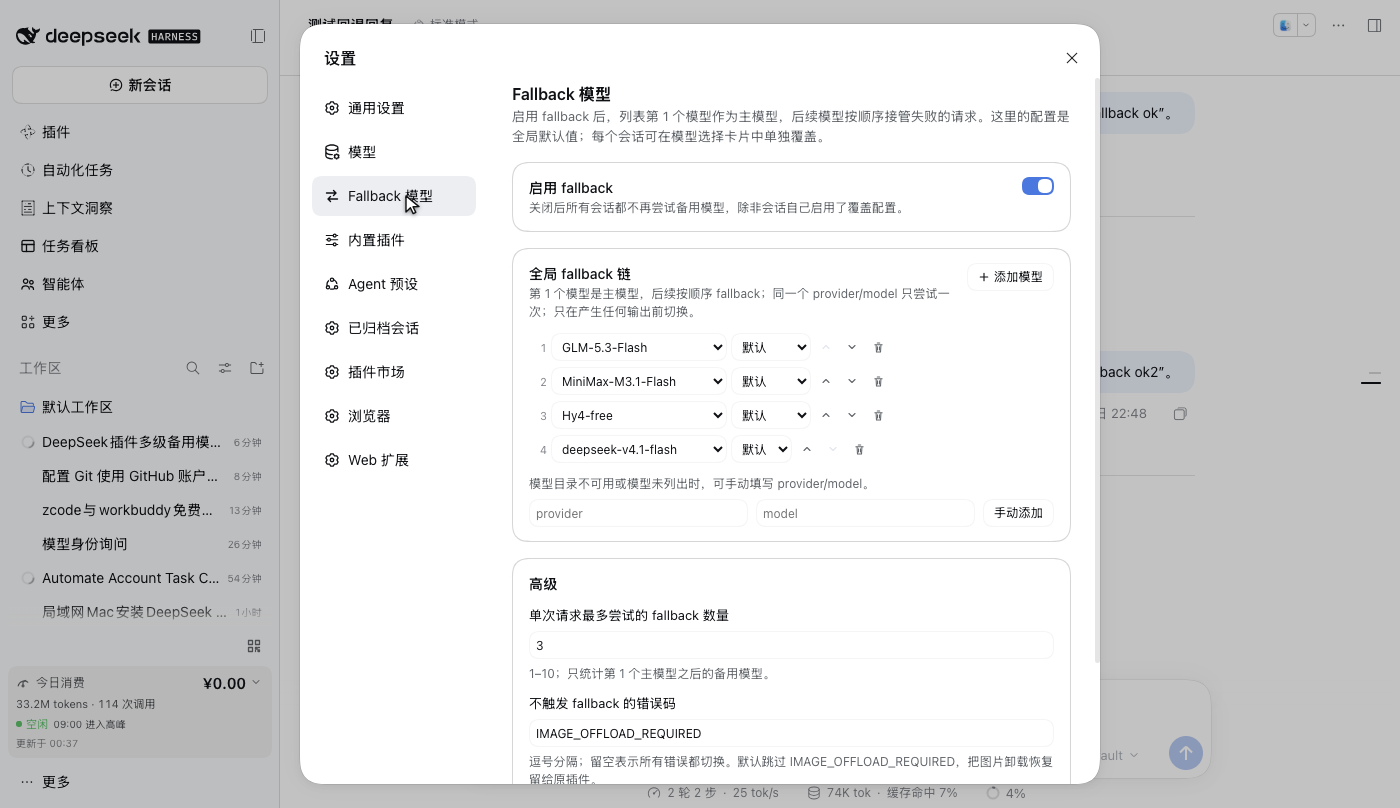
Maintain the global default chain, its switch, the fallback budget, and skipped failure codes in Settings → Fallback models.
Model selection card
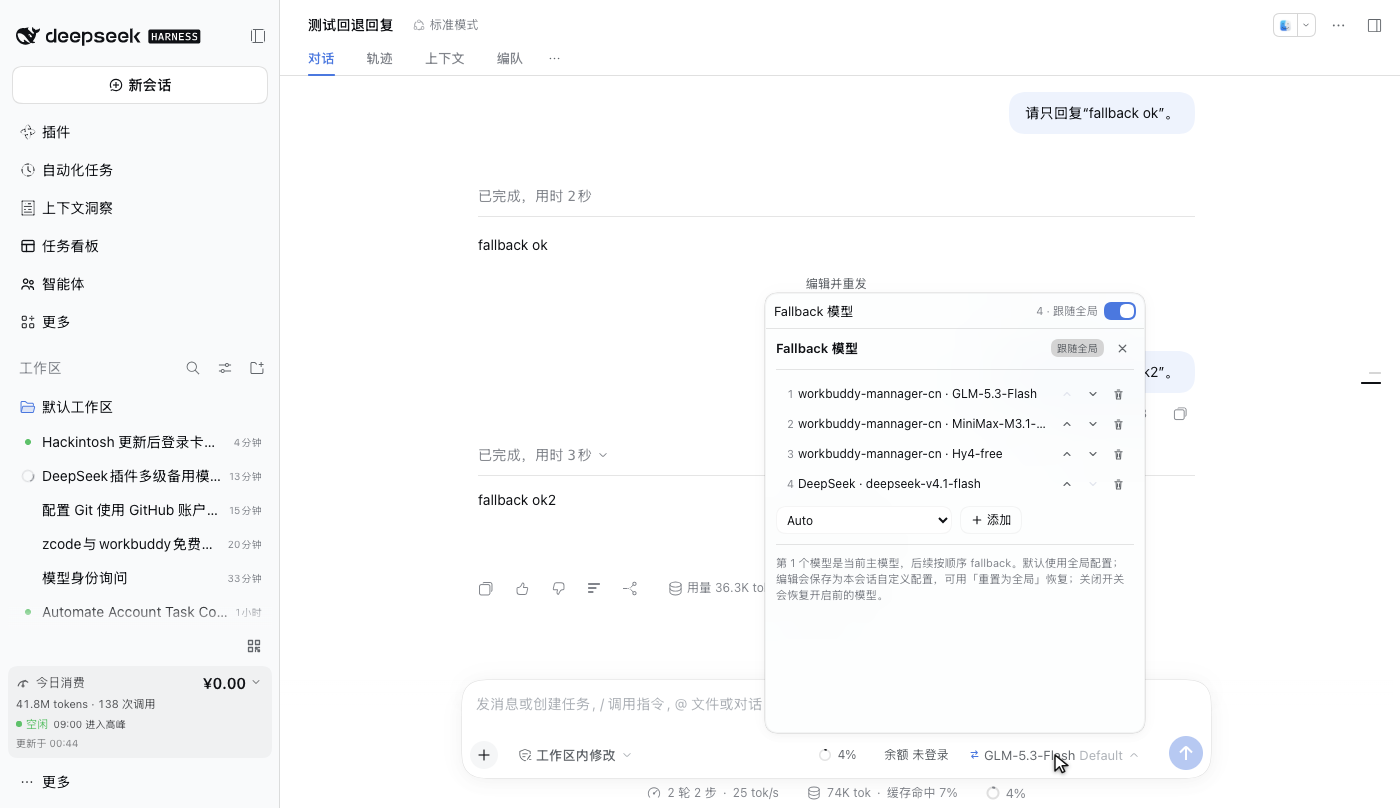
The model selector is the single entry point: the switch at the top of the card chooses between the shipped model page and the fallback page. When enabled, the first model in the list is the primary and later models take over a failed request in order; the circular-arrow button resets the Session to the global configuration.
Installation
Requirements: DeepSeek Harness 0.2.2-rc.1 or a compatible 0.2.x, Node.js >= 24.9, and the profile launcher (dsh web / the desktop app).
Option A — folder link (development)
cd /path/to/dsh-fallback-models
npm install          # resolves @deepseek-ai/schemastery into ./node_modules
Then, through the DSH plugin manager:
plugin_manager { "action": "install_bundle", "target": "/absolute/path/to/dsh-fallback-models" }
A linked install keeps the folder as the plugin body, so editing client.js or the Host files can be picked up by HMR / a page refresh. Uninstall before deleting or moving the folder.
Option B — npm registry (for any DSH profile)
The package is published on npm, so the DSH plugin CLI can install it directly:
dsh plugin --profile web add dsh-fallback-models
The CLI installs the package into that profile, adds it to dsh.profile.bundles, and activates the bundle layer (verified with a clean profile on 1.0.0). Restart dsh web / the desktop app if the running Host has not picked up the new profile composition. Remove it with dsh plugin --profile web remove dsh-fallback-models.
Option C — tarball (standalone copy)
npm pack
# produces dsh-fallback-models-1.0.0.tgz
plugin_manager { "action": "install_bundle", "target": "/absolute/path/to/dsh-fallback-models-1.0.0.tgz" }
A tarball install extracts a copy into the profile; the source folder can then be moved or deleted. Upgrade with a new version and another install_bundle.
Verify
- Host row and schema:
cordis_inspect_query→host/Config/listConfigs,{ "name": "dsh-fallback-models" }. - Browser slots:
cordis_inspect_query→client/Slots/listSubTree, rootssettings.sectionandconversation.input.model.label; both should list an activefallback-modelsoccupant. - UI: open Settings → Fallback models, and open a Session's model menu; the
Fallback modelsswitch row sits above the model list, with a reset button when the session carries its own configuration.
Configuration
The Host row is the settings namespace and stores both layers:
- id: fallback-models
  name: dsh-fallback-models
  config:
    enabled: true
    fallbacks:
      - provider: deepseek-official
        model: deepseek-v4.1-flash
      - provider: workbuddy-mannager-cn
        model: auto
    maxFallbacks: 3
    skipCodes: [IMAGE_OFFLOAD_REQUIRED]
    sessions:
      session-abc:
        enabled: true
        fallbacks:
          - provider: workbuddy-mannager-cn
            model: glm-5.3-flash
| Field | Meaning |
|---|---|
enabled | Global switch. A Session override carries its own switch. |
fallbacks | Ordered global model list: { provider, model, reasoningEffort? }. The first entry is the primary when fallback is enabled; the rest are fallbacks. |
maxFallbacks | Maximum backup routes attempted for one request (1–10). |
skipCodes | Failure codes that never fail over. Empty means every error fails over. Default: IMAGE_OFFLOAD_REQUIRED, so the image-offload recovery keeps ownership. |
sessions | Per-Session overrides keyed by Session id. An absent key follows the global chain. |
The first entry is the primary
When a Session has fallback enabled and a non-empty list, the plugin treats the first entry as the active model:
- Enabling the switch, adding the first model, reordering the list, or rendering the composer after a reload selects that first route through the shipped
session.selectModelRemote. The outer model name follows, and the Agent loop's next request uses that route as its normal primary request. An existing session whose selection predates the chain therefore self-heals on the next page load. - The remaining entries are fallbacks, tried in order after the primary fails before output.
- Turning the switch off restores the model that was selected before fallback was enabled (
basein the Session override). Reset to global removes the override; a globally enabled chain then selects the global first entry, while a disabled global chain restoresbase.
If the route cannot be selected (unavailable model, writer conflict), the selection is left unchanged; the chain stays configured and the first entry remains a fallback after the currently selected model. The fallback editor still shows the configured order.
Session override semantics
- An absent
sessions.<id>means follow global, live: the effective chain is the global one, resolved at request time. - Any edit (switch, add, remove, reorder) materializes a Session override from the current global values, then applies the change to it.
- Reset to global (the circular-arrow button in the switch row) removes the Session key.
- A Session override replaces the global list; it never appends to it.
maxFallbacksandskipCodesremain global policy.
Per-Session overrides live in the profile patch, so they are shared by every browser on the same Host and survive restarts. They are not written into the Session log; deleting the profile or clearing sessions removes them.
Behavior and limitations
- Only a failure before output fails over. A provider error after content has streamed is surfaced, because replaying the request would duplicate an answer the user already saw.
- Cancellation is never failed over. An
abortedfinish and an aborted request signal end the chain immediately. - The logged source is the selected route. The Agent loop logs
assistant/message.sourceas the route it assembled. With fallback on, the plugin selects the chain's first entry as the session model, so the logged source normally matches the active primary. A later fallback is recorded in the adapter'sreplayState.response(for adapters that report provider/model there) and in the Host warning log; the transcript's model label is not rewritten per attempt. If the alignment Remote fails, the old selection remains the logged primary while the configured first entry is a fallback. - Provider retries happen first for the primary. Because the fallback happens inside
llm/stream, the primary'sllm-retrypolicy does not see a failure that a fallback absorbed. If every fallback fails, the last failure reachesagent/request-errorand the retry policy applies to the primary route. - Catalog membership is advisory. A configured route is attempted even if the catalog no longer lists it; an unavailable adapter or model is skipped, and the next route is tried.
- Hand-built calls without a
sessionIdare untouched. The engine only reads a chain for a Session-bound request; auxiliary one-shot callers that pass no Session id keep their existing behavior. - Session config accumulation. Per-Session entries are kept until cleared. Use the switch row's reset button to remove one; a profile whose sessions change often may want a periodic cleanup of the
sessionsmap. - No client-visible fallback toast in 1.0. A client-facing notice needs a generated Remote or a Session projection; adding one is listed in
docs/design.mdas future work.
Development
npm install
npm test
The suite uses Node's built-in test runner:
test/fallback-stream.test.js— config normalization, route deduplication, hold/commit behavior, fallback selection, budget, skip codes, aborted streams, unavailable routes, and optional-constraint retry.test/client-smoke.test.js— loadsclient.jsthrough a fakewindow.__ModuleLoader__and asserts the registrations, the locale dictionaries, and the injected form/catalog faces.
Layout:
| Path | Role |
|---|---|
index.js | Host entry: name, inject, Config, apply (installs the listener and suppresses the generic form). |
lib/config.js | Schemastery Config, normalization, global/Session resolution. |
lib/fallback-stream.js | The llm/stream engine, prepared dispatch, streaming hold. |
client.js | Settings page, navigation icon, model label, model-menu switch card, styles. |
cordis.patch.yml | The single Host row inserted into the profile composition. |
locale/*.json | Plugin-manager title and description. |
docs/design.md | Design decisions, API references, and deferred work. |
License
MIT. See LICENSE.
Comments
Loading…
Similar plugins
by soffits
Fallback model chain for DeepSeek Harness: when a model request keeps failing, the work continues on the next model in your list.
★ 0
MIT
JavaScript
Nov 8, 2026
dsh plugin --profile web add dsh-fallback-modelsby Visol-456
DeepSeek Harness 回退链插件:主模型失败自动切换备用 provider,带 Web UI 配置面板 | Provider fallback chains for DeepSeek Harness
★ 4
↓ 95/wk
MIT
TypeScript
Sep 29, 2026
dsh plugin --profile web add @visol-456/dsh-llm-fallbackRule-based multi-provider model routing for DeepSeek Harness with pre-first-token failover, cooldown circuit-breaking, usage accounting, and a status API.
★ 0
dsh plugin --profile web add @botton/dsh-model-routerby windwhiterain
Per-model outbound proxy routing for DeepSeek Harness: send only the models you name through a proxy, with a direct fallback while it is unavailable.
★ 1
↓ 17/wk
MIT
JavaScript
Sep 30, 2026
dsh plugin --profile web add dsh-model-proxyby elfgzp
Switch model and reasoning effort across every DeepSeek Harness session at once — one control, all conversations, effort included.
★ 0
MIT
JavaScript
Nov 5, 2026
dsh plugin --profile web add dsh-unified-modelby Letter2025
Two-level model circuit breaker with failover for DeepSeek Harness: trip a model or a whole provider after repeated request failures and route the next request to a configured fallback
★ 5
↓ 631/wk
MIT
TypeScript
Sep 28, 2026
dsh plugin --profile web add dsh-model-failover