

billion-context-dsh
Manifest valid★ 43Model-driven context management (Active Context Pruning / ACP) for the DeepSeek Harness — the model decides when and what to compress. Ported from billion-context-pi (ranxianglei); acp-kernel reused v
billion-context-dsh
⚠️ Beta notice — do not use in production This project (v0.2.23) is still a beta under development. DeepSeek Harness itself is also in the public beta stage. Do not use either of them in engineered / production environments — breaking changes and rough edges are expected.
衷心感谢以下项目——请给它们一个 ⭐:
DeepSeek Harness ·
billion-context-pi ·
acp-kernel ·
opencode-acp
Billion-Context for DeepSeek Harness
由模型决定何时压缩、压缩什么——而不是一个硬性上限。




npm install billion-context-dsh
Why?
When conversations grow long, the model runs out of context. Most tools just hard-truncate — silently dropping early messages. billion-context-dsh gives the model a compress tool: the LLM decides when and what to compress, writing high-fidelity summaries that reclaim context space while preserving critical details (file paths, decisions, error messages).
Unlike DSH's built-in automatic compaction (which replaces a range with auto-generated summaries), billion-context-dsh:
- Model-driven — summaries are written by the model itself, with no second LLM summarization call
- Suggests only, never commands — the auto-policy only nudges; the model decides whether and when to compress
- Durable and recoverable — compressed ranges become checkpoint nodes; the original text is retained in the append-only session log;
decompresscan restore it, andsearch_contextcan search within blocks - Stable on long tasks — each step builds on the previous one, key conclusions stay available and keep accumulating, making very long tasks more likely to complete
- Context always stays slim — every request uses only a small, refined context keeping just the key information; no large-scale blanket compaction, so details don't degrade with it, and token consumption stays naturally lower
This is a port of billion-context-pi (the Pi coding-agent adapter) onto DeepSeek Harness: the compaction kernel (acp-kernel) is reused as-is, and the adapter layer is rewritten for DSH's durable-surface model — see docs for the verified mappings.
Installation
💡 Want DeepSeek Harness to install it for you? This repo itself runs on DSH: hand docs/INSTALL.md to the agent in the session — it will read the guide, resolve your profile, edit the composition config, and verify the mount. Prerequisites: ① the config lives under
~/.dsh, which requires you to grant file permissions once; ② after install, have it callacp_statusto prove it.
Method 1 (recommended): DSH Store / dsh plugin one-click install (bundle) — takes effect globally right after install, zero config.
Click install in the DSH plugin store, or run in the command line:
dsh plugin --profile web add billion-context-dsh
Internally the command installs the package and automatically attaches this package's bundle patch (cordis.patch.yml) into that profile's layer stack. The patch does two things:
- Disables the host's
compaction-basic— to prevent two backends from registeringctx.compactionsimultaneously within the same realm (modern DSH web bundles already ship with this disable; this is an idempotent safety net that holds on any supported version); - Attaches the ACP engine to the host plane — the four model tools (
compress/decompress/search_context/acp_status), the/acpcommand, the nudge, and the ACP prompt section take effect for all modes of that profile (standard / code / minimal / cordis / custom presets). Window auto-detection, tools/commands/nudge are on by default — no manual configuration needed.
After installing, restart dsh (the bundle layer is composed at startup), and it will be available in new sessions — have the model call acp_status or run /acp status to verify. The realm-level compaction-basic auto-compaction fallback inside shipped presets (standard / code / cordis) remains (in those modes "auto summarization" works as before, coexisting with the ACP tools and nudge); presets without a compaction realm, such as minimal, use this engine directly.
Compatibility with DSH versions. The package declares all five runtime seam packages (
dsh-compaction/dsh-session/dsh-llm/dsh-tools/dsh-settings) as peer dependencies, sharing the same range>=0.1.5-alpha.1 <0.1.6-0— exactly the entire0.1.5line (all prereleases plus the final0.1.5). From the0.1.5line on, the protocol fields for session replace operations were renamed from{ op, start, end }to{ op, startSeq, endSeq }, with strict validation (only these three fields are accepted); this engine only emits the new shape, so on older DSH (< 0.1.5) everycompresswould be rejected by the host at runtime (issue #136) — older versions are no longer supported; please upgrade DSH before installing this release. The range is written as an explicit interval rather than a caret deliberately: a caret would silently pull in unverified 0.1.6+ lines. Declaring all five seam packages as peers (rather than justdsh-compaction) is to ensure that under pnpm's integrated/hoisted layout they still resolve to the host's own copies, rather than some stale nested copy that is inconsistent with the host.Behavior note (from 0.1.5 on): the host no longer allows "invisible" replace nodes; when the engine cleans up orphaned tool messages, it leaves a short visible placeholder message in their place; the host's system-prompt node (surface node 0) is excluded from the compressible range table.
Method 2: plain npm install (package only, requires hand-writing the composition line).
npm install billion-context-dsh
This only adds the package to your project/global scope; it does not touch any profile. Hand-write the composition line (see below) for the engine to mount.
Git source install (the github: spec, the form shown in the plugin store). The prebuilt artifacts dist/ are committed to the repo, so installing from a git source is equally out-of-the-box — no build step required; pnpm 11's default blocking of build scripts (allowBuilds) does not obstruct this package:
dsh plugin --profile web add github:Tyan66666/billion-context-dsh#v0.2.23
Installing with #<tag> is recommended, giving you artifacts that are exactly identical to the corresponding npm version; without a ref, the latest build from the default branch is installed. Only building from source yourself by cloning the repo (npm run build) requires allowing builds. See docs/git-source-install-design.md (issue #92) for background and design trade-offs.
Scopes and Customization
This section serves two audiences: ① Method 2 (plain npm install, where the composition line must be hand-written); ② Method 1 users wanting to customize config (the bundle already has defaults; you only need to override with a line of the same id).
Customizing config (Method 1 bundle users). Append a compaction-acp line with a config: to your profile patch (e.g. ~/.dsh/profiles/web/cordis.patch.yml) — a line with the same id overrides the bundle's default line:
- id: compaction-acp
  name: 'billion-context-dsh'
  config:
    modelContextLimit: 128000   # 可选;省略时自动探测模型真实窗口(回退 128000)
Globally effective (host plane, all modes) — recommended. This is the default behavior of the Method 1 bundle; plain-npm-install users should append all of the following in their profile patch (bundle users skip the first two lines):
# ACP 作为全局压缩后端:四个模型工具 + `/acp` 命令 + nudge + ACP 提示词段,
# 对所有模式(standard / code / minimal / cordis / 自定义预设)生效。
# 必须同时禁用 host 的 compaction-basic:同一 realm 内两个后端同时
# provide `ctx.compaction` 会冲突。(bundle 安装已自动带上这两行。)
- id: compaction-basic
  disabled: true

- insert:
    - id: compaction-acp
      name: 'billion-context-dsh'
      config:
        modelContextLimit: 128000   # 可选;省略时自动探测模型真实窗口(回退 128000)
(Optional) Custom prompt wording — config.prompts. All model-visible prompts (normal/urgent nudge first lines, context breakdown, growth line, batch prompts, tier distillation lines, range table, ACP system prompt section, the four tool descriptions) by default directly reuse acp-kernel's renderNudgeText — efficiency prompts, context breakdown, compression rules, and batch prompts all come from the kernel's original text; only the range table is swapped to the surface-seq version (the kernel uses mNNNNN references; our architecture has no <acp> tags; the seq range table likewise carries [tool X% | text Y%] composition ratios and is sorted oldest-first, matching the kernel's display semantics). Overriding any nudge slot automatically switches to template rendering. Templates support named placeholders (e.g. {pct}, {philosophy} for the nudge, {surface} for the range table), with construction-time validation: a misspelled placeholder will throw an error at engine startup (fail-fast) instead of leaking a literal {pct} into the model context:
      config:
        modelContextLimit: 128000
        prompts:
          nudge:
            normal: '上下文使用率 {pct}%。这是效率提示——请尽早压缩保持上下文精简。'  # 中文 nudge 首句
          tools:
            acpStatus: '报告 ACP 块账本:压缩块数、回收 token、当前上下文压力。'  # 自定义工具描述
See docs/configurable-prompts-design.md for the list of configurable slots, the placeholders available per slot, and the semantics of empty-string/null. Deployments that do not configure prompts use kernel rendering directly (aligned with kernel/pi, see design doc v6).
(Optional) Runtime settings — edit ~/.dsh/settings.yaml or use /acp config, no restart required. The six scalar keys (modelContextLimit, autoModelContextLimit, nudgeMinContextLimitPct, nudgeMaxContextLimitPct, nudgeEmergencyThresholdPct, autoNudge; see the rows in the "Configuration" table marked "runtime hot-tunable") have a hot-reloadable copy in the host settings layer: editing the settings file or /acp config takes effect immediately on the running session (the composition line config: remains the starting point — layering is schema defaults → composition line → user settings section):
# ~/.dsh/settings.yaml
compaction-acp:
  nudgeMaxContextLimitPct: 0.72   # 保存即生效,无需重启
/acp config                                  # 列出六个键当前值 + 来源层(user / base / default)
/acp config set nudgeMaxContextLimitPct 0.72 # 热改一个键
/acp config set autoNudge false              # 布尔键(false 是合法值)
/acp config reset nudgeMaxContextLimitPct    # 退回组合行 / 引擎默认
/acp config reset all
Changes to window-related keys (modelContextLimit / autoModelContextLimit) clear the window detection cache — the next pre-step re-probes with the new values (a probe failure is also cached, which is exactly the mechanism that allows re-probing after the gateway is fixed). Under a plain-npm-install composition without a settings provider, /acp config degrades to guidance text; settingsEnabled: false turns off this integration entirely (composition-line only, not carried into the settings layer — the switch cannot turn itself off). Design details in docs/settings-integration-design.md.
Per-mode only (the agent preset's compaction realm). First disable (or delete) the existing dsh-compaction-basic line within that realm, then insert this engine — two backends cannot coexist in the same realm:
# 先禁用 realm 内默认后端(或直接删掉这一行)
- id: compaction-basic
  disabled: true

# 再插入本引擎
- id: compaction-acp
  name: 'billion-context-dsh'
  config:
    modelContextLimit: 128000   # 可选;省略时自动探测模型真实窗口(回退 128000)
Keep only one context manager per agent. Two backends providing
ctx.compactionsimultaneously will conflict — never coexist in the same realm. See docs/INSTALL.md for the full installation and verification guide.
How It Works
Every model request in DSH derives from its append-only session log (the surface). ACP semantics map directly onto this model:
| ACP Concept | DSH Implementation |
|---|---|
compress tool shadows a range | Persistent surfaceOp: { op: 'replace' } — the model-written summary becomes a checkpoint node; the original text remains in the log |
refs (m00001 tags) | surface seq, carried by the nudge's compressible range table |
| nudge ("efficiency hint — compress early to stay lean") | Injected at agent/pre-step by the kernel's pressure decision — efficiency notice + context breakdown + compression rules, tone aligned with kernel/pi; never a command |
decompress | Read-only restore of the shadowed original from the log |
search_context | Rebuilds a unified document set of block summaries + shadowed originals from the log (cached per log snapshot: repeated searches before new events hit disk are served directly from the cache, issue #133), scored by acp-kernel searchBlocks (hybrid: stemming + CJK bigram + character n-gram fuzzy); hits back-link to their owning block |
acp_status | CONTEXT BREAKDOWN (tool/text/summaries share of the visible total) + compressed-block ledger + nudge decision line + Checkpoint seqs line (bN → seq mapping of active blocks — compressing a checkpoint seq distills that block, issue #60); no context window; supports drill-down via scope/view/tool/sort/limit |
| Block state | In-memory kernel state + log-rebuilt ledger (no sidecar files) |
| Tiered distillation (T2/T3) | Compressing a block's summary node again = distill that block (tier 2); distilling a tier-2 block yields tier 3; tier and kernel block id are persisted in the log; on restart the kernel state is re-hydrated from the log and can continue distilling |
| Compaction accounting (shadow price) | shadowedTokenCount (the host's occupancy is deducted by this) is priced at the host token-meter's fixed heuristic price (ctx.tokenMeter.measure preferred, read via heuristicTokens ?? tokens for the fixed heuristic price baseline, src/host-tokens.ts exact mirror as fallback) — never mixes in the plugin's internal CJK-aware estimate (that is a display currency; mixing would drive the host's ledger negative and freeze Chinese sessions, issue #54), nor prices via the routing-repriced node.tokens (under 0.1.2+ image-routing pricing that is a request-pressure price; reading it would make claims over image spans over-report the visual price, also driving the ledger negative, issue #103) |
| Image/file block visibility | image/file blocks have no characters and were previously silently dropped by the projection layer — so they had no ref in the compressible range table, could not serve as boundaries, weren't protected by the kernel's "most recent user message" rule, and were priced at 0 tokens (in screenshot sessions the last question could be compressed away wholesale, issue #117). Now extractText generates a deterministic one-line placeholder from the attachment's persistent metadata ([image image/png shot.png 800x600 4.2KB], [file notes.txt 1.0KB], same source as the host's file handle text projection), media price is read as the difference between tokens and heuristicTokens on the host token-meter node (that node exposes only these two prices: tokens is the request pressure under the current routing, carrying the adapter-declared visual price when media is present; heuristicTokens is the routing-agnostic fixed heuristic — the difference is exactly the extra amount routing charges), and on top of that the host's fixed-heuristic structural price for media references is added (hostMediaStructuralPrice, mirroring the host's own estimateStructuralBlock): today no adapter declares a visual price, the difference is always 0, reading only the difference would make images look "free" again; the range-table line tail is annotated [+N images]; sessions without media perform no extra measurement |
| Injection directive hygiene | The host injects policy files such as AGENTS.md into the session surface; compressing the current copy would cause the host to immediately re-inject the same file — an infinite compress→re-inject→compress loop (issue #71). The compressible range table treats injection lines as barriers: never offered, never counted into segments; manual compression (the model's compress tool, the human-facing /acp compress command) that covers a file's current copy is rejected outright (the error names the line number and notes that stale older copies may be compressed), because compressing the current copy yields no benefit — the host will always re-post it. Grouped by source.changes[].scope (= one file), only the newest copy per group is protected — older copies superseded by an update can be safely compressed |
Carrying compaction guidance (tools, philosophy, summary rules, tier distillation/condensation rules) is registered as a one-time system prompt section; each nudge carries a slimmed version (efficiency hint + philosophy + context breakdown + compression rules + range table + batch prompt). No automatic summarization by design: the auto-policy only nudges the model (compactIfNeeded returns null).
Video Walkthrough
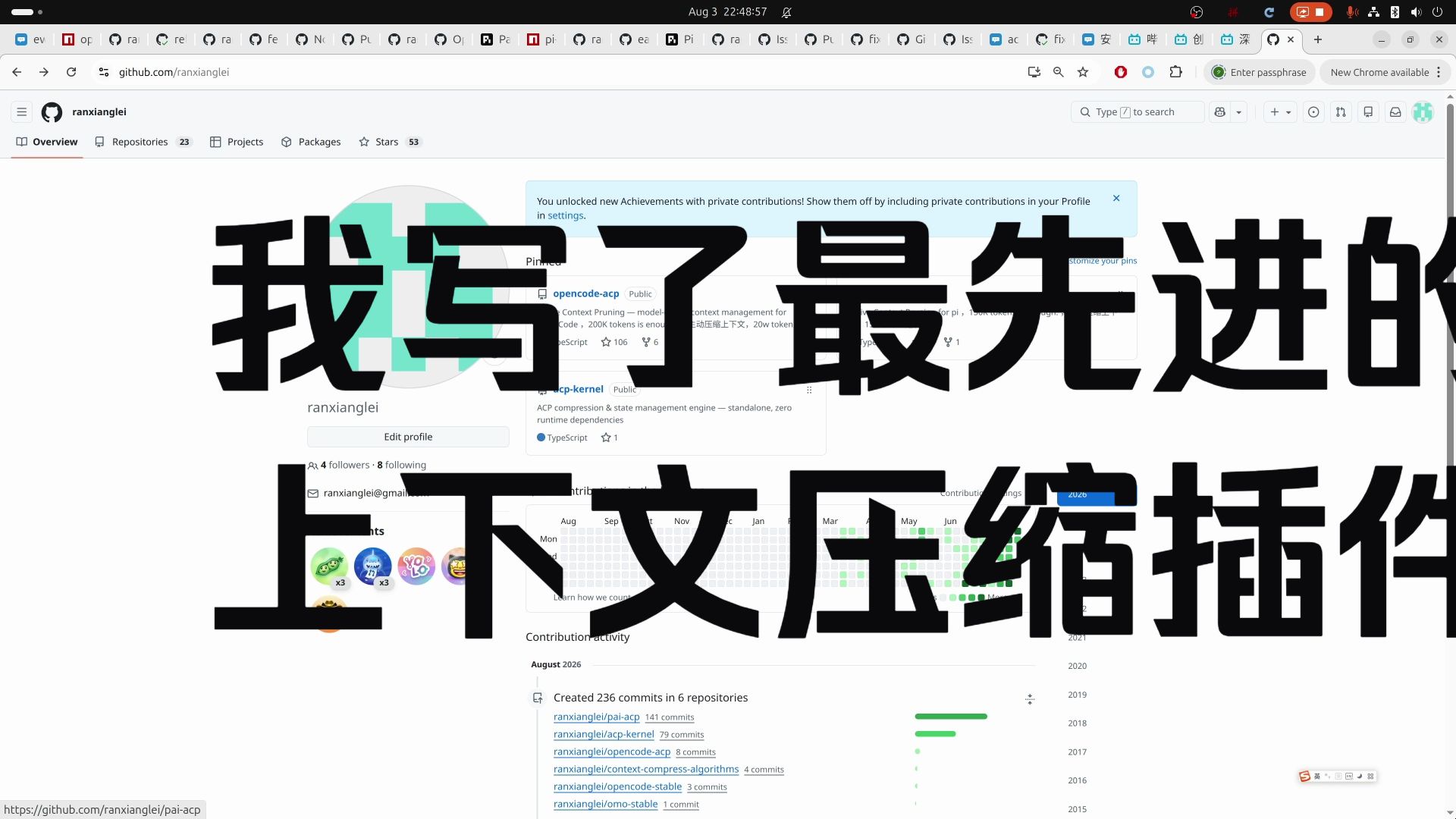
A walkthrough of the ACP philosophy this project inherits — how active context compression keeps a session lean within roughly 200K tokens (opencode-acp and billion-context-pi). Original video by: Qiu Xianglian (Bilibili uploader), not produced by this project.
Model Tools
| Tool | Function |
|---|---|
compress | Replaces a seq range with your compact summary (boundaries are auto-balanced to tool-call/result pair points); compressing a block's summary node again = hierarchical distillation (tier 2/3). Each range can carry verifiedReadings: string[]—a record of files/sections you actually read and verified within that range; it persists with the summary and is echoed back as verified: … in compress results, so subsequent turns know what has been verified without re-reading |
decompress | Restores original content of a compressed block (read-only); accepts the bN shown by acp_status or a compaction id. Large blocks are paginated by character budget (default ~7K chars per page, up to 100 pages) so ordinary pages stay below the host's tool-result truncation threshold (8192); offset/limit + continuation hints walk through the whole block |
search_context | Keyword search across compressed block summaries and originals (acp-kernel hybrid retrieval: stemming + CJK bigram + fuzzy); hits are back-linked to their owning block |
acp_status | CONTEXT BREAKDOWN (tool/text/summaries as share of visible total) + compressed block ledger + nudge decision line + Checkpoint seqs line (the bN → seq distillation entry point for active blocks, issue #60); excludes the context window. Drill-down supported: scope:"compressed" per block, scope:"uncompressed" + view:"messages"/"ranges" per message/interval, tool filter, sort ordering, limit truncation. Drill-down row refs are kernel mN—usable directly as startSeq/endSeq for compress (auto-mapped to live surface seq); the seq on Surface: lines is also usable |
/acp | Run status / compress / decompress from the command bar; status additionally displays human-side window info (estimated context, context window source, compression ledger, nudge arbitration — nudge: idle/ACTIVE — reason and how many tokens until the next nudge, using the same kernel decision as the nudge path) |
- Source labeling on summaries (framework line for model-written summaries): every compressed summary is prefixed on write with
[Model-written summary — not user words; re-verify any obligations before relying on them]—written into both the persisted summary event and its checkpoint node (same text); the projection path idempotently back-fills the framing for older blocks. Purpose: prevent the model from treating obligation statements inside a summary as verbatim user instructions and executing them directly. - Slim nudge: the compression philosophy/rules section is no longer repeated on every nudge (it is already in the system prompt); nudge body keeps only the trigger framing + context breakdown + range table. The template path (
config.prompts.nudge) strips these sections too. Design background: docs/injection-governance-design.md.
Upstream Projects & Credits
This project is a port/derivative built on the shoulders of the following upstream work — all under the MIT license. Sincere thanks to ranxianglei and the DeepSeek Harness team for creating and open-sourcing these projects:
| Upstream Project | Author | Role |
|---|---|---|
| billion-context-pi | ranxianglei | The Pi coding-agent adapter this project ports; source of the adapter design, tool semantics, and default configuration |
| acp-kernel | ranxianglei | Framework-agnostic context compression engine — reused as-is (refs, blocks, tiers, nudge decisions, search, status) |
| opencode-acp | ranxianglei | Origin of the ACP ("the model decides when to compress and what to compress") design |
| DeepSeek Harness | DeepSeek AI | The host platform this project extends (compaction capability seam, agent presets, persistent session logs) |
This project reuses acp-kernel's compression core and billion-context-pi's default behaviors verbatim; the DSH adapter layer (session event projection, durable surface transactions, model tools, nudge, configuration) is original to this repository. Upstream copyright and licensing belong to their respective authors; this project's license terms are in LICENSE.
配置
| Key | Default | Description |
|---|---|---|
modelContextLimit | Auto-detected (falls back to 128000) | The context window used for kernel pressure decisions; explicit configuration takes priority and skips detection. When omitted, the host session projection contextPressure.contextWindow is read first (the newly disclosed window for the current active routing; switching models in a session automatically follows without restart), and if no projection is available, the model API is queried; explicit configuration also skips the output-reservation deduction (the denominator is fully operator-defined) (runtime hot-tune: /acp config) |
autoModelContextLimit | true | Automatically detect the real window from the model API (agent.ctx.llm.resolveModelInfo); detection failure falls back to the default value; the /acp command displays the window source (the model tool acp_status does not include window information). When omitted, the window is read first from the host projection (windowFor → projectedContextWindow, src/window.ts) and then from detection; both projection and detection are skipped when autoModelContextLimit: false. A detection failure is flagged in host logs and the /acp panel (restart to re-probe) — failed results are also cached; re-detection requires a restart or an explicit modelContextLimit after the gateway is fixed. On successful detection, the per-request output limit for the adapter (defaultMaxTokens, the guaranteed per-request output reservation at the tail of the window) is also subtracted: all downstream pressure decisions (nudge tiers, truncate, growth) use "sustainable input budget" (window − output reservation) as the denominator — a 96K window + 16K cap can actually hold at most 80K input; the raw window denominator would underestimate usage by cap/window (≈17% here; the ratio is higher for small-context-window models). When the cap is not disclosed, explicitly configured, or detection fails, the raw-window behavior is preserved; /acp status shows the deduction details (raw − reservation). Changing modelContextLimit/autoModelContextLimit via /acp config clears the window cache; re-detection happens immediately after the change |
nudgeMinContextLimitPct | Kernel default 0.45 | Nudge window lower bound (usage ratio) — only used for configuration validation; the growth-path trigger has no percentage floor — same default as billion-context-pi (runtime hot-tune: /acp config) |
nudgeMaxContextLimitPct | Engine default 0.70 (kernel/pi default 0.75) | Over-limit line: exceeding this value triggers a nudge regardless of growth — intentionally set below the host's compaction-basic 80% auto-compaction threshold to ensure the forced nudge fires first; explicit configuration takes priority (the same-named key in coreOverrides.nudge has higher precedence, see below) (runtime hot-tune: /acp config) |
nudgeEmergencyThresholdPct | Engine default 0.85 (kernel/pi default 0.95) | Emergency nudge (bypasses per-turn deduplication, but at most 3 injections per user turn — issue #108) — lowered from 0.95: at 95% the model has no room to act and is masked by the 80% auto-compaction line; explicit configuration takes priority (the same-named key in coreOverrides.nudge has higher precedence, see below) (runtime hot-tune: /acp config) |
preset | — | (Optional) pick the nudge aggressiveness in one word: preserve / relaxed / balanced / efficient / aggressive (see "Presets" below). Fills in only the three nudge thresholds you have not explicitly set; priority is explicit value > preset > engine default; unknown names throw at construction time; if the combined result has a reversed window (min / max / emergency order wrong) it also throws at construction time. Does not affect other keys (modelContextLimit / autoNudge / prompts / coreOverrides) (composition-line only: preset is not yet wired to /acp config; see follow-up on issue #75) |
coreOverrides | — | Any other acp-kernel Config overrides (the coreOverrides escape hatch from billion-context-pi). Merge order: kernel defaults → top-level pct config → coreOverrides.nudge applied last — same-named keys here win (read-only: composition-line only, not exposed through the settings layer) |
autoTools | true | Registers the four model tools in ctx.tools |
autoCommand | true | Registers the /acp command in ctx.commands |
autoNudge | true | Injects a nudge into agent/pre-step when the kernel recommends it (runtime hot-tune: /acp config) |
settingsEnabled | true (enabled when not configured) | (Optional) Disables runtime settings integration entirely (composition-line only; not in the settings layer — the toggle cannot switch off itself; once disabled, the composition-line config: is the only active channel) |
prompts | — | (Optional) Custom prompt text: override nudge / scope table / system prompt / tool description per slot (template + named placeholders, validated at construction time; see "Custom Prompt Text" above and docs/configurable-prompts-design.md) |
Presets
不想逐个调三个百分比时,用一个词选择 nudge 的激进程度——从「尽量保留上下文」到「尽早频繁压缩」共五档:
preset | min | max | emergency | 定位 |
|---|---|---|---|---|
preserve | 0.55 | 0.78 | 0.93 | 尽量保留上下文,接近上限才提醒压缩 |
relaxed | 0.50 | 0.75 | 0.90 | 轻度压缩,比 preserve 稍早提醒 |
balanced | 0.45 | 0.70 | 0.85 | 默认平衡——与插件开箱阈值一致(选它等于不改) |
efficient | 0.40 | 0.60 | 0.78 | 更勤快地修剪,偏向低 token 占用而非保留完整历史 |
aggressive | 0.30 | 0.50 | 0.70 | 精简上下文,更早更频繁地压缩 |
- 只填未设的阈值:
preset仅填充你没有显式设置的nudge*ContextLimitPct;同时写了preset和某个阈值时,该阈值以你的显式值为准(优先级 显式 > preset > 默认)。 - 不碰其他旋钮:
modelContextLimit、autoNudge、prompts、coreOverrides完全不受影响;coreOverrides.nudge仍最后落地、同名键最高优先。 - 查看当前档位:
/acp status会打印生效的preset及其真实生效的三个阈值——这一行镜像kernelConfigFor的合并顺序,所以你在其上做的显式覆盖、以及coreOverrides.nudge里的同名键都会如实显示。 - 拼错即报错:未知名称在引擎构造期直接抛错并列出合法值(与自定义提示词模板同一约定),不会静默回退默认。注意 bundle 行本身不带
config,preset只能由你自己的同 idcompaction-acp行提供;该行构造失败即挂载失败,profile 会在你修好配置前一直起不来(fail-fast 的既定行为)。 - 运行时热切换:预设目前走组合配置(安装 /
cordis.patch.yml);待 #75 的 settings.yaml 热加载落地后,可在/acp config里改。本 PR 先让它在组合层可用。 - 反向窗口直接报错:与显式阈值合并后若出现
min > max、max > emergency或min > emergency(例如preset: 'preserve'配nudgeMaxContextLimitPct: 0.5),引擎在构造期抛错并列出三个值。内核对这种配置只打警告、不会拒绝,所以这道校验由引擎在resolveAcpConfig里补上。 - 与宿主 80% 线赛跑的是
max:反复触发的过限提醒(OVER-LIMIT)由max决定;preserve/relaxed的 emergency(0.93 / 0.90)高于宿主 compaction-basic 的 80% 线,只是超过它之后的标签升级,宿主先压缩时不会到达。 min是首见提醒与 T2/T3 块数触发的地板:内核 0.0.63 在运行时读它两处——①firstSightMassReady(从未提醒过、还没有基线、用量 ≥min且待压内容达到增长下限时立刻提醒一次,理由串带[first-sight mass]);②tierCountUsageFloor(T2/T3 的「块数达标」触发同样要求用量 ≥min)。常规 T1 增长提醒不看min(由max与growthRatio决定),所以五档之间的主要差异仍来自max与emergency,但更低的min会让首见提醒来得更早。- 两个暂未纳入的旋钮:原始需求里的
growthRatio(内核已有nudge.growthRatio,可经coreOverrides调)和protectedLastMessages(≈ 内核preserveRecentMessages)目前不是本项目的一等旋钮;是否采纳为命名键 / UI 项由维护者决定,未擅自并入预设。
开发
npm install
npm run typecheck   # 严格 TS
npm test            # node --import tsx --test tests/*.test.ts
npm run build       # tsup 打包(内联 acp-kernel)+ .d.ts
npm run test:e2e   # 端到端宿主回归:真实 agent 循环 + 脚本化假 LLM(见下文)
端到端回归(scripts/e2e/)在进程内组装真实 DSH 宿主(cordis + agent-loop + DeepSeek 适配器),指向脚本化假 LLM 服务,挂载本引擎作为压缩后端,然后断言持久化事件日志:compaction 起止配对、durable replace 节点、严格 tool-call/result 配对、nudge 注入节奏;以及假 LLM 实际收到的请求体(wire 级 prompt-cache 字节稳定性:envelope、tools 数组、leading message,无 compaction 场景全程 append-only)。背景与取舍见 docs/e2e-harness-design.md(issue #120)。
dist/index.js 自包含,仅外链 @deepseek-ai/* 接缝包(由宿主部署提供)。
架构
src/
├── index.ts        # AcpCompactionEngine(CompactionEngine 后端)+ 接线
├── messages.ts     # M1: 会话事件 ↔ acp-kernel CoreMessage 投影
├── state.ts        # M2: 每会话内核状态
├── region.ts       # M5: 持久化区域事务 + 日志重建块账本
├── block-ledger.ts # M5 支持:tier/lineage 字段编码进 compaction/summary 的 rawOutput(绝不作顶层成员,issue #141)
├── tools.ts        # M3: compress / decompress / search_context / acp_status
├── nudge.ts        # M4: 内核压力决策 → 注入的建议式 nudge
├── system-prompt.ts# M4: 一次性 ACP 指引段(让 nudge 保持简短)
├── config.ts       # 内核配置组装(阈值 + coreOverrides)
├── window.ts       # 自动上下文窗口探测(宿主投影优先,LLM 运行时探测回退,兜底 128000)+ 输出预留探测(defaultMaxTokens,windowFor 内扣除)
└── commands.ts     # M4: /acp 斜杠命令
License
MIT
Compatibility
Versions
| Latest version | Published | Size |
|---|---|---|
| 0.3.0 | — | — |
| 0.2.3 | — | — |
| 0.1.9 | — | — |
| 0.2.16 | — | — |
| 0.2.4 | — | — |
| 0.1.7 | — | — |
| 0.2.17 | — | — |
| 0.1.8 | — | — |
| 0.2.9 | — | — |
| 0.2.5 | — | — |
| 0.2.22 | — | — |
| 0.2.12 | — | — |
| 0.2.19 | — | — |
| 0.2.14 | — | — |
| 0.2.1 | — | — |
| 0.2.13 | — | — |
| 0.2.7 | — | — |
| 0.2.20 | — | — |
| 0.2.8 | — | — |
| 0.2.6 | — | — |
Comments
Loading…
Similar plugins
Model-driven context compaction for DeepSeek Harness. The agent decides when and what to compress, commits durable session-log replacements, and ships reversible tool-result compression with byte-exac
★ 0
dsh plugin --profile web add @internetnutzer/dsh-ascby Icstick
DeepSeek Harness 的 AdaptiveContextPlane (ACP) 插件——带治理的长期记忆系统
★ 4
MIT
JavaScript
Oct 25, 2026
dsh plugin --profile web add dsh-adaptive-contextby markelayan
Agent-requested context export & delete for DSH — companion to billion-context-dsh (ACP). No automation: every change is an explicit agent call.
★ 0
MIT
JavaScript
Oct 4, 2026
dsh plugin --profile web add billion-context-reliefby aerince
Model-authored context pruning for DeepSeek Harness through the official compaction API.
★ 2
MIT
JavaScript
Aug 15, 2026
dsh plugin --profile web add dsh-active-context-pruningby zzzxxxxxxxxxx
Dynamic context pruning for DeepSeek Harness — model-driven compaction and duplicate-output pruning.
★ 0
AGPL-3.0
TypeScript
Oct 5, 2026
dsh plugin --profile web add @zzxxxxxx/dsh-dcpby snow-The
Unified local memory for DeepSeek Harness, backed by ACP graph: seven-layer memory (soul/user/project/fact/lesson/topic/rules), capture→recall→inject, module-separated core (server-ready) + thin DSH a
★ 0
MIT
TypeScript
Oct 19, 2026
dsh plugin --profile web add @snow-the/dsh-acp-memory