

dsh-voice-conversation
Manifest valid★ 3Hands-free Italian/English voice conversations for DSH, with automatic prompts, an inline chat dock and optional local speech models.
DSH Voice Conversation



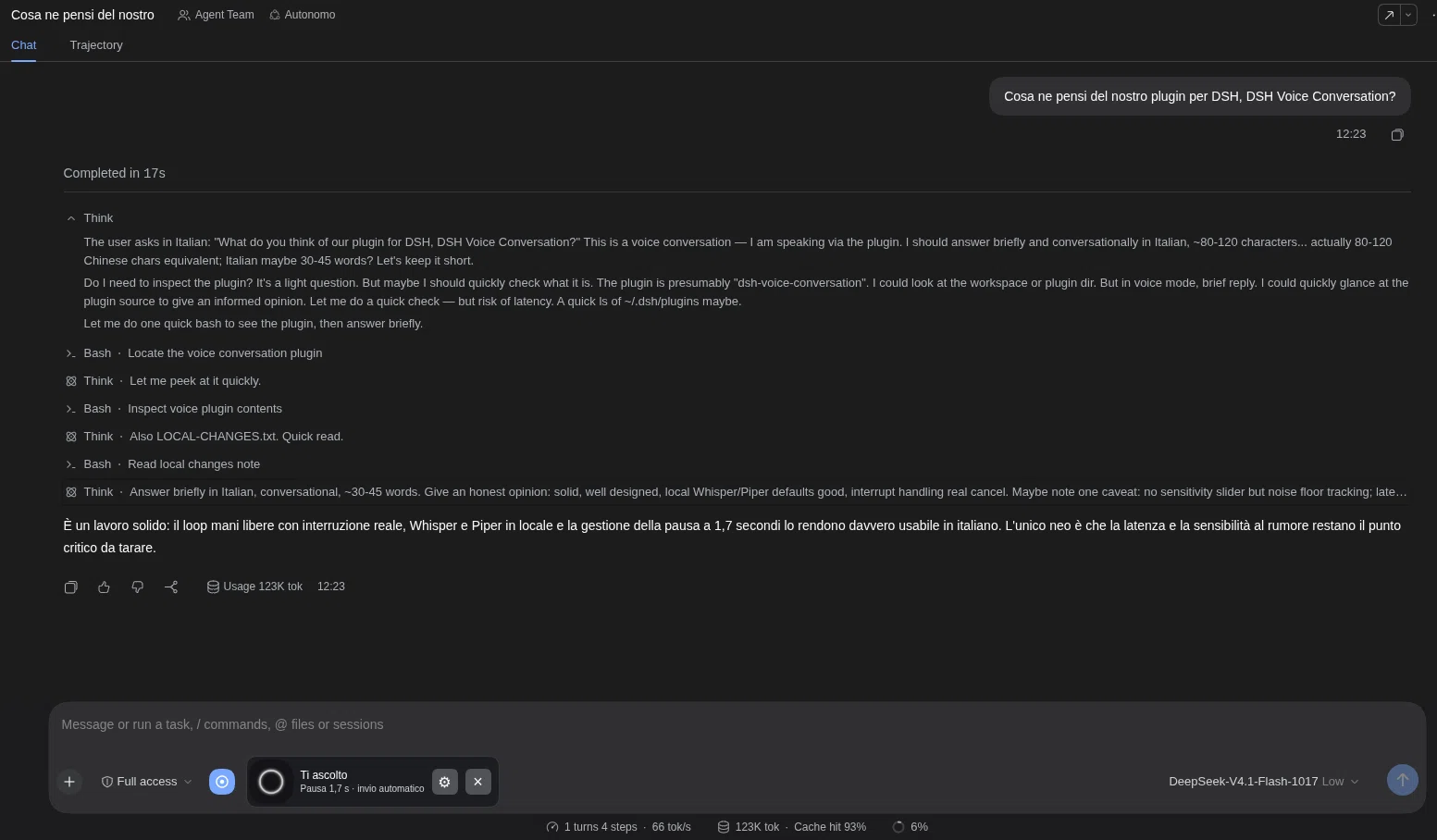
Maintainer / autore del fork: RedHunt07 · License: MIT. Original Voice Loop code by ZG2017; see NOTICE.md. Hands-free Italian/English conversations for DSH. Speak, pause for 1.7 seconds, and your prompt is submitted. After the final spoken reply, listening resumes using the same microphone stream. A compact composer dock keeps the native chat, tools and DSH-provided Think output visible. This displays reasoning exposed by DSH, not private model reasoning.
Guida italiana · npm package · GitHub Package · Credits and licenses
Compatibility
Tested: DSH 0.2.0-rc.2, Node.js 22+, Linux web profile. Other DSH releases, operating systems and browsers need validation. Microphone access requires localhost or HTTPS and browser permission. Use headphones to reduce loudspeaker echo triggering spoken interruption.
Install
npm package: dsh-voice-conversation (release 0.1.2).
dsh plugin --profile web add dsh-voice-conversation
This installs the current npm release. To pin the verified version:
dsh plugin --profile web add dsh-voice-conversation@0.1.2
The previous 0.1.1 release is also available as a prebuilt archive below.
# equivalent prebuilt GitHub archive
dsh plugin --profile web add https://raw.githubusercontent.com/redhunt07/dsh-voice-conversation/main/dist/dsh-voice-conversation-0.1.1.tgz
The DSH command also selects the bundle. Verify that "dsh-voice-conversation" occurs once in dsh.profile.bundles in $DSH_HOME/profiles/web/package.json (normally ~/.dsh/profiles/web/package.json); add it only if missing and preserve existing entries. Disable any older Voice Loop bundle first: the two plugins use the same API paths and cannot run together. Restart DSH and hard-refresh the browser.
No backend, global transcript preferences or background services are installed automatically.
Optional local backend
Extract the source archive and open its directory. Prerequisites: python3, uv, and ffmpeg on PATH. Setup creates an isolated Python 3.12 environment, downloading the interpreter through uv if necessary, and downloads approximately 3.1 GB of pinned Whisper/Piper model files. Review NOTICE.md first.
python3 scripts/runtime.py setup --device cpu
python3 scripts/runtime.py start
Whisper large-v3 can be slow on CPU. On Linux with a compatible NVIDIA CUDA 12 driver and sufficient VRAM (tested on a 16 GB GPU), use setup --device cuda instead. Setup installs pinned CUDA libraries inside its environment, not system drivers or system packages.
Keep the foreground process running; Ctrl+C stops it. Data lives at ~/.local/share/dsh-voice-conversation; --data-dir PATH overrides it. Whisper uses the standard Hugging Face cache. Inspect configuration and service availability with:
python3 scripts/runtime.py doctor
The backend binds only to 127.0.0.1:8766. DSH must run on the same machine; its host proxies the audio. Browser-origin requests are rejected. Local processes can access this unauthenticated backend; keep the port private. For remote browser access, DSH still needs HTTPS for microphone permissions.
Use and configure
Enable Voice Mode once in a DSH chat and allow the microphone. Select local recognition/synthesis. Choose paola for Italian speech or lessac for English. Recognition automatically chooses between Italian and English; output uses the selected voice and does not automatically switch language.
The dock shows listening, processing and speaking. Responses are read only after the agent finishes; intermediate tool-step text is skipped. Speak over a reply to interrupt it. Approval requests remain in the normal chat and can require a click. Close Voice Mode to release the microphone.
The default endpoints are http://127.0.0.1:8766/v1/audio/transcriptions and /v1/audio/speech. The local/cloud selectors are two configurable slots; both initially point to localhost. Configure compatible remote endpoints and credentials explicitly in plugin settings if desired. There is no implicit remote fallback or ambient API-key lookup. STT accepts multipart file and model, returns JSON {text}. TTS accepts JSON {model,input,voice,lang_code,response_format:"mp3"}, returns MP3 bytes.
Native Think sections open once while voice mode is active; manual collapse is respected. For more activity detail, optionally choose verbose transcript and detailed usage in DSH's own settings. The plugin does not override these global preferences.
Privacy and limits
The supplied backend processes audio in memory and does not save recordings or transcript logs. Transcribed prompts and replies remain in DSH's normal session history and follow the selected chat model's data handling. Remote speech endpoints receive audio/text when explicitly configured. Setup needs internet; cached local speech models run offline afterward. The chat model can still use a remote provider.
Pause detection and barge-in use audio energy, not semantic end-of-turn detection. Room noise, microphone gain and echo affect them. Recordings are capped at 120 seconds; audio requests time out after 90 seconds; playback has a watchdog and can truncate unusually long replies. The voice prompt requests concise answers while active.
Tests simulate microphone/audio events and cover VAD, the dock, consecutive replies, tool-step filtering, TTS failure, interrupted synthesis, agent errors, and missing playback completion. Real-room microphone testing is still required before a stable public release. Version 0.1.1 is an initial release candidate.
Develop and publish
npm ci --legacy-peer-deps
npm run build
npm test
npm pack
prepack rebuilds and tests. Browser code is hand-written JavaScript. Python dependency locks and model revisions are included. There are no npm install lifecycle hooks. An explicit file allowlist excludes models, environments, credentials and session history.
The npm name dsh-voice-conversation is already published and linked to this repository. For a new release, increment the version, update the changelog, rebuild and test before deliberately running npm publish --access public. If renaming, update package.json, src/client.js and cordis.patch.yml together. No registry publication is performed by setup.
To uninstall, remove the bundle entry, run dsh plugin --profile web remove dsh-voice-conversation, and restart DSH. Runtime data and shared model caches are not automatically deleted.
More natural local Italian speech (0.1.1)
Choose the optional Kokoro backend during setup: python3 scripts/runtime.py setup --device cuda --tts kokoro (or --device cpu). Start normally afterward. Setup downloads a pinned ONNX model and voice bank (~354 MB extra), verifies SHA-256, and installs separate optional dependencies. The local model provides if_sara and im_nicola for Italian, and af_heart for English. The engine preserves sentence/clause pauses and normalizes Markdown for speech; the chat text is unchanged. Piper remains the default for existing runtime setups. With Kokoro enabled, legacy Paola/Lessac selections map to Sara/Heart. Voice quality is subjective and is not equivalent to a commercial realtime voice service.
The patch also fixes delayed chat completion, same-turn approval continuations, no-op submissions, queued media abort/pause events and Italian alternate-voice selection. Autoplay/synthesis failures are shown in the dock rather than silently skipped.
GitHub Packages
The repository's Packages sidebar contains the public @redhunt07/dsh-voice-conversation package, version 0.1.1. The scoped GitHub distribution adjusts the package, browser module and bundle identities together. Registry setup and installation. Choose either the npm distribution or the GitHub Packages distribution in a profile; do not enable both at once.
Plugin Hub
The plugin is listed on dsh-plugin.org. The official badge above links directly to its catalog page. The original submission is tracked in DSH Plugin Hub issue #548.
The repository is public, carries the GitHub topic dsh-plugin, has a root package.json, and exports the host plugin through lib/index.js (apply, name, inject, Config). src/index.ts contains the source apply(ctx, config) implementation.
0.1.2 catalog compatibility
The 0.1.2 package adds the dsh-plugin / deepseek-harness npm keywords and emits a direct export function apply(ctx, config) declaration in the built entry. This matches the entry style of listed plugins while preserving the same function implementation. It is a precaution for static discovery; the Hub scanner code is not public, so the exclusion reason remains unconfirmed.
Versions
| Latest version | Published | Size |
|---|---|---|
| 0.0.0-stage | — | — |
| 0.1.0 | — | — |
| 0.1.1 | — | — |
| 0.1.2 | — | — |
Comments
Loading…