
dsh-claim-check
IdentifiedDeterministic claim support checking for DeepSeek Harness: verbatim quote spans, number matching, labelled-value contradiction, negation and hedging polarity against the cited sentence, REP v1 evidenc

dsh-claim-check
Does the source actually support the claim as written?
Byte-level, deterministic, recomputable: verbatim spans, numbers, labelled values, negation and hedging. A paraphrase is reported as insufficient — never as "supported".
简体中文 · Español · Português · हिन्दी


What it does
- Verbatim span check — every quoted span in the claim must occur in the source (whitespace/Unicode normalized).
- Number check — every numeric literal in the claim must occur in the source, with formatting tolerance (
2.50=2.5). - Labelled-value check — when the claim says
d = 0.80and the source saysd = 0.45, the claim isdisprovenwith both values shown. This is what turns "a number is missing" into a real contradiction. - Polarity check — an affirmative claim built on a fragment of a negated sentence ("not significant") is
contradicted. - Strength check — a hedged/associational sentence ("may be associated", "preliminary") sold as causal ("proves", "demonstrates") is
contradicted. - REP integration — source snapshot + claim + verdict + checks become a valid record;
claim_bindchecks against evidence already stored bydoc_anchor/cite_verify.

Structure: extract → compare → record; checks[] and verdict are the two outputs, and a paraphrase with no verbatim span is insufficient rather than "supported". The token labels inside the diagram are the real tool and check names, so the same picture serves all five languages.
What it does not do
- No semantics. A paraphrase with no verbatim span is
insufficient, not "supported". This is a deliberate limit, not a bug. - No data re-analysis. It does not check whether the underlying statistic is right — that is
dsh-statcheck. - No PDF reading. Extract text first (
dsh-doc-anchor). - No misconduct claims. A verdict is about the text, never about the authors.
- No model call. Every finding is recomputable from the two strings.
Verdict semantics
| Verdict | Meaning |
|---|---|
verified | a verbatim span was located and the numbers agree (and no polarity/strength contradiction) |
disproven | the quoted span is absent, or a labelled value contradicts the source |
contradicted | the cited sentence's negation or hedging was flipped |
insufficient | no verbatim span (paraphrase), or a number is missing, or the source says nothing |
unverified | reserved by REP v1 for a claim with no checkable content; v0.1 reports such a paraphrase as insufficient |
insufficient never means false, and never means "clean".
Tools
claim_check
{ claim, text? | path?, quote?, persist? } → { ok, verdict, checks[], quotes[], labels[], evidenceId?, claimId?, recordPath? }.
claim_bind
{ claim, evidenceId, quote?, persist? } — reads the evidence's textual snapshot from the REP store and writes the claim + verdict there.
claim_report
{ claim, verdict, checks } → { ok, markdown, sarif }. Failed/warning checks become SARIF results.
Error codes
INVALID_INPUT · NOT_FOUND · PATH_ESCAPE · NOT_A_FILE · TOO_LARGE · EVIDENCE_UNKNOWN · STORE_ERROR
Compatibility & install
| DeepSeek Harness | dsh-v0.2.3-alpha.1 (verified 2026-11-22); peer >=0.2.1-0 <0.3.0 || >=0.2.2-0 <0.3.0 |
| Node | ^22.19.0 || >=24.9.0 (tested 24.22.1), ESM only |
| Peers | @perrylink/dsh-research-core ^0.1.0, @deepseek-ai/cordis ^4.0.5-alpha.1, @deepseek-ai/dsh-tools, @deepseek-ai/schemastery ^3.18.5-alpha.1 |
| Runtime dependencies | zero |
dsh plugin --profile <name> add @perrylink/dsh-research-core @perrylink/dsh-claim-check
dsh --profile <name> --dump-config | grep @perrylink/dsh-claim-check
Configuration
| Key | Default | Meaning |
|---|---|---|
enabled | true | false mounts nothing |
root | .claim-check | store + records root |
workspaceRoot | process.cwd() | source paths must resolve inside it |
maxChars | 2000000 | source-character cap (fails, never truncates) |
persist | true | store evidence + claim + record |
Evaluation
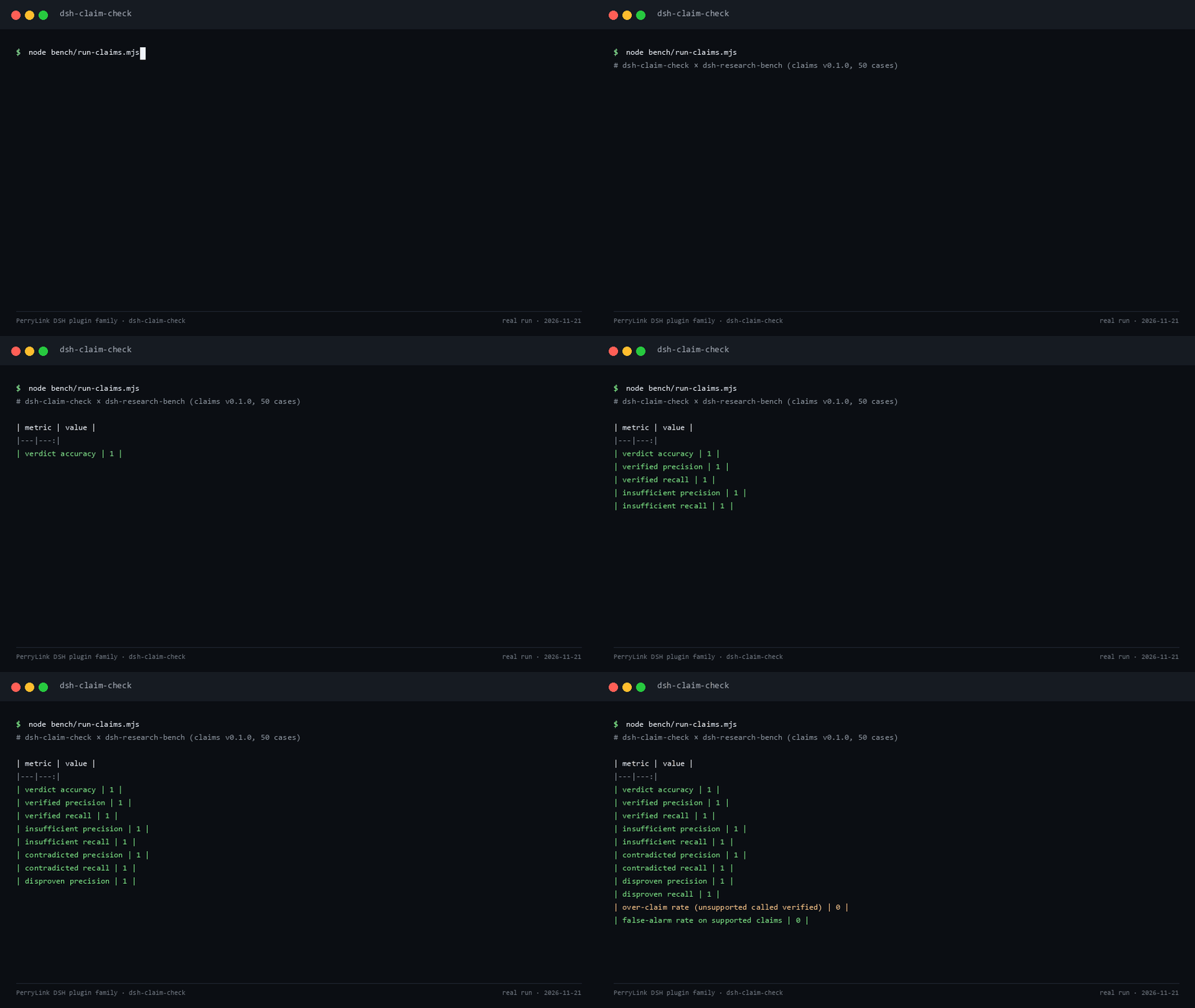
Animated: node bench/run-claims.mjs over the frozen dsh-research-bench claims v0.1.0 set (sibling bench checkout supplied via BENCH_DIR; no network, no model call; re-run 2026-11-21). These are regression-baseline numbers, not an unbiased estimate — the held-out section below reports 0.96.
Regression baseline — dsh-research-bench claims v0.1.0 (50 cases)
pnpm run bench:claims
| metric | value |
|---|---|
| verdict accuracy | 1.00 |
| verified precision / recall | 1.00 / 1.00 |
| insufficient precision / recall | 1.00 / 1.00 |
| contradicted precision / recall | 1.00 / 1.00 |
| disproven precision / recall | 1.00 / 1.00 |
| over-claim rate (unsupported called verified) | 0.00 |
| false-alarm rate on supported claims | 0.00 |
Raw per-case predictions: bench/results-claims.json.
Validity caveat (read this before quoting the numbers). The 50 cases and the detector rules were written together from the same rubric, and the polarity rule was narrowed after one supported case failed during development. These numbers are a regression baseline, not an unbiased estimate of real-manuscript accuracy. The held-out set below is the next step; it is a same-author temporal hold-out, not a fully blind external audit.
Held-out set — dsh-research-bench claims-heldout v0.1.0 (50 cases, frozen 2026-11-08)
pnpm run bench:claims-holdout
The 50 cases live in the sibling dsh-research-bench working tree at
data/claims-heldout/ (seven synthetic sources, four sentences each) and were
frozen before the first evaluation run. SUMMARY.json records
heldOut: true, frozenAt: "2026-11-08" and
sha256:016eaa67ba12ec1b3022e68dbc627b414c43733551fdd457b70dd1907e81d470.
The runner re-hashes cases.jsonl on every run and refuses to score if the
frozen hash no longer matches; no label was changed after the freeze.
| metric | regression baseline | held-out |
|---|---|---|
| verdict accuracy | 1.00 | 0.96 (48/50) |
| verified precision / recall | 1.00 / 1.00 | 0.88 / 1.00 |
| insufficient precision / recall | 1.00 / 1.00 | 1.00 / 1.00 |
| contradicted precision / recall | 1.00 / 1.00 | 1.00 / 0.83 |
| disproven precision / recall | 1.00 / 1.00 | 1.00 / 1.00 |
| over-claim rate (unsupported called verified) | 0.00 | 0.06 (2/35) |
| false-alarm rate on supported claims | 0.00 | 0.00 |
Per-category accuracy: supported 15/15, paraphrase 10/10, number-wrong 8/8, negated 6/7, quote-mined 4/5, insufficient 5/5.
Raw per-case predictions: bench/results-claims-holdout.json;
markdown: bench/results-claims-holdout.md.
The two misses are over-claims, and both are cue-list coverage gaps. Quote location, number matching and labelled-value contradiction were perfect on this set; the errors are semantic cues the lexical lists do not know:
claim-0034(negated; expectedcontradicted, predictedverified). The source says "The coating failed to improve rate capability..." and the claim quotes only "improve rate capability at 4.2 V". "Failed to" is a semantic negation, but the v0.1 negation cues arenot/no/never/ ... and do not include it, so the polarity check never runs. Candidate fix: addfail(?:ed|s)? to,unable toanddeclined toto the cue list, with regression tests.claim-0045(quote-mined; expectedcontradicted, predictedverified). The source says "Cooling seems tied to canopy density..." and the claim says that "proves" a causal effect. "Seems tied to" is associational/hedged, but the v0.1 hedge cues do not include it, so the strength check never runs. Candidate fix: addseem(?:s|ed)?,appear(?:s|ed)?,tied to,linked to,tentativeandexploratoryto the hedge cues, with tests.
These are exactly the cases a regression baseline cannot expose: the same author wrote the baseline cases alongside the cue lists.
Independence (honest). The held-out set is not a fully blind external
audit. It was written by the same rubric author as the regression baseline,
from rubric/CLAIMS.md, and it follows the same construction conventions
(explicit double-quoted spans, one quoted span per claim, synthetic English
paragraphs). What is independent is the content: seven new topics, new
sentences, new numbers, and no source paragraph or claim reused from
data/claims; the labels were fixed and hashed before the first evaluation
run, and no label was changed afterwards. It is a temporal hold-out and a test
of cue-list coverage, not an unbiased estimate of real-manuscript accuracy: the
set is synthetic and small (5–15 cases per category). The dataset stays in the
sibling bench working tree for now; this repository commits the runner and the
frozen results, not the cases.
Tests
26 tests across three files: evaluator (quote extraction incl. possessives, exact quote offsets when the first token repeats, sentence location, verified / paraphrase / absent quote / labelled-value contradiction / negation flip / hedged overclaim / null-result accuracy / interval quotes / missing number / absent content), runtime/tools (REP record validity, re-check without an evidence conflict, persist=false, path escape, bind to stored evidence and to its text snapshot rather than the first snapshot; schemas, renderers, failure branch, package contract), mount (the enabled/disabled mount contract).
Known limitations (v0.1)
- Indirect quotation, citation markers and table lookups are not parsed.
- Hedging detection is lexical (a fixed cue list), so a causal claim that avoids those verbs may pass.
- A quoted interval or sample size does not carry direction, so polarity is only checked for directional fragments.
- Non-English claims are supported structurally but the cue lists are English-only.
- The held-out run found two concrete cue gaps:
failed to(semantic negation) andseems tied to(hedge); both are tracked in the held-out section above.
License
Apache-2.0. No third-party runtime code.
Comments
Loading…
Similar plugins
by PerryLink
Verifiable research-report engine for DeepSeek Harness: content-addressed evidence ledger (claim-snapshot binding, tamper-evident) plus versioned sealed reports with per-claim verification verdicts an
★ 220
↓ 1.8k/wk
Apache-2.0
TypeScript
Nov 22, 2026
dsh plugin --profile agent add dsh-research-reportby AaronandWork
Evidence-first conclusion gate that cross-checks first-hand claims against a durable per-session tool-activity index, blocks unverified guesses and tracks blocked-versus-converted metrics.
★ 8
↓ 188/wk
MIT
JavaScript
Sep 12, 2026
dsh plugin --profile web add @aaronandwork/dsh-evidence-gateby XWH-0v0
Evidence-gated code review for DeepSeek Harness - verbatim anchors, adversarial verifiers, and explicit coverage gaps. Read-only.
★ 0
JavaScript
Nov 22, 2026
dsh plugin --profile web add @local/dsh-review-kitby zirscard
Principle-library auditor for DeepSeek Harness: one principles_audit tool that checks a principle library for principle_id collisions, legacy ids, missing causal statements, boundaries, counter-exampl
★ 0
MIT
JavaScript
Oct 20, 2026
dsh plugin --profile web add dsh-principles-auditby dongsheng123132
Deterministic revision-pinned benchmarks and regression evidence for DeepSeek Harness
★ 3
MIT
JavaScript
Nov 13, 2026
dsh plugin --profile web add dsh-benchmarkCollects the papers a DeepSeek Harness conversation cited, checks each one against Crossref, OpenAlex, arXiv and DataCite, and exports the confirmed entries as BibTeX or RIS.
★ 1
MIT
TypeScript
dsh plugin --profile web add dsh-refkeeper