

open-dream-rsi
Discovered★ 10Recursive Self-Improvement through Evolving Worlds (Dream-RSI) for LLM agents
Open Dream-RSI
📄 Preprint: Open Dream-RSI: An Open-Source Library for Recursive Self-Improvement Around a Frozen LLM, with Replay-Gated Learned Policies and a Curated Knowledge Base — P. Orwat, 2026. PDF · LaTeX source



What is this?
Every AI agent pays the same tax over and over: it fails a task, works out what went wrong, and then throws that understanding away when the session ends. Open Dream-RSI keeps what was learned — without touching the model.
The LLM stays frozen. What improves is everything around it:
- the exploration policy (even re-written as Python code by the LLM itself, gated by replay before it is trusted),
- a library of verified solutions (recipes) reused as warm starts,
- curated lessons distilled from failures — every one of them promoted only after it measurably helps on replay,
- and the world model the policy is scored against: a Discovery Tree of every attempt, enriched with replay-safe error-class facts by the Sentinel engine.
Between runs the system "dreams": it replays thousands of strategies over the recorded history in-process, at zero API cost, and keeps only what beats the incumbent. An open implementation of Recursive Self-Improvement through Evolving Worlds (Dream-RSI, Zheng et al., arXiv:2609.14858).
Zero runtime dependencies — Python 3.10+ stdlib only, ~10.2k lines of library code, ~5.1k lines of tests, no build step.
Not another memory plugin. Experience-memory systems record what the agent learned and reuse it as-is. ODR is an evolving worlds loop: every attempt is recorded into a Discovery Tree, and between runs the system dreams — replaying thousands of strategy variants against that recorded world. Nothing is promoted on the model's word alone: a candidate policy, recipe or lesson replaces the incumbent only after surviving counterfactual replay.
Evaluation policy: this project makes performance claims on exactly
one benchmark — goose × TravelPlanner, public and scored by the
benchmark's own evaluators (below).
The scripted suites (bench, bench-policy) are deterministic
self-checks — behavioural regression contracts for the machinery — and
carry no model-quality claim.
How it works
                        ┌───────────────┐
                        │  Frozen LLM   │
                        └──────┬────────┘
                               │ proposals
              online loop      ▼      offline dream
        ┌──────────── DiscoveryTree ──────────── ReplaySimulator ──────────┐
        │                     │                          │                 │
        │              node.sentinel              counterfactual          │
        │              (Sentinel facts,           rollout scoring         │
        │               replay-safe)                    │                 │
        │                     │                         ▼                 │
        │                     └────→ Policy improvement ────→ next cycle  │
        │                                                                   │
   SENTINEL MODE (tool-execution layer)                                     │
        │          │             │                                          │
   error-class   nudge       permute-gate ──→ block tool calls             │
   ledger        (once/session)              past 80% of budget ───────────┘
- Online execution — the agent attempts each task with the real LLM and a sandboxed verifier, appending every attempt to a per-task Discovery Tree (code, test feedback, score, one-line plan, and — when a Sentinel engine is wired — structured error-class facts and an explicit termination reason).
- Offline dreaming — instead of paying for real-world rollouts, the agent "dreams" over the recorded history: thousands of strategy variants are scored in an in-process replay simulator at zero external-call cost. The best parameters, programs and recipes are persisted and steer the next cycle.
Beyond parameter-level dreaming, the loop closes section 3 of the paper
("dreaming with code"): each cycle the LLM may rewrite the exploration
policy itself as a small Python program, choose_action(frontier, step).
Candidates are statically validated (AST gate), executed only in a hardened
subprocess sandbox, and scored by counterfactual replay rollout on the
recorded tree. A candidate replaces the incumbent only on evidence — and
the incumbent is re-scored on the current tree, not trusted at its stored
score. A crashing or cheating policy can never break the loop: expansion
falls back to the greedy baseline.
Quick start
git clone https://github.com/patrykorwat/open-dream-rsi.git
cd open-dream-rsi
pip install -e .
Point it at a model — or don't. Any OpenAI-compatible endpoint works;
keys are read only from the environment. The model name is
auto-detected from the endpoint (GET /v1/models), so pointing at a local
vLLM/Ollama needs only the base URL:
export OPENAI_BASE_URL=http://127.0.0.1:8000/v1   # vLLM / Ollama / any gateway
export OPENAI_API_KEY=***                         # any token for local servers
# no ODR_LLM_MODEL needed: the first model the endpoint serves is used.
# Pin ODR_LLM_MODEL only to select among several served models.
Queue a task in tasks.json:
[{
  "task_id": "add1",
  "category": "math",
  "prompt": "Implement add(a, b) returning the sum.",
  "tests": [{"call": "add(2, 3)", "expected": 5}],
  "max_attempts": 3
}]
Run the supervisor — once, as a daemon, or as the recommended automated
dream cycle (one command that imports session evidence, runs the promotion
gate when the evidence justifies it, and publishes earned lessons as skills):
python -m open_dream_rsi --memory .dream_rsi dream \
    --sessions ~/.hermes/state.db --skills-out ~/.hermes/skills/odr-curated
python -m open_dream_rsi loop --tasks tasks.json --interval 300   # daemon mode
python -m open_dream_rsi loop --tasks tasks.json --once           # single cycle
python -m open_dream_rsi status                                   # what it learned
No key? Everything deterministic still runs: bench, bench-policy,
gate-replay and the dashboard all use a scripted mock client. A full
in-process walkthrough with a mock OpenAI server: examples/live_loop_demo.py.
Don't want the CLI at all? The same loop runs as an MCP server inside your existing coding agent — that is the fastest way in:
python3 -m open_dream_rsi mcp --tasks ./tasks.json --memory ./.dream_rsi
…see the next section for the exact block for your agent.
Plug in your favourite agent
The loop speaks MCP (Model Context Protocol). One config block and your everyday agent can queue tasks for the dreamer, pull back verified recipes and consult curated lessons — zero extra LLM setup: the dreamer resolves its own brain (env → local goose config → localhost vLLM), and asks the endpoint itself which model to use.
| Tool | What it does |
|---|---|
odr_status | what the loop has learned (policies, recipes, events) |
odr_recipes | best verified solution for a category — use as warm start |
odr_lessons | curated failure lessons for a category / search query |
odr_add_task | queue a task (prompt + tests, or prompt + criteria) — test-less tasks are completion-judged |
odr_run_once | run one improvement cycle now (bounded API budget) |
odr_dream | the automated cycle: import host session evidence, distill curated lessons, run the promotion gate, publish skills |
Tools are registered prefixed per client (e.g. Hermes
mcp_open_dream_rsi_odr_run_once). No model calls tools on its own
initiative — trigger them via a recipe's instructions:, a hook, or an
explicit ask ("check odr_recipes before you try again"). A tip that makes
the loop proactive: add to your project AGENTS.md:
## Self-improvement loop (MCP: open-dream-rsi)
- Before implementing a self-contained Python utility, call `odr_recipes`
  and `odr_lessons` for its category; reuse a verified recipe verbatim.
- When you finish a hard, testable function, queue it with `odr_add_task`
  (task_id = function name, tests = your test cases) so the loop can
  dream over it offline.
OpenCode
Create (or merge into) opencode.json in the project root where you
work:
{
  "$schema": "https://opencode.ai/config.json",
  "mcp": {
    "open-dream-rsi": {
      "type": "local",
      "command": ["python3", "-m", "open_dream_rsi", "mcp",
                  "--tasks", "./tasks.json", "--memory", "./.dream_rsi"],
      "enabled": true
    }
  }
}
Start OpenCode and type /mcps — you should see open-dream-rsi: connected.
Goose
Recommended — the script wires everything (diagnoses the install, resolves
your goose provider, optionally starts the model-borrowing proxy, and
writes the extension block into ~/.config/goose/config.yaml itself):
./scripts/odr_goose_setup.sh            # diagnose + configure goose + start proxy
./scripts/odr_goose_setup.sh --check    # diagnose only, change nothing
./scripts/odr_goose_setup.sh --no-proxy # skip the proxy (use provider='goose')
Or add the extension manually to ~/.config/goose/config.yaml:
extensions:
  open-dream-rsi:
    enabled: true
    type: stdio
    name: open-dream-rsi
    description: "Dream-RSI self-improvement loop. Use odr_add_task to queue a
      Python task with tests, odr_run_once to run an improvement cycle,
      odr_recipes/odr_lessons to reuse verified solutions and failure lessons,
      odr_status to inspect what the loop has learned."
    cmd: python3
    args: ["-m", "open_dream_rsi", "mcp",
           "--tasks", "/ABSOLUTE/PATH/projects/myproject/tasks.json",
           "--memory", "/ABSOLUTE/PATH/projects/myproject/.dream_rsi"]
    timeout: 300
Goose spawns extensions without a shell and with a scrubbed environment:
use absolute paths (no ~, no relative ./) and pass any env the server
needs via envs: — it will not inherit your export'ed OPENAI_*. After
any config edit: fully quit goose (the desktop app caches config at
startup), relaunch, and activate open-dream-rsi in the session's
extensions picker. One-shot alternative (no config edit):
goose session --with-extension "python3 -m open_dream_rsi mcp --tasks ./tasks.json --memory ./.dream_rsi".
Two first-class ways to run the dreamer on exactly the model goose uses
(no second API key): provider: "goose" reads ~/.config/goose/config.yaml
itself (CLI and desktop dialects, custom_providers/*.json, secrets.yaml,
macOS keychain), and python3 -m open_dream_rsi proxy --port 8799 exposes
goose's brain as a plain OpenAI-compatible endpoint — details in
docs/integrations.md.
Hermes Agent
Add under mcp_servers in ~/.hermes/config.yaml (or via the dashboard's
MCP catalog):
mcp_servers:
  open-dream-rsi:
    command: "python3"
    args: ["-m", "open_dream_rsi", "mcp",
           "--tasks", "/ABS/PATH/open-dream-rsi/tasks.json",
           "--memory", "/ABS/PATH/open-dream-rsi/.dream_rsi"]
    timeout: 300
    env:
      OPENAI_BASE_URL: "http://YOUR-VLLM-HOST:8000/v1"
      OPENAI_API_KEY: "***"        # any token for local servers
Restart Hermes; tools appear as mcp_open_dream_rsi_* in every platform
toolset. Hermes is also the one host with MCP sampling support, if you
ever want the dreamer to borrow the host's model through the protocol
(today ODR resolves the endpoint itself instead).
Hermes in Docker: mount the repo read-only and export PYTHONPATH
(no pip layer in the image), then add the server block with an explicit
env: (the container has no goose config):
ENV PYTHONPATH=/opt/open-dream-rsi
# compose.yaml -> services.hermes
volumes:
  - /home/USER/git/open-dream-rsi:/opt/open-dream-rsi:ro
  - ./data:/opt/data
Point --tasks/--memory at paths under the mounted data volume (e.g.
/opt/data/dream-rsi/...) so memory survives rebuilds. Updating = git pull on the host + restart the container — no image rebuild.
Codex CLI
codex mcp add open-dream-rsi -- python3 -m open_dream_rsi mcp \
  --tasks /ABS/PATH/tasks.json --memory /ABS/PATH/.dream_rsi
Verify with codex mcp list (or [mcp_servers.open-dream-rsi] with
command/args in ~/.codex/config.toml).
Claude Code
claude mcp add open-dream-rsi -- python3 -m open_dream_rsi mcp \
  --tasks /ABS/PATH/tasks.json --memory /ABS/PATH/.dream_rsi
Check with /mcp inside a session.
Claude Cowork / claude.ai (remote only)
Cowork connects to remote MCP URLs brokered from Anthropic's cloud. Serve HTTP, tunnel, add the URL as a custom connector:
python3 -m open_dream_rsi mcp --http --host 0.0.0.0 --port 8800 \
  --tasks /ABS/PATH/tasks.json --memory /ABS/PATH/.dream_rsi
# tunnel 8800 (tailscale funnel / cloudflared) -> Settings -> Connectors -> Add custom
The endpoint implements the stateless Streamable-HTTP profile (POST /mcp,
one JSON-RPC message per request; GET /health). Treat the URL as a
credential: whoever reaches it can queue tasks and spend your LLM budget.
DeepSeek Harness
DeepSeek Harness (dsh)
runs external MCP servers through its first-party bridge
(@deepseek-ai/dsh-mcp-client). The bundle is published on npm:
dsh plugin --profile web add dsh-open-dream-rsi
The tools appear as mcp__open_dream_rsi__<tool> (odr_status,
odr_recipes, odr_lessons, odr_add_task, odr_run_once, odr_dream).
Bundle defaults point --tasks/--memory at tasks.json/.dream_rsi
beside the directory dsh launches from; override the
mcp-open-dream-rsi row from your profile's cordis.patch.yml (same id).
DSH scrubs the spawned child's environment (names matching
KEY|PASSWORD|SECRET|TOKEN and all DSH_*), so the bundle re-passes
OPENAI_BASE_URL / OPENAI_API_KEY / ODR_LLM_* / PYTHONPATH from the
harness process's env — without them the dreamer falls back to
http://127.0.0.1:8000/v1 with model auto-detection (fine for a local
vLLM/Ollama, needs no key). toolCallTimeoutMs: 1800000 replaces the 60 s
default because odr_run_once/odr_dream cycles run for many minutes.
Prefer a hand-rolled overlay?
dsh --patch /ABS/PATH/TO/open-dream-rsi/plugins/deepseek_harness/odr.cordis.yml web
inserts the same row with explicit absolute paths (a remote Streamable-HTTP
variant, odr-http.cordis.yml, points at the mcp --http endpoint — the
URL is a credential, same caveat as Cowork below). Full walkthrough:
plugins/deepseek_harness/README.md.
Zero configuration (all of them)
odr_run_once resolves the brain automatically, in this order:
OPENAI_BASE_URL/OPENAI_API_KEYin the server's environment,- your local goose config (
~/.config/goose:active_provider+providers:block +custom_providers/*.json+secrets.yaml+ macOS keychain) — read from disk, so it survives the env scrubbing that Hermes/Codex/Claude Code apply to spawned servers, http://127.0.0.1:8000/v1(vLLM/Ollama default).
The served model is auto-detected (GET /v1/models) unless pinned.
Self-hosted endpoints run with hidden reasoning disabled by default
(chat_template_kwargs.enable_thinking=false — a thinking-on Qwen otherwise
burns the whole completion budget); endpoints that reject the flag get a
clean automatic retry without it. An empty task queue is a benign no-op
with a hint, never an error.
Full per-host instructions (including the launchd keep-alive for the goose proxy and troubleshooting): docs/integrations.md.
Providers
The agent talks to any OpenAI-compatible POST {base_url}/chat/completions
server. API keys are read only from environment variables.
| Provider | Preset | Base URL | Key env var |
|---|---|---|---|
| OpenAI | openai | https://api.openai.com/v1 | OPENAI_API_KEY |
| Cursor Models API | cursor | https://api2.cursor.sh | CURSOR_API_KEY |
| Local (vLLM / Ollama / LM Studio) | local | http://127.0.0.1:8000/v1 | OPENAI_API_KEY |
| Borrowed from goose config | goose | resolved from ~/.config/goose | — |
Precedence is always: explicit overrides → environment → endpoint model
discovery (first id from GET /v1/models) → preset defaults. A redeployed
local server is picked up automatically — and a pinned model the endpoint no
longer serves self-heals: the client re-discovers once and retries instead
of failing the whole run. Self-hosted reasoning endpoints get
enable_thinking: false automatically; an HTTP 400 rejection of that flag
triggers a self-heal retry.
Library-level use (no CLI):
from open_dream_rsi import (DiscoveryTree, DreamEngine, ReplaySimulator,
                            DreamAgent, LLMConfig, OpenAICompatibleClient)

client = OpenAICompatibleClient(LLMConfig.from_preset("local"))
tree = DiscoveryTree()
dreamer = DreamEngine(simulator=ReplaySimulator(tree))
dreamer.run_offline_optimization(iterations=100)
agent = DreamAgent(dreamer=dreamer, client=client)
What persists between runs (--memory dir)
| Artifact | File | Effect |
|---|---|---|
| Dreamed policy parameters | policies.json | next cycle starts from the last one's optimum |
| Promoted policy programs | policy_codes.json | LLM-written choose_action steers expansion |
| Recipe library | recipes.json | verified solutions replayed as warm starts |
| Knowledge base | lessons.json | curated, replay-gated lessons (declarative text) |
| Discovery trees | trees/ | offline dreaming always has history; nodes optionally carry replay-safe Sentinel facts |
| Audit log | events.jsonl | append-only record of every decision |
Switches worth knowing: --no-policy-code, --no-knowledge, --no-thoughts,
--no-judge ablate the four optional machinery layers; --budget N caps API
calls per cycle (dreaming stays free).
Automated dreaming: when does the loop actually run?
The seam is dream_once() (CLI odr dream, MCP odr_dream, or a host
hook). You do not set a schedule — the module decides the tier per call,
so firing it after every task is safe and costs nothing extra when there is
nothing new to learn:
| Tier | Triggered when | What runs |
|---|---|---|
| maintenance | quiet call (no new evidence, recent last dream) | ingest scan (cheap), ALM stale/supersede/archive/GC, skills republish — zero LLM |
| full | min_new_evidence (default 3) new failure-shaped sessions, OR max_age_seconds (default 6 h) since the last full dream | + online attempts, dreaming, paired-replay promotion gate (budget, default 20 API calls) |
A busy day dreams a few times, a quiet day once, an idle day never;
concurrent calls collapse on a single-instance lock. Probes are queued
automatically: every failure-shaped session appends its own request to
tasks.json as a probe:<session> task (max_attempts=1, appended after
manual tasks), so the promotion gate never depends on hand-written task
files — the evidence you already produced is the counterparty.
For a mass install the whole thing is two artifacts, no host glue:
python3 -m pip install git+https://github.com/patrykorwat/open-dream-rsi  # library + CLI + MCP server
cp -r plugins/hermes_odr_trigger $HERMES_HOME/plugins/odr-trigger
hermes plugins enable odr-trigger                # restart to load the hook
# optional overrides:
hermes config set plugins.entries.odr-trigger.settings.provider local
hermes config set plugins.entries.odr-trigger.settings.base_url http://.../v1
Benchmark: goose × TravelPlanner (public, externally scored)
This is the only benchmark in this project — everything else below the
heading line is machinery self-check. A real agent (goose v1.53) plans real
itineraries against the official TravelPlanner offline database
(osunlp/TravelPlanner) over a stdlib MCP sandbox, scored by the benchmark's
own commonsense and hard-constraint evaluators (nothing in the scoring path
is ours), on the model Qwen3.8-Flash-Next served by vLLM. Same endpoint and
model across every study in this repo and the paper.
Frozen protocol: iterations only on train.csv (45 tasks); one preregistered
eval pass on official validation rows 102–181 (79 tasks, 60 hard),
configuration unchanged from the dev split; official test split never
touched. Arms interleaved task-by-task per pass (paired, McNemar-ready).
The gate arm is choice removal, not persuasion: past 36 of 45 tool calls
the sandbox refuses to serve (all text channels off).
| split | arm | delivered plans | commonsense pass | hard pass | final pass |
|---|---|---|---|---|---|
| train (45) | cold | 15/45 (33%) | 4 | 3 | 6.7% |
| train (45) | gate | 41/45 (91%) | 18 | 9 | 20.0% |
| eval (79) | cold | 18/79 (23%) | 12 | 6 | 7.6% |
| eval (79) | gate | 74/79 (94%) | 40 | 17 | 21.5% |
McNemar on paired delivery: eval 56↔0 discordant, p=1.4e-17 (train 28↔2, p=4.3e-7).
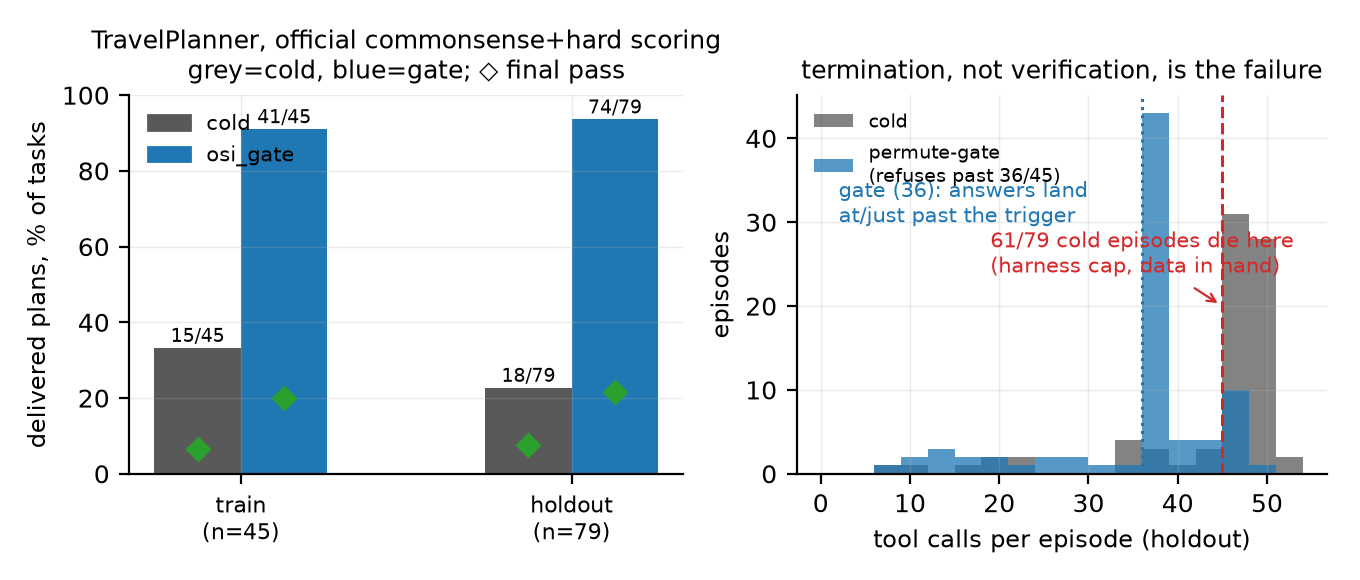
Why it works: every single undelivered cold episode (91/91 across both
splits) died pinned at the harness call cap with the sandbox data already
in hand — the binding failure under budget pressure is termination, not
error recovery, and three text-in-context channels measured earlier
(pull tool, Stop-hook note, budget nudge) converted zero of those episodes.
Removing the option to keep exploring is the only lever that moved delivery.
Honest caveats: the choice of gate over persuasion was made knowing
results on the earlier 101-task validation pool (selection era, archived —
the eval pass is a preregistered confirmation, not a first exposure); the
gate's 5 residual eval failures are episodes that called through the
refusals to the cap anyway. Everything behind these numbers is in this
directory: benchmarks/travelplanner/ — the sandbox MCP server, the
episode runner, the official-evaluator wrapper, the exact split CSVs and
the raw per-episode records. python3 score.py results/submissions/…
reproduces the table above to the task from the committed records; the
directory README documents prerequisites and the one-command rerun. The
figure re-renders from fixtures/tp_v3_summary.json via
paper/make_figures.py. Paper §Evaluation.
Machinery self-checks (deterministic, key-free)
Not benchmarks — behavioural regression contracts: a scripted solver makes the model arm a constant, so every delta is attributable to the library's gates, sandboxes, promotion and retrieval logic. They exist so a broken mechanism fails CI instead of silently mutating a published number, and they re-run from a fresh clone in seconds.
bench — the dreaming loop against a cold baseline
| arm | solves | API calls | calls / task·cycle | dream its |
|---|---|---|---|---|
| cold_baseline (fresh memory each cycle) | 50 | 150 | 3.0 | 0 |
| dream_rsi_loop (policies + recipes + dreaming) | 50 | 69 | 1.38 | 3000 |
54% fewer API calls at equal solve quality (re-measured on this commit: identical to the published table).
python -m open_dream_rsi bench --cycles 10 --markdown
bench-policy — decoy traps (exploration contracts)
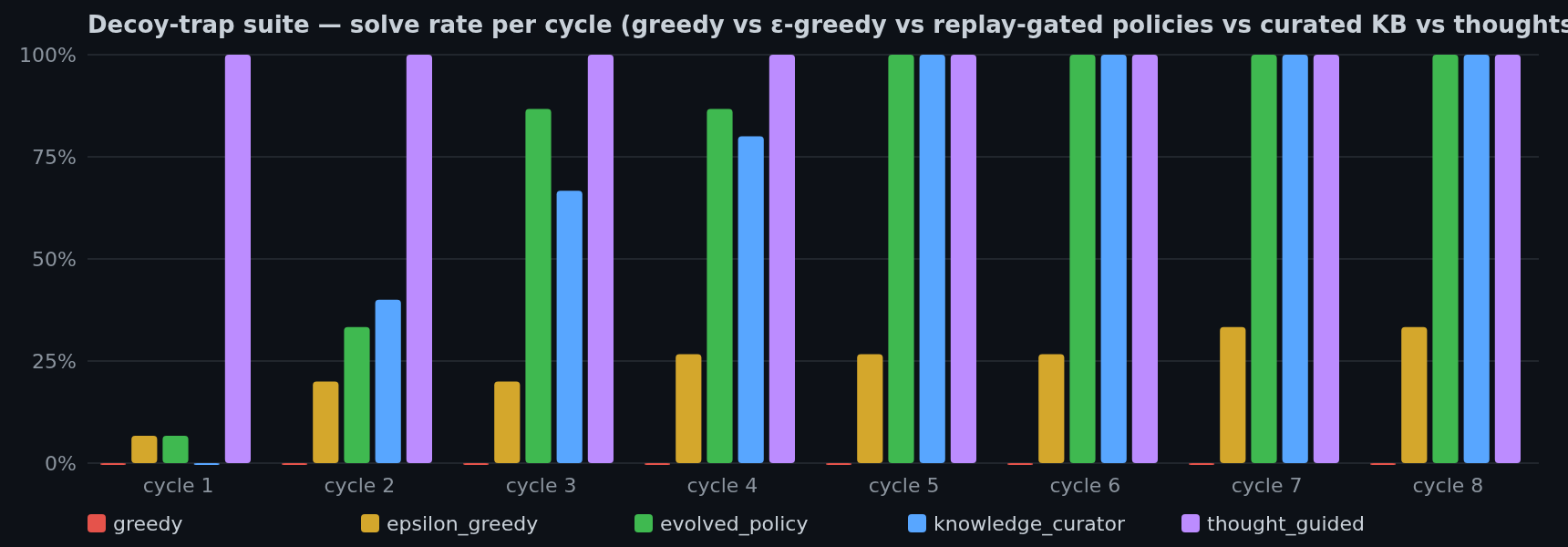
Solve-rate self-checks saturate on easy suites and cannot tell good
exploration from luck, so bench-policy hides each fix behind a
low-scoring branch (passes 1/3 tests) past a plausible decoy (passes 2/3
forever). A score-greedy loop locks onto the decoy and starves; escaping
requires structural exploration. Five arms, one scripted solver, one budget:
python -m open_dream_rsi bench-policy --cycles 8 --format md
| arm | solves | solve rate | API calls | calls / solve | policy calls | curator calls |
|---|---|---|---|---|---|---|
| greedy | 0/120 | 0% | 480 | ∞ | 0 | 0 |
| epsilon_greedy | 29/120 | 24% | 405 | 13.97 | 0 | 0 |
| evolved_policy | 92/120 | 77% | 252 | 2.74 | 27 | 0 |
| knowledge_curator | 88/120 | 73% | 332 | 3.77 | 0 | 34 |
| thought_guided | 120/120 | 100% | 164 | 1.37 | 0 | 0 |
- evolved_policy — the loop asks the LLM for a policy program per category, validates and replay-scores it, and promotes only on evidence. 100% solve rate by cycle 5 while spending fewer total calls than ε wasted on luck.
- knowledge_curator — ε-greedy with zero policy calls: every escape above the ε baseline came from remembered knowledge (73%, at parity with the gated policies at ~80% of ε's calls).
- thought_guided (library default) — each attempt records its one-line
PLAN:; expansion leaves a branch as soon as its idea repeats itself. With ε forced to 0 and no policy/curator calls it escapes every trap from cycle 1; the ledger-only ablation (same text in prompts, pick disabled) collapses back to the baselines — the win is the expansion rule, not prompt length.
gate-replay — would a lesson set have been promoted?
Applies the shipped promotion rule (lesson_gate_verdict) to per-task
outcome pairs from any recorded replay harness — no model, no GPU:
python -m open_dream_rsi gate-replay \
  --baseline cold=/tmp/arms.json?label=cold \
  --compare lessons=/tmp/arms.json?label=warm \
  --key task_id --format md
What the loop learned about memory (honest results)
The knowledge curator distils verifier failures into short, validated, deduplicated lessons — pure text, never executed. Live-model replay, however, proved that fresh lessons are hazardous by default:
- Structurally perfect lessons (passed every schema/caps gate) dropped solve-rate 18/20 → 6/20 on a greedy decoder: "keep checking"-style advice turns greedy decoding into an over-exploration loop.
- The same facts rewritten as declarative background (no imperative verbs, explicit stop clause): 18/20 — indistinguishable from cold (McNemar p=1.0). The hazard is imperative mood, not content.
- Seven further published injection strategies (abstract workflows, exemplars, evidence certificates, reactive-on-error notes, end-of-prompt position) scored zero paired gains against a contemporaneous cold baseline; moving safe text to the end of the prompt was actively harmful (11/20, p=0.008 — recency makes the model act on facts that were inert mid-prompt).
The shipped design encodes all of that: lessons are staging candidates
that must pass a paired-replay gate (net ≥ 1, zero solve→fail
regressions, explicit stop clause) before any prompt sees them; proposal
prompts frame the KB as declarative background; and a per-category
headroom verdict (skip curation when recent solve-rate ≥ 0.7 and
calls/solve ≤ 5) spends zero curator/gate calls where the cold baseline
already wins. Guidance pays a perturbation tax — the loop only pays it
where there is measurable headroom to spend it against.
Learning vs lifecycle vs history
The repository keeps four planes strictly apart:
| Plane | Owner | Question it answers |
|---|---|---|
| Learning | Dream-RSI pipeline (dreamer, replay gate, lesson gate) | Does this artifact deserve to be active? |
| Current artifact state | ArtifactLifecycleManager (lifecycle.py) | What is true about this artifact now? |
| Transition history | append-only artifacts/events.jsonl | How did it get here? |
| Immutable evidence | Discovery Trees + the event logs | Why do these artifacts exist, and what world produced them? |
The ALM manages the four artifact types (policy_parameters,
policy_program, recipe, lesson) through an explicit state machine
(CANDIDATE → VALIDATED → ACTIVE → STALE/SUPERSEDED/QUARANTINED → ARCHIVED,
terminal REJECTED), with hard rules: activation is only an explicit
promotion call carrying the evidence; every state change appends exactly
one immutable event before exposing the new state; the materialized
view must always equal rebuild_artifact_state(events) (a hand-edited view
is rebuilt from the log, never trusted); merges create NEW artifacts with
lineage and never mutate sources; deletion never prunes the event log.
Discovery Trees and audit events are evidence, not artifacts — the ALM
refuses to register them. Inspect the store:
odr artifacts [--type lesson --state ACTIVE --history].
Importing real sessions: Hermes and Cursor (curator's second door)
The loop distils lessons from failures it produces itself. sessions.py
opens a second legitimate door: transcripts from host agents are evidence
you already paid for. Imports feed the same pipeline as loop-collected
failures — structural gate, staging-by-default, paired replay promotion.
Nothing imported is trusted; activation is still earned. Transcripts are
treated as hostile input: opened read-only, credential-scrubbed, parsed
defensively — and lessons that never passed the promotion gate never reach
a prompt.
From Hermes sessions
Hermes persists every session to <HERMES_HOME>/state.db (SQLite:
sessions + messages). Export, then distil:
python -m open_dream_rsi --memory .dream_rsi sessions export \
    --source hermes --db ~/.hermes/state.db --limit 50 \
    --out episodes.jsonl

# inspect what WOULD be distilled — no LLM calls, no writes:
python -m open_dream_rsi --memory .dream_rsi sessions distill \
    episodes.jsonl --dry-run --limit 5

# real run: staging lessons into the KB (per-category = episode cwd name)
python -m open_dream_rsi --memory .dream_rsi sessions distill episodes.jsonl
The next odr loop cycle gates the staging entries exactly like
loop-collected ones; odr artifacts --type lesson --history shows the
lifecycle events behind every activation.
From Cursor chats
Cursor keeps conversations in globalStorage/state.vscdb (Linux:
~/.config/Cursor/User, macOS: ~/Library/Application Support/Cursor/User,
Windows: %APPDATA%\Cursor\User), with workspaceStorage mapping chats to
project folders for the category. The reader handles the undocumented
layout and the bubble-ordering rules; re-verify after major Cursor
upgrades.
python -m open_dream_rsi --memory .dream_rsi sessions export \
    --source cursor --out episodes.jsonl --limit 100
python -m open_dream_rsi --memory .dream_rsi sessions distill episodes.jsonl
Notes: the live DB is write-ahead-logged — immutable=1 may miss the
newest chats, so quit Cursor or copy state.vscdb+-wal+-shm together
and point at the copy for a complete snapshot. Chat history contains
everything ever pasted into it: export redacts credential-shaped substrings
by default (--no-redact exists for local processing only) — review
episodes.jsonl before sharing it.
Curator lessons as Hermes skills
python -m open_dream_rsi --memory .dream_rsi skills export \
    --out ~/.hermes/skills/odr-curated
Renders only active (promotion-gated) lessons into Hermes-style skills —
one directory per category, declarative bullets, never imperative commands
(the measured hazard). The export is one-way and regenerated wholesale:
edit lessons.json (or distil again), not the skills.
Sharing lessons: git-backed stores
share.py turns curated knowledge into a portable, verifiable store that
other instances (or other people) can consume — a directory of JSON files,
optionally a git checkout, so GitHub is just storage:
# one-time: point the store at a repo (clone/pull handled for you)
python -m open_dream_rsi --memory .dream_rsi lessons export \
    --store git@github.com:you/dream-rsi-lessons.git

# on the consumer side — someone else's store becomes your staging:
python -m open_dream_rsi --memory .dream_rsi lessons import \
    --store https://github.com/you/dream-rsi-lessons.git
Trust model: export ships only what earned activation (staging and
rejected lessons excluded by construction, secrets scrubbed, sha256
manifest); import lands as staging, never active (checksum mismatch
aborts the whole import — tampering detected, not trusted; each lesson
still needs your paired-replay gate to reach a prompt). A local directory
works identically (--store ./store) — git is just the transport.
Full Hermes wiring (what exists today)
| Path | Direction | What it does |
|---|---|---|
odr mcp (stdio) / --http | Hermes → ODR | Hermes calls odr_run_once / odr_dream / odr_status as tools |
plugins/hermes_sentinel/ | Hermes → ODR engine | Sentinel observes tool results, annotates, gates |
plugins/hermes_odr_trigger/ | Hermes → ODR engine | session-end hook spawns the detached odr dream cycle (no shell/cron) |
plugins/deepseek_harness/ | DeepSeek Harness (dsh) → ODR | Cordis overlay: the ODR MCP server behind @deepseek-ai/dsh-mcp-client |
odr sessions export/distill | Hermes → curator | session history becomes staging lessons |
odr skills export | curator → Hermes | active lessons become discovered SKILL.md files |
odr dream | any trigger | one automated cycle: evidence → gate → ALM → skills |
Security model
Candidate code — both task solutions and policy programs — runs in a
hardened subprocess (open_dream_rsi/sandbox.py): python -I, scrubbed
environment (only PATH — API keys never cross the wall), a timeout that
kills the entire process group, and POSIX address-space / CPU /
thread-count limits. Policy code additionally passes an AST gate before
any spawn: required entry point, no imports, no dunder access, no
__builtins__ reference (name plus constructed-key indexing is itself an
escape route).
This is defence in depth, not a container. The subprocess does not
restrict filesystem or network access, and an AST gate cannot be provably
complete against code that is not statically gated. For hostile task
sources set ODR_SANDBOX_CMD to a
bubblewrap/nsjail wrapper
(e.g. bwrap --unshare-all --die-with-parent --ro-bind / /) or run the
loop inside a container.
Live dashboard
One command, no dependencies, stdlib http server:
python -m open_dream_rsi dashboard                   # mock LLM, port 8765
python -m open_dream_rsi dashboard --provider cursor # real model
python -m open_dream_rsi dashboard --host 0.0.0.0    # LAN access
Dark single-page UI: KPIs (cycles / solved / API budget / dream iterations), live event feed, per-task attempt boards with score bars and code diff-downs, dreamed-policy gauges per category and the learned recipe library.
Positioning
- The paper this implements: Dream-RSI (arXiv:2609.14858); official repo zhengkid/Dream-RSI, explainer dream-rsi.com.
- Peer implementations (this repo is an independent open one, not the first): TheAstrayDev/dream-rsi-sdk (adapter SDK, strict replay; LLM-written policies on their roadmap), robinber/dream-rsi-spark (local Qwen + CUDA kernel exploration), plus skill variants (hermes-dream-rsi, dream-rsi-skill, Pi-RSI). What differentiates this repo: an always-on autonomous supervisor with budget guards, LLM-written exploration policies gated by counterfactual replay (section 3 closed), a public-benchmark measurement (goose × TravelPlanner) rather than self-scored claims, a deterministic decoy-trap self-check suite, persistent cross-run memory, and a negative-results section on memory that the loop itself enforces.
- OpenRSI / Frontis-MA1 (FrontisAI/OpenRSI) is a different layer: they post-train weights; this library optimises the exploration policy around a frozen model — no training, no GPU, no weight access. Complementary: their trained improver could be the frozen LLM behind our client.
Module architecture
| Module | Role |
|---|---|
core.tree | DiscoveryTree — hypotheses, results, actions, thoughts, Sentinel facts, termination reason |
core.simulator | replay simulation without touching the environment |
core.dreamer | offline optimisation over recorded history |
core.agent | LLM agent driven by the rewarded policy |
core.policygen | policy generation, AST gate, rollout scoring, promotion |
core.curator | lesson distillation, headroom verdict, gate verdict |
core.judge | completion judge for test-less (criteria) tasks |
loop | AutoRSIRuntime — the autonomous supervisor (opt-in sentinel_engine) |
dream | dream_once — automated cadence seam: evidence ingest, tier decision, gate + ALM, skills publish; lock-guarded |
lifecycle | ArtifactLifecycleManager — state machine, event-sourced history, lineage, GC |
sessions | Hermes state.db / Cursor state.vscdb readers, redaction, lessons→skills bridge |
memory | DreamMemory — policies, recipes, lessons, trees, events |
sandbox | run_isolated — the single untrusted-code execution boundary |
tools | CodeVerifier — sandboxed verification of candidate solutions |
llm | OpenAI-compatible client (stdlib urllib transport; model discovery + 404 self-heal) |
cli | loop / status / dashboard / bench / bench-policy / gate-replay / mcp / proxy / sentinel |
mcp, mcp_server | MCP stdio server for loop tools and sentinel checks |
proxy | loopback OpenAI-compatible proxy borrowing goose's upstream |
dashboard | zero-dependency live web UI |
gate_replay | offline validation of the lesson promotion rule |
sentinel | host-agnostic error-class engine + SentinelObservation world contract |
utils.goose | goose config resolver (CLI + desktop dialects, keychain) |
plugins/* | Hermes / Claude Code / goose / DeepSeek Harness adapters |
benchmarks/travelplanner | the benchmark: sandbox MCP server, episode runner, official-evaluator wrapper, split CSVs, raw published episode records |
Tests
python -m unittest discover -s tests # or: pytest tests/ -q
321 tests (+10 subtests), stdlib-only: benchmark behavioural contracts
(greedy must solve nothing; the gated arm must dominate ε; the rollout must
be prefix-only), sandbox escape regressions, gate semantics, MCP protocol,
goose config dialects, sentinel channel semantics (nudge fires once per
budget, merges with recurrence notes, clean calls count toward the budget;
the permute-gate serves until ceil(0.8·budget) then refuses forever, per
session; the 30-day production replay must reproduce its recorded note count
exactly), model discovery and stale-pin self-heal contracts, and the
structured seam (cross-session counts never reach to_world_dict(); the
frontier-feature attribution pattern — beats greedy with metadata, ties
without; the vendored Hermes engine pinned byte-for-byte to upstream by
test_vendored_engine_matches_upstream).
License
MIT — see LICENSE.
Comments
Loading…
Similar plugins
by huchunlinnk
Recursive Self-Improvement engine for DeepSeek Harness — DSH maintains DSH: bounded perceive→integrate→verify→parity→repair→propose loop enforcing 1:1 upstream feature parity
★ 4
MIT
JavaScript
Aug 18, 2026
dsh plugin --profile web add dsh-desk-rsiby pk14742952-AD
DSH host RSI for local LLMs (currently Qwen3.8 27B): per-use continual self-improvement, counter-reason self-check, critic escalation, and memory retrieval.
★ 17
MIT
JavaScript
Oct 7, 2026
dsh plugin --profile web add dsh-host-rsiby STARDUSTLC666
Dreaming for agents: replay recent conversations between sessions (dream_digest), reflect and write a dream journal (dream_save/journal/recall), and idempotently bridge recurring lessons into AGENTS.m
★ 2
MIT
JavaScript
Oct 8, 2026
dsh plugin --profile web add @stardustlc/dsh-dreamby jasen215
DeepSeek Harness (DSH) plugin for self-improving AI agents: continual learning, persistent memory, cross-session knowledge, review-and-refine workflows, and automatic rollback.
★ 9
↓ 444/wk
MIT
TypeScript
Oct 8, 2026
dsh plugin --profile agent add dsh-continual-harnessDeepSeek Harness plugin for Reactive Resume: bridges your resumes and job applications into a Harness session over MCP.
★ 41.7k
↓ 156/wk
MIT
Aug 24, 2026
dsh plugin --profile web add dsh-plugin-reactive-resumeby TaurenMountain
LLM-as-a-Verifier for DeepSeek Harness: fine-grained reward, Probabilistic Pivot Tournament best-of-N selection, and per-step progress tracking as agent tools.
★ 5
↓ 106/wk
TypeScript
Aug 24, 2026
dsh plugin --profile web add dsh-llm-as-a-verifier