
dsh-reflex
IdentifiedReflex arc for DS Bot: runs as a sibling DSH plugin with no change to ds-bot, collects facts in cheap layers, scores them with a local decision model, and wakes a Bot only when something crosses a thr
dsh-reflex
给 ds-bot 加一条反射弧:大多数时候保持安静,只在值得占用大模型注意力时才叫醒它。
一个 DSH(DeepSeek Harness)的兄弟插件,与 ds-bot 并存,不改动 ds-bot 任何代码。
它解决什么
大模型不适合做轮询的事。每 5 分钟醒一次问"有事吗",绝大多数答案是"没有",而每次都要花钱、占配额、还要处理一遍上下文。
dsh-reflex 的做法是把判断上移到便宜的地方:便宜的层一直跑(采集事实、本地决策模型打分),只有跨过阈值时才唤醒贵的层。所以叫"反射" —— 不经过大脑的判断。
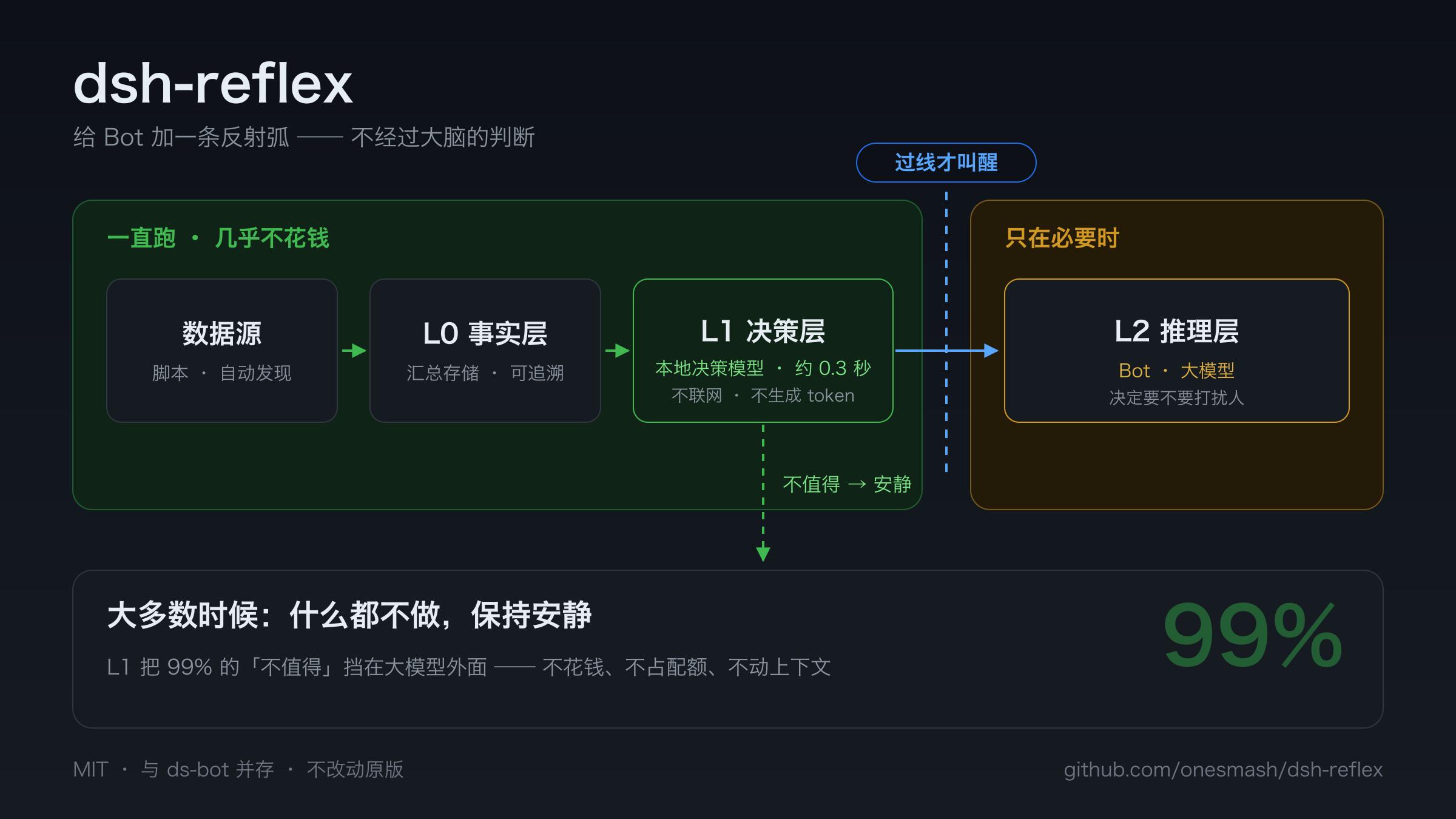
纯文本版(同一张图,终端友好)
                 ┌─── 一直跑,几乎不花钱 ───┐   ┌─ 只在必要时 ─┐
  数据源  ──►   L0 事实层  ──►  L1 决策层  ──►   L2 推理层
  (脚本)       (汇总存储)     (本地决策模型)     (ds-bot / 大模型)
                                    │
                                    └─ 大多数时候:什么都不做,保持安静
三层各做什么
| 层 | 职责 | 成本 | 实现 |
|---|---|---|---|
| L0 | 采集事实,落盘成可追溯的时间线 | 极低 | 脚本驱动,自动发现 collectors/*.sh |
| L1 | 判断"这条值不值得占用 L2 的注意力" | 极低(本地决策模型,一次前向) | 脚本驱动,自动发现 targets/*.sh |
| L2 | 真正需要判断"要不要打扰人、以什么形式"的事 | 高 | 唤醒 ds-bot 里的 Bot |
为什么要分层:判断"要不要打扰人"这件事本身是大模型的活,但它不该在每一次采集后发生。L1 用本地决策模型(SemIf 读答案槽 logits,约 0.3 秒、不联网)先筛一遍,把 99% 的"不值得"挡在 L2 之外。
一次唤醒长什么样
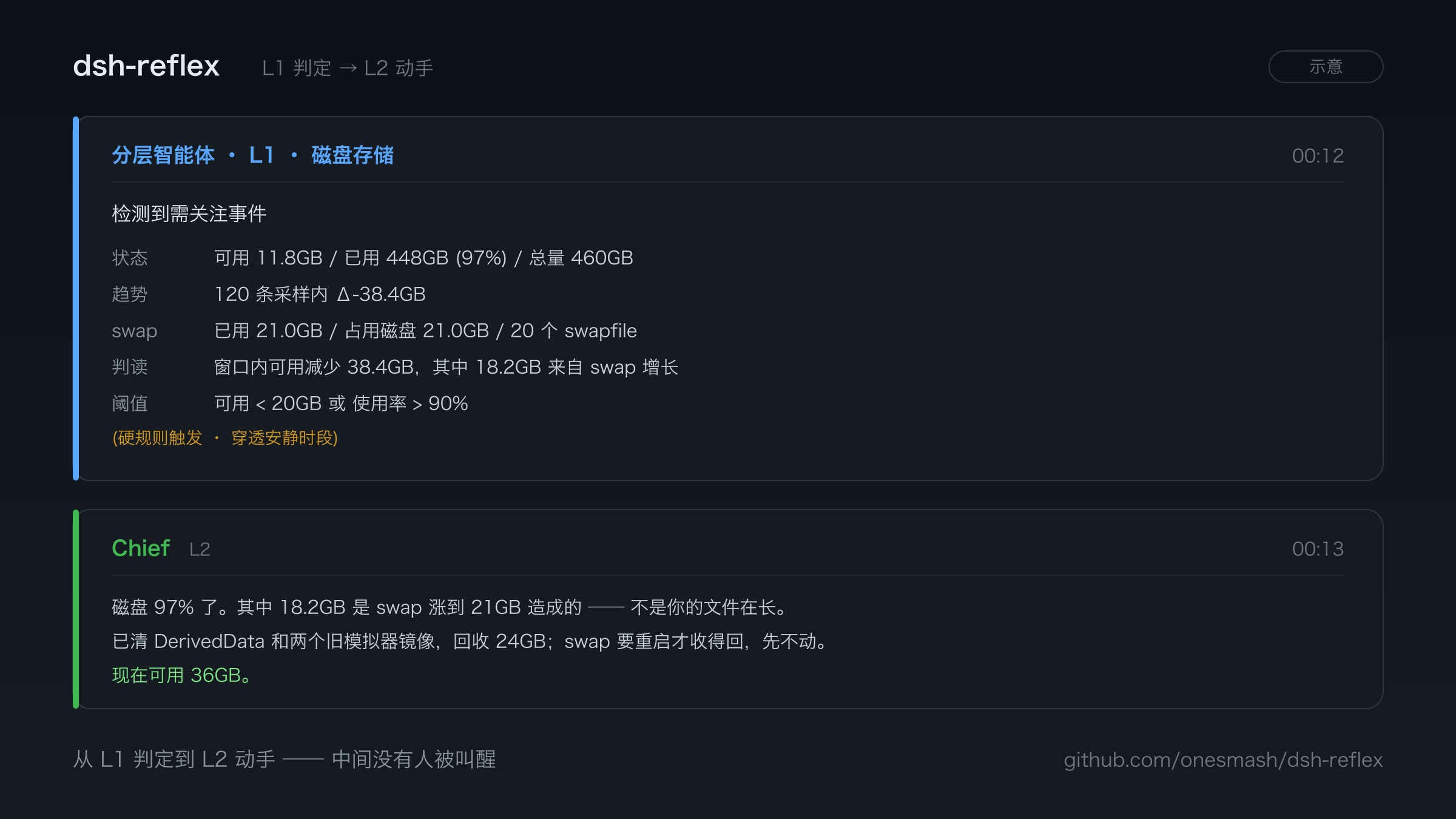
L1 判定命中后交给 L2 的是一条结构化通知(字段名来自内置 target 的真实渲染),要不要打扰人、以什么形式,由 L2 定:
与 ds-bot 的关系
- 独立 cordis 插件,通过
cordis.patch.yml以insert方式挂载 - 与 ds-bot 同进程运行(拿到
sessionController用于投递),但零修改原版 - 初始化失败会降级为日志记录,不拖垮宿主(兄弟插件的硬要求)
安装
dsh plugin --profile <你的 profile> add github:onesmash/dsh-reflex
dsh plugin 把参数转发给 profile 目录里的 pnpm:它拉取并安装这个包,并因为本包在
package.json 里声明了 dsh.bundle,同时把 dsh-reflex 追加进该 profile 的
dsh.profile.bundles。依赖随包一起装在 profile 里,不需要额外步骤。
不启动、先验证层已生效:
dsh --profile <你的 profile> --dump-config # 应出现 "# == dsh-reflex"
然后在同一个 profile 的 cordis.patch.yml 里给插件留配置块:
- id: dsh-reflex
  config:
    l0:
      sources: [disk, swap]        # 启用哪些采集源
    l1:
      targets: [disk]              # 启用哪些判定目标
      targetBot: Chief             # 唤醒哪个 Bot
      quietHours: { from: '18:00', to: '09:00' }
重启 DSH 生效(脚本源/脚本 target 无需此配置:collectors/、targets/ 里的脚本落盘即自动启用,热发现,
dsh-reflex installed: L0=60000ms L1=60000ms target="Chief" sources=[disk,swap] targets=[disk,x-timeline]
本地开发:指向你的 checkout
改这个插件本身时,用路径安装 —— pnpm 会建符号链接,改动直接随源码走:
dsh plugin --profile <你的 profile> add /绝对路径/dsh-reflex
这种方式下依赖要装在 checkout 里:linked 安装保留自己的 node_modules,
Node 按仓库真实路径解析依赖,所以要单独跑一次:
cd /绝对路径/dsh-reflex && pnpm install
(从 GitHub 安装没有这个问题 —— 包和依赖一起装进 profile。)
配置
全部配置项都可以在 profile patch 的 dsh-reflex.config 下覆盖。关键项:
| 项 | 默认 | 说明 |
|---|---|---|
l0.intervalMs | 60000 | 采集周期 |
l0.sources | [disk] | 启用的源;内置 disk/swap,其他靠 collectors/*.sh |
l0.homeDir | ~/.dsh/dsh-reflex | 工作目录(可用环境变量 REFLEX_HOME 覆盖) |
l1.intervalMs | 60000 | 判定周期 |
l1.targets | [disk] | 启用的内置判定目标;脚本 target 无需在此声明(落盘即 drop-in 启用) |
l1.threshold | 0.8 | 本地模型打分阈值 |
l1.hardRule | {lowAvailableGB:20, highUsedPct:90} | 硬规则(如磁盘告警),可穿透安静时段 |
l1.targetBot | Chief | L1 命中后唤醒谁 |
l1.cooldownMs | 1800000 | 同状态冷却,避免重复唤醒 |
l1.quietHours | null | 安静时段:内容类命中不打扰,攒到时段结束合并成一条 |
l1.profile | '' | 用户画像,组装判定 context 用 |
决策后端可切换(backend 字段):本地 SemIf(默认,不联网)或托管 Jev。适配层在 tools/semif-adapt.py。
数据源:由你自己写
插件仓库里没有 collectors/ targets/ tools/ —— 这三样是你的东西(接哪些源、什么判定口径、回执走哪个渠道),因人和环境而异,不属于框架。它们只活在运行目录(默认 ~/.dsh/dsh-reflex/)里。
插件启动时会扫描:
~/.dsh/dsh-reflex/
├── collectors/     <name>.sh → 自动注册为采集源(配 <name>.env.json 提供参数)
├── targets/        <name>.sh → 自动注册为判定目标
├── tools/          判定脚本可以调用的工具
├── facts/          L0 采集到的原始事实(按源/日期分文件)
└── dsh-reflex.log
完整契约、模板、验证清单见 DATASOURCE.md —— 也可以作为 skill 自动加载(skill/reflex-datasource/)。
目录结构
index.js              宿主侧: L0 调度 + L1 判定 + 唤醒投递
client.js             面板侧: 配置表单
cordis.patch.yml      挂载声明
DATASOURCE.md         数据源开发契约
skill/                随插件分发的能力包
tests/                回归测试
第三方
skill/ 下有两份随插件分发的第三方内容,各自保留原许可与署名:
| 包 | 来源 | 许可 |
|---|---|---|
skill/semif-decide/ | SemIf 源码快照 | MIT |
skill/typesafe-ai/ | TypeSafe 官方 agent skill | MIT |
两者均为 seed-only 策略:只在你本地缺失时安装,已存在则跳过,不会把你自己装的上游版本降级。
License
判定调优(reflex-tuning)
L1 的阈值和判据不该拍脑袋。插件随包分发 reflex-tuning skill(自动部署到 ~/.agents/skills/reflex-tuning/),
提供一条可回放的调优闭环:shadow 影子记录 → 历史 facts 回放 → 分层标注 → 阈值拟合 / 判据 A/B /
风险证书 / 校准 → 唤醒策略(单条目暂存合并)与策略仿真。target 通过 REFLEX_TUNING_DIR 引用脚本,
运行目录不再放副本。契约见 skill/reflex-tuning/SKILL.md,实验记录见 docs/threshold-fitting.md。
Comments
Loading…
Similar plugins
by Senguk520
A Multitask "shock absorber" plugin & agent preset for DeepSeek Harness (DSH): the main chat only plans, briefs subagents and summarizes results, while file reads, commands, search and builds all run inside subagent contexts. Four worker types, an approval gate, zero DSH source changes.
★ 40
↓ 91/wk
MIT
JavaScript
Oct 23, 2026
dsh plugin --profile web add dsh-multitaskby lolipop-1x1
A DeepSeek Harness plugin that surfaces important facts, trade-offs, and useful context while your AI agent works.
★ 4
↓ 240/wk
MIT
TypeScript
Oct 3, 2026
dsh plugin --profile web add dsh-you-should-knowby edusrez
Wakes the main agent after any DSH restart so interrupted work resumes automatically — adds a restart tool and an optional canary that validates the boot and warns instead of breaking.
★ 8
↓ 184/wk
MIT
JavaScript
Sep 22, 2026
dsh plugin --profile web add dsh-smart-restart思考锚点:从模型上一段思考中提取已确立结论,在工具结果后注入,减少重复推导;并可识别打转与伪工具调用
★ 0
MIT
JavaScript
dsh plugin --profile web add dsh-cot-anchorby zhangzhenwen1
Auto-adjust model reasoning effort per task (off/low/high/max): task classification, [effort=...] markers, in-turn error escalation, DeepSeek peak-pricing-period capping with countdown notices, and ma
★ 0
↓ 61/wk
MIT
JavaScript
Aug 30, 2026
dsh plugin --profile web add dsh-task-effortby neo805
DSH plugin: context-aware per-step reasoning-effort routing — classify → escalate → hysteresis → capability clamp; Auto mask in the native selector; default effort fill + wire mapping for custom llm-pi-ai models. AI-authored (kimi-k3), produced by @neo805. No Issues/PRs; forks welcome (MIT).
★ 0
NOASSERTION
JavaScript
Oct 14, 2026
dsh plugin --profile web add dsh-effort-router