

dsh-plugin-loom-chat
Manifest valid★ 4Loom Chat is a DSH Web client plugin that turns linear ordinary sessions into a pannable, zoomable Loom-style canvas for parallel exploration.
dsh-plugin-loom-chat
Loom Chat is a DSH Web client plugin that turns linear ordinary sessions into a pannable, zoomable Loom-style canvas for parallel exploration.



Loom project
Loom is a local Agent workbench that turns AI conversations into an explorable space for thinking. It combines streamed conversations with a branching canvas, project-based files and sessions, deliberate context management, Agent tools, MCP servers, long-term memory, and local Agent activity tracking. A question can be split into multiple lines of investigation, arranged as a thought graph, and continued with the right context on each branch. Loom is designed for research, learning, writing, coding, and other work that benefits from sustained thinking and parallel exploration. This plugin brings Loom's branching-canvas experience to DSH Web as a lightweight companion.
Install
Loom Chat is available as an npm package with prebuilt browser code. Install it without a tag to receive the current latest release:
Latest release
dsh plugin --profile web add dsh-loom-chat
dsh web
Install from GitHub
Use the repository source when you need the latest unreleased commit:
dsh plugin --profile web add github:onenameneo/dsh-plugin-loom-chat
dsh web
GitHub installs build the package locally through its prepare script. If pnpm asks for permission to run the build, add the exact package name it reports to the profile's pnpm-workspace.yaml under allowBuilds, then run the install command again. Prefer the npm installation for normal use because it downloads prebuilt artifacts.
To update or remove the plugin:
dsh plugin --profile web update dsh-loom-chat
dsh plugin --profile web remove dsh-loom-chat
The plugin contributes to the web profile only; it does not modify the DSH native sidebar or replace the native conversation renderer.
What it does
It is designed for exploring several directions around one question: keep the main session as the context origin, fork new questions into independent sessions, and inspect the resulting paths together on the canvas.
- Every Canvas window can read its transcript, edit its draft, send a message, and stop generation independently.
- Canvas transcript rendering is owned by this plugin: it displays text/Markdown, code, reasoning, tool and status summaries, commands, context, attachment references, and readable fallbacks for unknown content shapes.
- A message or text selection can start a branch. The child inherits the DSH context before the fork boundary, while selected text remains as a reference card at the top of the child session.
- Child sessions are independent and can branch to unlimited depth. The plugin does not copy rendered messages or synchronize later messages automatically.
- Use native single-session mode when you need the full host composer, including attachments, slash commands, model selection, or Plan controls.
Usage demo
Open Loom from the native DSH session header to pan and zoom across the canvas. Use the branch action on any session window to continue exploring from that context. Every branch keeps its own history, draft, and runtime state, so several lines of thought can move forward in parallel.
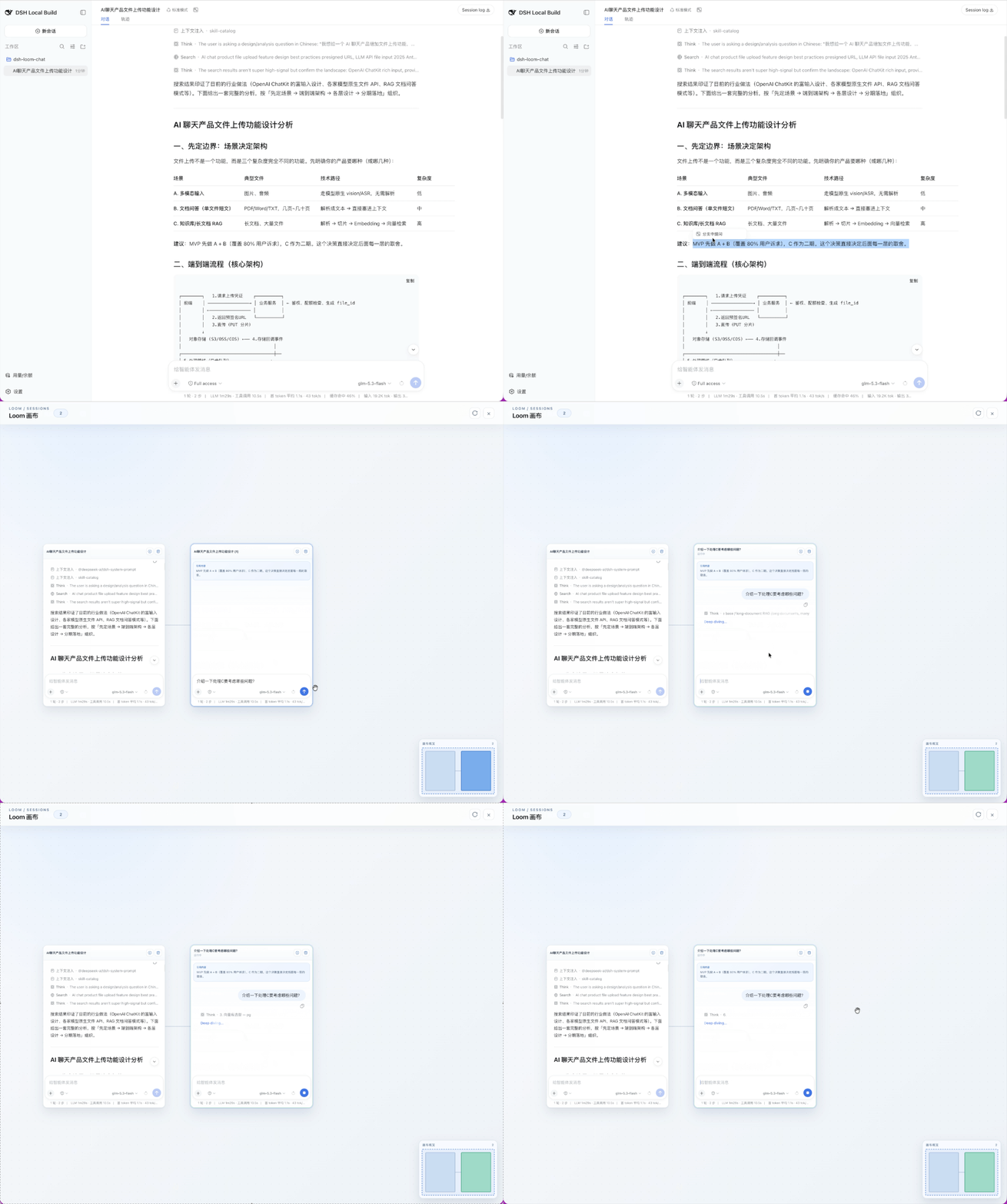
Opening the Loom canvas from a native session.
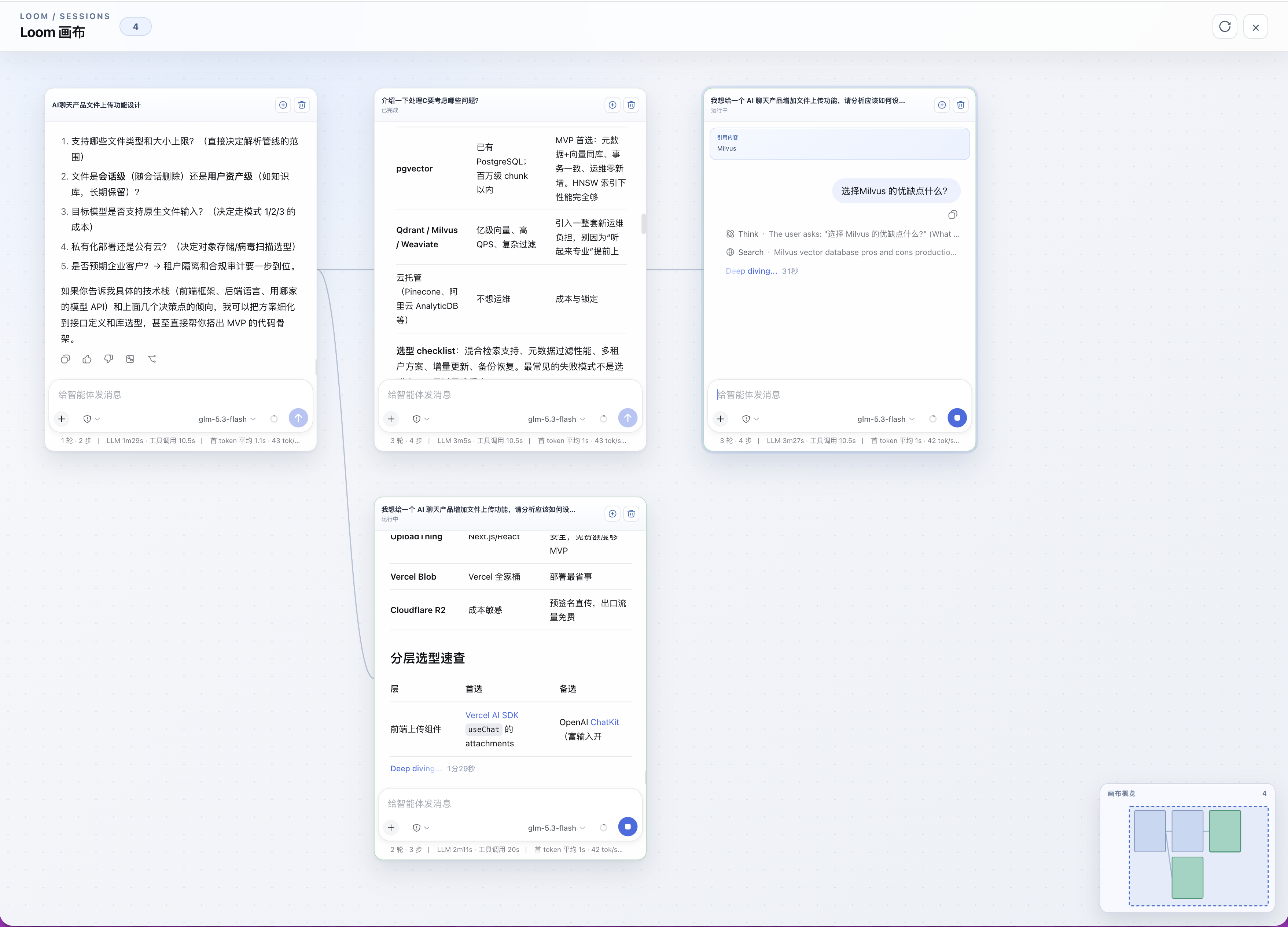
Viewing related but independent conversations together on one canvas.
Why “Loom”
“Loom” is a weaving machine. A conversation can be thought of as a thread of reasoning: it starts from a main session, branches into different directions, and unfolds in parallel on the same canvas. Loom Chat is named for the way it weaves those separate lines of exploration into a visible, extensible conversation network instead of flattening them into a single linear record.
Interaction model
- Canvas mode: the default view shows the complete tree containing the current session (parents, sibling branches, and descendants). The canvas supports pan, zoom, node selection, and branching from any window.
- Interactive windows: every visible session keeps its own projected transcript, draft, send action, stop action, and running/error state. Multiple sessions can run side by side without opening one over another. Deleting a window requires confirmation and archives its descendants together.
- Single-session mode: opening a node returns to DSH's native conversation surface, including the native composer, tools, attachments, Plan, model selection, and projections.
- Mode switching: clicking a window only selects it; the window's Chat action enters native focus mode. The native session header exposes a Loom entry action; returning to Canvas restores the selected node and the in-memory viewport for the current page.
- Unlimited depth: Canvas recursively derives lineage from each session's
parentIdwithout a branch-depth limit. - Navigation and performance: Entering Canvas locates the current session. The toolbar provides locate-current and reset controls. Subtrees can be collapsed, existing nodes keep their slots while messages, titles, or status change, and cold histories load on demand near the viewport or selected node while offscreen sessions use lightweight cards.
Context inheritance
Topic branching uses DSH sessions.fork({ sessionId, atSeq, increaseTitle }). A child inherits the durable session history through the fork boundary and is independent from its parent and siblings afterward. For a text-selection branch, the first submitted prompt also carries the selected excerpt in a structured reference block, so the model receives both the inherited history and the exact selected text. The plugin never copies rendered messages or synchronizes future messages automatically.
The fork boundary must be a stable completed-turn boundary. Running sessions are not clipped. Selection-branch presentation state is restored by child session ID after a page reload, so the reference card remains visible while inherited messages before the boundary stay hidden. Sessions with origin: 'subagent' are excluded from the ordinary Loom topic graph.
The first non-empty continuation prompt in a Loom child becomes its normalized title, truncated to 30 Unicode characters with an ellipsis when needed. This works with both the fallback plugin composer and the host full Composer by observing the first user node after the fork boundary. It uses the public session rename operation, makes no auxiliary model request, and does not rename the child again for later prompts.
Canvas windows use the public DSH session and per-session input faces. They are intentionally a compact interaction surface for parallel work; use single-session mode for the host's full composer features such as attachments, slash commands, model selection, and Plan controls.
Canvas keeps the complete relationship graph separate from its presentation: collapsing and releasing offscreen windows do not change durable parent-child relationships or recursive archive behavior. Running, focused, composing, or dirty-input windows stay protected and resume with the same session input when they return.
DSH plugin assembly
The host entry exports Cordis apply; the browser entry declares the Web platform, injected dependencies, and exports["./client"] through dsh.client. dsh.bundle.patch points to a top-level array cordis.patch.yml, allowing a profile to load the plugin as an optional bundle.
The plugin consumes only public DSH session, runtime, conversation, workspace, and UI slot capabilities. New host capabilities should be exposed by DSH as public slots or services before a plugin consumes them; the plugin does not import private host components.
For the minimal Cordis plugin structure, see Your first plugin. For browser bundle assembly, see Client Modules.
Host boundary
The plugin does not modify DSH's native sidebar, ui-workspace, or the main conversation renderer. Canvas uses the public session/runtime APIs and shell.overlay; when a detached window is cold, the plugin temporarily stages it through ctx.sessions.open() to hydrate public history, serializes those requests, and restores the user's previous current session. Canvas never calls private host renderers or a per-window session.open() method. Single-session mode returns control to the host with ctx.sessions.open().
Canvas deliberately does not promise the host's full Composer inside every window. Attachments, slash commands, model selection, Plan controls, and other host-specific controls remain available after opening a window in native single-session mode.
Privacy & permissions
Based on its current runtime code, Loom Chat:
- does not directly send data to third-party servers;
- does not read API keys or environment variables;
- does not execute shell commands;
- uses DSH's public session, runtime, conversation, workspace, and UI APIs;
- stores Loom branch presentation metadata, including derived titles and boundaries, in browser
localStorage; - can open, fork, rename, cancel, and archive DSH sessions when requested through the plugin UI.
Compatibility
- DSH Web profile with the public session, runtime, conversation, workspace, and UI slot APIs.
- DSH package line
0.1.x, tested against the aligned0.1.0-rc.7public package set; the peer dependency range is<0.2.0. - The plugin follows the DSH developer-preview APIs; compatibility can change as DSH evolves.
- Local development and package builds require Node.js
^22.19.0or>=24.0.0and pnpm11.7.0.
Local development
pnpm install
pnpm test
pnpm typecheck
pnpm build
pnpm pack --pack-destination ./.artifacts
Test a packed plugin in a temporary profile:
DSH_HOME=/tmp/dsh-loom-chat-profile \
  dsh plugin --profile web add "$PWD/.artifacts/dsh-loom-chat-0.1.0-rc.4.tgz"
Publishing
Maintainers publish releases to the latest channel:
npm login
npm whoami
pnpm test
pnpm typecheck
pnpm build
pnpm run pack:verify
pnpm publish --tag latest
The prepare script builds lib/ before publishing, and files limits the published package to the runtime, type declarations, DSH patch, documentation, and license.
Compatibility
Versions
| Latest version | Published | Size |
|---|---|---|
| 0.1.0-rc.1 | — | — |
| 0.1.0-rc.2 | — | — |
| 0.1.0-rc.3 | — | — |
| 0.1.0-rc.4 | — | — |
Comments
Loading…
Similar plugins
by supergameboy
dsh web conversation plugin: fold runtime activity into expandable boxes, chat bubbles, deep customization (fork of dsh-client-ui-conversation)
★ 0
JavaScript
Sep 10, 2026
dsh plugin --profile web add dsh-chat-focusby snail-vs
OAuth login plugin for DeepSeek Harness (DSH), enabling subscription LLM accounts such as ChatGPT Plus/Pro to work without API keys.
★ 0
MIT
TypeScript
Aug 22, 2026
dsh plugin --profile web add dsh-llm-oauthby MarkJun236
DSH Web GUI 普通对话插件:不绑工作区、不带工具,复用 ctx.llm 模型路由流式聊天,多会话历史本地持久化。
★ 4
↓ 760/wk
MIT
JavaScript
Aug 17, 2026
dsh plugin --profile web add dsh-chatMulti-provider LLM API balances under the chat input, with presets for DeepSeek, OpenRouter and SiliconFlow.
★ 0
dsh plugin --profile web add dsh-llm-balanceby lwklbb
A DSH Web plugin that turns chat sessions into editable mind maps, with Markdown, Mermaid, PlantUML, XMind text, and TODO exports.
★ 3
MIT
JavaScript
Aug 17, 2026
dsh plugin --profile web add dsh-sessiongraphby zjuatri
A DSH browser sidebar plugin with an isolated Chrome profile for every conversation, live interaction, and agent automation.
★ 0
JavaScript
Sep 11, 2026
dsh plugin --profile web add dsh-browser-plugin