

dsh-balance-hud
Manifest validBalance and per-session spend HUD for DeepSeek Harness, with budget alerts, peak-hour warnings and opt-in official price sync.
English | 简体中文
dsh-balance-hud
An always-on HUD in the bottom-right corner of the DSH (DeepSeek Harness) Web GUI that shows your DeepSeek account balance and the cost of the current session.
简体中文说明 · Design notes · 设计说明 · LICENSE
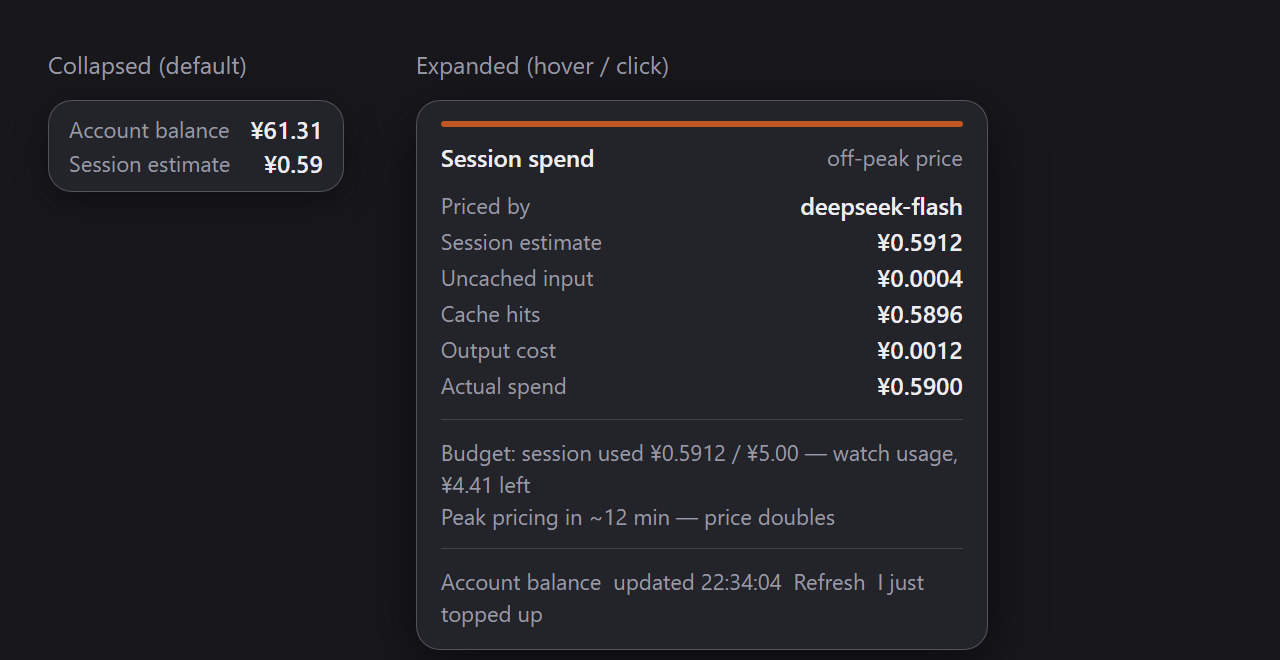
About these images: they are not photographs of a live DSH window. They are renders of the plugin's own layout and colours, driven by its real style values and real figures — a capture tool for the running GUI was not available when they were made. Treat them as a faithful layout reference, not as evidence of a running install. Pull requests replacing them with genuine screenshots are welcome.
- Account balance — recharge balance + bonus balance, read through the same service the
Settings → Account & balance page uses (
ctx.deepseekAccount.getBalance()). - Two cost figures — a token-based estimate from the official price table, and an actual figure accumulated from real balance decreases (external reductions excluded).
- External balance changes, both ways — a top-up raises the balance, and a lapsed bonus grant is reclaimed by the platform; money moving in or out externally never touches the spending counter.
- Per session — the tracker is keyed by session id; refreshing the page or switching sessions never damages or clobbers another session's record, because the read → modify → write round trip is lossless.
- No credentials, and no outbound network unless you opt in — the plugin never touches your API key. It reaches the network only after you turn price syncing on (see Prices and syncing); until then it makes zero external requests.
- Two halves, one relay — a browser half renders the HUD; a Host half exposes read-only loopback HTTP routes (balance, bonus signal, price sync, model list), so the browser itself never talks to anything but loopback.
- Configurable, and budgeted — a preference row in Settings → General sets the model, the poll intervals, the budgets and the warnings; the card gains a coloured edge as spending approaches a budget, and the panel counts down to the next peak/off-peak switch.
node tools/install.mjs    # install into ~/.dsh/profiles/desktop, then restart DSH
node tools/smoke.mjs      # offline smoke suite (83 assertions), no DSH install needed
The HUD
                                                        ┌──────────────────────────────┐
                                                        │  Balance             ¥43.42  │
                                                        │  Session est.         ¥0.59  │
                                                        └──────────────────────────────┘
Hovering the card expands a detail panel: balance rows (recharge / bonus / total), the three priced
components of the estimate, the actual figure, token counts, and — with parallel sessions — the
apportionment rows (Session share, Other sessions, Tracked sessions, Account total). The
panel uses 4 decimals; the card uses 2. The shipped labels are currently Chinese; the English names
here are what each row means.
| Field | Meaning |
|---|---|
| Balance | Total account balance (recharge + bonus), 2 decimals |
| Session est. | Estimate for the current session; 2 decimals on the card, 4 in the panel; — when the session has no token usage yet |
| Actual charged | Accumulated real spending for this session (single session; becomes Session share when parallel) |
Amounts below the smallest displayed unit render as <¥0.01 on the card and <¥0.0001 in the
panel, so real spending is never rounded down to a flat zero.
Interaction
- Hover the card and the detail panel expands; move away and it closes.
- The card and the panel are separate elements with an intentional 8 px gap between them, and the
pointer must be able to cross that gap without the panel closing. The hover decision is attached to
the card and the panel themselves — each has its own enter/leave handler — never to the enclosing
positioning container. A 140 ms pending-close timer carries the card's
mouseleaveacross the gap so the panel'smouseentercancels it. - Leaving the left edge of the card or the left edge of the panel closes the panel. This is deliberate: the container reserves extra space above and to the sides, so hanging the close behaviour on the container box would keep the panel open over dead space.
- Click the card to fold it down to a small corner badge showing 2 cells — label and balance; click again to restore it.
- Keyboard: the card is a
role="button"withtabIndex=0and toggles the fold onEnterandSpace. The panel is arole="dialog". - The panel header carries a Refresh button that immediately shows a busy label and then an
Updated at HH:MM:SStimestamp, plus the manual I just topped up button, which shows a querying state while it works. - There are deliberately no
titleattributes anywhere in the HUD. A native browser tooltip appears as an opaque black box about a second after hover and covers the panel, so the summary lives inaria-labelinstead — asserted by the smoke suite as a regression guard.
Settings
The plugin contributes one preference row — 余额与花费 HUD — to the DSH slot
settings.general.item, which DSH declares as "one preference row inside the General section — the
additive seat for a single setting that needs no page of its own" (a whole page is
settings.section; the same slot carries DSH's own Language, link-opening and performance-usage
rows). Find it at Settings → General → 余额与花费 HUD. It does not take over a whole settings
page.
| Setting | Values | Default | Effect |
|---|---|---|---|
Model (计价模型) | deepseek-flash, deepseek-v4-pro | deepseek-flash | Price table used for the estimate and the apportionment weights |
Price auto-sync interval (自动同步价格) | off / 6 h / 24 h / 3 d / 7 d | off | Auto-sync cadence for the official price table; nothing runs until you pick one (see Prices and syncing) |
Foreground poll interval (前台刷新间隔) | 30 / 60 / 120 / 300 s | 60 s | Balance poll cadence while the page is visible |
Hidden interval (后台(页面隐藏)) | 30 / 60 / 120 / 300 s | 300 s | Balance poll cadence while the page is hidden |
Peak-warning lead time (峰前提醒) | 5 / 10 / 15 / 30 min | 10 min | How early the peak/off-peak warning appears |
Session budget (本会话预算(元)) | CNY, 0 = unset | 0 | Budget for this session's estimated spend |
Daily budget (每日预算(元)) | CNY, 0 = unset | 0 | Budget for the Beijing-day confirmed spend |
Show account total row (显示账户级合计) | on / off | on | Account total row in the panel when parallel sessions exist |
Peak warnings (峰时提醒) | on / off | on | The peak/off-peak warning line in the panel |
System notification on budget breach (预算超限发系统通知) | on / off | off | Optional Notification when a budget level is first reached |
The shipped row is labelled in Chinese; the English names above are what each control means.
Persistence. The row writes the localStorage key dsh-balance-hud:settings:v1 — deliberately
separate from the accounting key (dsh-balance-hud:tracker:v4), so the two can never interfere.
Two registrations, one container. The settings row (settings.general.item) and the HUD overlay
(shell.overlay) are two independent slot registrations with no common React ancestor, so they
cannot share React state. They share a small subscription container instead —
createSettingsStore → get / set / subscribe: set merges a partial patch, persists it and
broadcasts, so editing in either place updates the other immediately — no reload, no shared parent.
useSettings is the React binding on top of the same container.
Dirty config is never trusted. normalizeSettings validates field by field against
whitelists: an unknown model, an interval outside the choices, a negative budget or a non-boolean
toggle falls back to the default rather than propagating into the UI. Corrupt JSON in localStorage
also falls back to defaults instead of throwing. The config is user-writable and version-dependent,
so it is re-validated on every read.
Budgets
Set a session budget and/or a daily budget (CNY; 0 means unset) in the settings row.
evaluateBudget(spent, budget) returns { level, ratio, remaining }, with level one of
none | warn | critical | over:
| Usage | Level |
|---|---|
| < 75 % | none |
| ≥ 75 % | warn |
| ≥ 90 % | critical |
| ≥ 100 % | over |
remaining is clamped at 0, so "over budget" never reports a negative remainder. worstBudgetLevel
then picks the more severe of the session and daily budgets, so an exhausted daily budget still warns
while the session itself is cheap.
Visual. When a budget is at or over a threshold the card gets a coloured 3 px left border —
warn / critical use the theme warning colour, over the error colour. It is deliberately not
an extra grid cell: the card grid must stay 2 columns × 2 rows, and the smoke suite pins that with
an assertion. The expanded panel adds a budget line showing spent / budget and either the remaining
amount or 已超限 (over budget).
Optional system notification. With system notification on budget breach enabled (off by
default), each level fires at most once per mount, so it cannot become a nag. It uses the browser
Notification API and only sends when permission has been granted; if it has not, the plugin silently
degrades to the coloured border only.
The daily budget uses a per-day ledger. The localStorage key dsh-balance-hud:daily:v1 holds
{ date, total }, where date is the Beijing calendar day (beijingDateKey) — the official
billing and peak windows are both Beijing-based, so the day boundary follows the same clock. It only
accumulates confirmed spend — the value a balance read confirmed as spending — never the
interpolated display value, so the same money cannot be counted twice. Reading on a new day resets it
to 0.
Peak-hour warnings
Peak windows are Beijing time Monday–Friday 09:00–12:00 and 14:00–18:00, and the peak price is
exactly 2× the off-peak price. minutesUntilTierChange(now) returns { minutes, to }, where to
is 'peak' (about to enter the expensive window) or 'off' (about to return to the cheap one).
The panel shows a warning line when the next tier change falls within the configured lead time:
约 N 分钟后进入峰时,价格翻倍— entering the peak window in about N minutes; the price doubles.约 N 分钟后回到闲时价— back to off-peak pricing in about N minutes.
A 60-second tick drives both the countdown and the daily rollover, so the numbers stay live while the page is open. The countdown is correct across the lunch break, overnight and weekends — e.g. Friday 18:30 → Monday 09:00 is 870 minutes — and the smoke suite asserts those cases.
The two cost figures
| Figure | How it is computed | Nature |
|---|---|---|
| Estimate | Session tokenUsage projection × the official price table | Exactly computable, but covers model tokens only |
| Actual | Accumulated sum of observed balance decreases classified as spending (drops beyond the token bound are external reductions and are excluded), stored per session in localStorage | What the platform really charged, but settled with a delay |
The estimate splits usage into four token classes — uncached input, cache hit, cache write and output — and prices each class with peak/off-peak rates. Cache writes are charged at the cache-miss rate, matching how the platform bills them. The actual figure is a counter, not a subtraction: every observed balance drop is added to the current session's counter, so neither a top-up nor an externally reclaimed bonus can disturb it.
Top-ups and other external balance changes
Principle: money entering or leaving the balance from outside changes the balance but must not change the spending counter.
The classifier applies the token-estimate upper bound in both directions rather than an arbitrary epsilon:
balance rise > total token estimate + 0.02  →  externally added money      (topup)
                                               top-up, bonus grant, billing correction
balance drop > total token estimate + 0.02  →  externally removed money    (expire)
                                               bonus expiry, refund reversal, billing correction
everything else                             →  ordinary spending, accumulate as usual
The platform can never have charged more than the tokens consumed are worth, so a bigger rise must have come from outside. Symmetrically, it cannot charge for tokens that were not consumed: a drop larger than the worth of every token spent in the window cannot have come from consumption either. The same bound therefore catches a bonus expiry as well, survives a "top-up and spending at the same time" event, and cannot be triggered by normal spending noise.
Why the reduction direction exists: bonus expiry. A bonus grant that lapses is reclaimed by the
platform, so the balance drops with no token consumption behind it. The previous implementation
classified every decrease as spending (if (delta < 0) return { kind: 'spend', amount: -delta }),
so a ¥5 bonus expiring was recorded as ¥5 of session spending — and because the counter only grows,
the error stayed in the record until the entry was pruned.
Both directions take the same code path (applyExternalChange): only the account-level bookmark
moves — every session's baseline and lastBalance — while spent is left untouched, and the
event is appended to the topups[] history carrying its kind ('topup' or 'expire'). Because
the balance is account-wide, one event re-anchors every session. The function deliberately never
touches lastRead — "the balance this session actually observed last" is session-private — so a
session that has not yet observed the change still sees the full drop on its next read and
classifies it as an external change instead of charging it to its own spending. Each session
self-heals, and the event is not double-counted because the session that triggered it already
advanced its own lastRead.
Three layers, in order of authority:
- The token-bound rule — pure client side, always active: the authority in both directions.
- Official bonus-grant confirmation —
GET /api/balance-hud/bonusesreadsctx.deepseekAccount.getUnnotifiedBonuses(). It is read-only and deliberately does not callackBonusNotified, so it never consumes DSH's own bonus notifications; the data stays readable and the client de-duplicates byorderId. This layer corroborates grants only: there is no official "expired" feed, which is exactly why the token bound has to be the authority in the reduction direction. If the route is unreachable a top-up is still detected — this layer is only corroboration.normalizeBonusesalso passesexpiresAtthrough (it is not what the accounting decision uses) so the notice can name the earliest lapse date. - A manual fallback — the I just topped up button takes the same re-anchor path and shows a "querying…" state while it re-anchors and queries the bonuses route.
Notices. An external change in either direction shows a one-line notice in the panel for about 12 seconds:
- a top-up:
已识别充值 ¥50.00,花费继续累计(官方赠金 ¥5.00 印证),最早到期 2025-12-31。— "recognised a ¥50.00 top-up; spending keeps accumulating (corroborated by an official ¥5.00 bonus); earliest expiry 2025-12-31". The earliest bonusexpiresAtis appended only when the bonuses route confirms a grant. - an external reduction:
检测到 ¥5.00 非消费性扣减(赠金过期回收等),未计入花费。— "detected a ¥5.00 non-consumption deduction (e.g. a bonus expiry being reclaimed); not counted as spending". It is stated explicitly because the money left the balance without appearing in any counter.
Parallel sessions and apportionment
The account balance is account-level: it does not say which session spent it, so the real cost of one session is not observable locally. The plugin apportions it:
session share = session accumulated spend × (session token cost / all sessions' token cost)
Token costs use the same four-class, peak/off-peak pricing for every session, so the weights are comparable. With a single session the weight is exactly 1 and the value degrades to the exact figure.
This is an estimate. Two sessions do not consume tokens in lockstep with the platform's
settlement, so the ratio drifts; when a new session joins the denominator the number steps down
once. The panel shows Session share, Other sessions and Tracked sessions so you can see what
the weight was.
Persistence
Records live in localStorage under dsh-balance-hud:tracker:v4, keyed by session id:
{ "sessions": { "<session id>": { "baseline": 43.42, "lastBalance": 43.12, "lastRead": 43.12, "spent": 0.3, "ts": 0 } } }
| Situation | Behaviour |
|---|---|
| Page refresh / remount | Read back from localStorage, counter keeps accumulating |
| Switching sessions | Each session has its own record; checkoutSession merges into it rather than rebuilding it, so baseline, lastRead, lastBalance and spent survive the switch |
| External change detected (top-up or reclaimed bonus) | Only the baseline moves; spent is untouched |
| Older than 30 days, or more than 30 sessions | Pruned on write; the 30 most recent records are kept |
localStorage unavailable | Degrades to memory-only; the HUD still works |
The in-memory store also carries a topups[] history and a lastObservedBalance while the page
lives; the current writer persists only sessions. Within a record, lastRead is the
session-private "balance this session actually observed last" and is the preferred comparison point
on the next read; lastBalance, baseline and the shared lastObservedBalance are only fallbacks
for records migrated from older versions that predate lastRead. Old data is migrated automatically
— v3 was { sessions: { … } }, v2 a flat { [sessionId]: { … } } dictionary, v1 a single
{ sessionId, … } record — and the legacy key is removed afterwards.
The balance is polled every 60 seconds (every 5 minutes while the page is hidden) by default, refetched immediately when the page becomes visible, and retried on failure with a 1s → 2s → 5s → 10s → 20s backoff. Not being logged in is not an error and does not trigger the fast retry. Both intervals are configurable in the settings row (see Settings).
Three more keys exist alongside the accounting one, and they are independent of it:
dsh-balance-hud:settings:v1 (the preference row, see Settings),
dsh-balance-hud:daily:v1 (the Beijing-day ledger, see Budgets) and
dsh-balance-hud:prices:v1 (the synced price table plus its validators, see
Prices and syncing). Clearing or corrupting one never affects the others.
Architecture
browser (client half, lib/client.js)          host (Host half, lib/index.js)
  registers the `shell.overlay` slot            inject: [deepseekAccount, webServer]
  polls every 60 s                              │
  fetch ──────────────────────────────────────► GET /api/balance-hud/balance   (read-only)
                                                GET /api/balance-hud/bonuses   (read-only)
                                                GET /api/balance-hud/pricing   (price sync, opt-in)
                                                GET /api/balance-hud/models    (model list, loopback only)
                                                └─► ctx.deepseekAccount.getBalance()
                                                    ctx.deepseekAccount.getUnnotifiedBonuses()
                                                      └─► official account platform
                                                    fetch(PRICING_DOC_URL)   ← opt-in sync only
                                                      └─► official pricing docs
Why the relay exists. The browser half cannot call ctx.remote.account.getBalance directly:
accessing it without declaring it throws
cannot get property "remote.account" without inject, and declaring inject = ["remote"] on the
client half cannot be satisfied — the fiber hangs forever and the plugin never activates. Both were
reproduced against real @deepseek-ai/cordis 4.0.4, so the Host half reads the balance and hands it
to the browser over a loopback-only, read-only route. All routes accept loopback sources only
(127.0.0.1, ::1, IPv4-mapped loopback forms) and answer 403 to anything else; they are
GET-only, never mutate state, never return credentials, and send cache-control: no-store. One of
them can cause an outbound request — the opt-in price sync — and only once the user has asked for it.
| Payload | Meaning | HUD shows |
|---|---|---|
{ kind: 'ready', currency, rechargeTotal, bonusTotal, total } | Logged in, wallets available | ¥xx.xx |
{ kind: 'unavailable', reason } | Not logged in / credentials changed mid-query | not logged in |
{ kind: 'error', reason } | Query failed, route unreachable, response malformed | read failed (reason in the panel) |
Pricing
CNY per million tokens, from the official models & pricing page; off-peak is exactly half of peak.
| Model | Cache hit | Cache miss | Output |
|---|---|---|---|
deepseek-flash | off 0.02 / peak 0.04 | off 1 / peak 2 | off 4 / peak 8 |
deepseek-v4-pro | off 0.15 / peak 0.30 | off 4.5 / peak 9 | off 13.5 / peak 27 |
- Peak = Beijing time Monday–Friday 09:00–12:00 and 14:00–18:00. Everything else (including weekends and public holidays) is off-peak; the conversion uses only the local weekday and hour, with no timezone library.
- Cache writes are billed at the cache-miss input rate.
- The price table holds both models; the model is a setting (default
deepseek-flash), so the estimate and the apportionment weights follow your choice. Unknown models fall back to flash prices rather than to zero, and the panel says so. After an official price change you can sync the table (see Prices and syncing) or editPRICESand refresh the page. - The table above is the built-in snapshot, dated 2026-09-29 (
BUILTIN_PRICES_DATE). Once you have synced, the newer official table is used instead.
Prices and syncing
The estimate is priced from a table that ships inside the plugin. That table is a dated snapshot (the built-in table's date is 2026-09-29), and it stays in use unless you ask the plugin to do otherwise. DeepSeek can change prices at any time, so the plugin can also sync the official price table from the official pricing page — the only external host it ever contacts.
Two ways to trigger a sync, both deliberate:
- the
Sync prices(同步价格) button in the settings row, which syncs once, immediately; - the auto-sync interval (
自动同步价格), whose options areoff/6 h/24 h/3 d/7 d(不自动(只手动)/每 6 小时/每 1 天/每 3 天/每 7 天). Auto-sync does not run until you pick an interval. The shipped state isoff(syncHours: 0): install the plugin and never touch these controls, and it still makes zero external requests. Once you turn auto-sync on, 24 h is the default cadence (DEFAULT_SYNC_HOURS) — because DeepSeek announces price changes in its changelog before the pricing page changes, so this is a months-scale event, not a daily one. The page is a CDN asset that sendsETagandLast-Modified, and the sync sendsIf-None-Match, so an unchanged page answers304 Not Modifiedwith no body — a few hundred bytes per poll. A 24 h cadence bounds the staleness window to a day at almost no cost.
The Host half performs the fetch, not the browser. The browser never talks to the pricing host.
It calls two further read-only loopback routes: GET /api/balance-hud/pricing (sync prices) and
GET /api/balance-hud/models (the models DSH has registered). Only the first one can cause an
outbound request; the second needs no network at all, because it reads DSH's own llm service
(listProviders() / listModels()). The settings row uses that catalog to fill the pricing-model
dropdown, falling back to the built-in choices if llm is unavailable.
A wrong table is worse than an old one. The page is parsed by a pure function that makes every judgement independently of the page's encoding (the fetch path can hand back UTF-8 bytes decoded as Latin-1, which turns the Chinese labels into mojibake) and that validates semantically: the official rule is "off-peak = half of peak", so the peak price must be strictly greater than the off-peak price. If anything fails validation the sync is rejected wholesale, and the plugin keeps the last good table — built-in or previously synced. A half-parsed table is never used to compute money.
Where it is stored, and what the row tells you. A synced table is cached in localStorage under
dsh-balance-hud:prices:v1, together with the ETag, the Last-Modified value and a capture
timestamp; a 304 refreshes the check time without touching the table. The settings row shows
which source is in use and from what date — 当前价格:内置表(2026-09-29), or
当前价格:已同步(YYYY-MM-DD) after a successful sync.
Install
This is a local profile plugin; nothing is published to npm.
node tools/install.mjs                     # install into ~/.dsh/profiles/desktop
node tools/install.mjs --dry-run           # preview, write nothing
node tools/install.mjs --uninstall         # remove it again
By hand, installing means placing the directory at
~/.dsh/profiles/<profile>/plugins/dsh-balance-hud (the client bundle is served from the profile,
so it must really live there), adding "dsh-balance-hud": "file:./plugins/dsh-balance-hud" to the
profile's dependencies plus "dsh-balance-hud" to its dsh.profile.bundles, linking it into the
profile's node_modules (a junction on Windows, a symlink elsewhere), and restarting DSH.
Gotcha: the profile
package.jsonmust not have a UTF-8 BOM. With a BOM the plugin manager fails withUnexpected token '\ufeff'.tools/install.mjsrewrites the manifest without a BOM and keeps apackage.json.bak-balance-hudbackup.
Changing the client half (lib/client.js) needs only a page refresh. Changing the Host
half (lib/index.js, e.g. the bonuses route or the price-sync fetch) needs a DSH restart, because
profile bundles are not hot-loaded.
Development
node tools/smoke.mjs                      # offline smoke suite, no DSH install needed
node tools/verify-install.mjs --package   # packaging self-check, no DSH install needed
node tools/verify-install.mjs             # verify a real installation
tools/smoke.mjs evaluates the real lib/client.js against a fake React runtime, fake host
responses, a fake localStorage and a fake document, then drives the component through its hook
cycle. It prints one ✓ line per check (83 in total) and exits non-zero on the first failure,
covering module/slot registration, the card layout, hover and fold interaction, the balance
protocol and every route failure mode, pricing arithmetic, display precision, the external-change
classifier (top-ups and bonus expiry), persistence and the migration chain, and
visibility-driven refetch. The A1–A3 features have their own guards: the two slot registrations
(the overlay and the settings row), settings defaults, the field-by-field sanitising of dirty
config, the persistence round trip, container broadcast with partial merge and unsubscribe, the
corrupt-config fallback, the four budget levels with clamping, most-severe-of-two selection, the
daily ledger (accumulate / ignore 0 and negatives / cross-day reset / corrupt fallback), and the peak
countdown across peak, off-peak, lunch break and weekend. The price-sync guards are there too: the
parser against a fixed copy of the real page and against a mojibake (UTF-8 read as Latin-1) copy, a
wholesale rejection when the page is malformed or the tiers are inverted, resolvePrices provenance,
the cache round trip preserving the conditional-request validators, and the opt-in default — an illegal
interval sanitises to off, 24 h is the default interval, and nothing runs until the user acts. One
persistence guard is the lossless round trip: switching sessions through checkoutSession must leave
baseline / lastRead / lastBalance / spent untouched, and the persisted blob must contain no
undefined field.
CI (.github/workflows/ci.yml) runs both offline scripts — node tools/smoke.mjs and
node tools/verify-install.mjs --package — on ubuntu, windows and macos with Node 20. Neither
script needs a DSH install, network access or a build step, so the matrix runs in clean containers and
proves that line endings (.gitattributes pins LF), path derivation and import.meta usage do not
depend on Windows.
It does not cover the Host half (lib/index.js is never loaded — so the loopback filter, the
outbound price fetch, its If-None-Match/304 path and the model-list route have no offline test), a
real browser, real Cordis injection, or the real platform. lib/client.js is a hand-written CJS-style
bundle in the official window.__ModuleLoader__.load({ id, factory }) format, so there is no build
step.
| File | Role |
|---|---|
package.json + cordis.patch.yml | Declare dsh.bundle.patch and dsh.client (platform: web, exports ./client), and insert the plugin into the profile entry tree |
lib/index.js | Host half: the read-only loopback routes (balance, bonus signal, opt-in price sync, model list) |
lib/client.js | Browser half: the shell.overlay HUD, the settings.general.item row, the price-table parser and all of the accounting |
tools/ | Installer, installation verifier, offline smoke suite |
.github/workflows/ci.yml | Offline smoke suite + packaging self-check on ubuntu / windows / macos |
docs/DESIGN.md | Contributor design note — the accounting model in full (简体中文) |
Privacy and security
- Default: zero external requests. Installing the plugin and never touching the price-sync
controls adds only loopback HTTP to
/api/balance-hud/…. The plugin uses its built-in price table and contacts no third party at all. - The one exception is opt-in price syncing. Only after you click
Sync pricesor deliberately select an auto-sync interval does the plugin additionally fetchhttps://api-docs.deepseek.com/zh-cn/quick_start/pricing— the official, public pricing documentation page — on the schedule you chose. That is the only external host involved, and the Host half performs the fetch, not the browser (see Architecture). - What is not sent, ever: no credentials, no API key, no account id, no session data, no cookies,
and no query parameters identifying you. It is a plain
GETof a public documentation page; syncing neither reads nor transmits your balance. - The official API key is never touched by this plugin. For account data the Host half only calls
getBalanceandgetUnnotifiedBonuses; it never callsresolveTokenorgetPlatformSession, so credentials stay inside@deepseek-ai/dsh-deepseek-account-platform. - No secrets, tokens or account ids are stored in the repository, in
localStorage, or in the HUD. The synced-price cache (dsh-balance-hud:prices:v1) holds prices, the HTTP validators and a timestamp — no account data. - The balance, bonuses and model-list routes stay loopback-only and read-only: they reject
non-loopback callers with
403and return balance numbers or registered model names only. The plugin's platform calls go through the account service DSH already uses. - The bonuses route is read-only and non-acking, so it cannot swallow DSH's own bonus notifications.
Limitations
- The estimate covers model tokens only. Any non-token billing item (plugins, retrieval, …) would make it too low.
- The price table is a dated snapshot. If you never sync and DeepSeek changes prices, the estimate
keeps using the built-in 2026-09-29 table until you sync, or edit
PRICESand refresh. The parser reads the current page structure, so a documentation redesign can make a parse fail — in that case the sync is rejected and the last good table is kept, so the estimate goes stale rather than wrong. - Apportionment is an estimate, and sessions whose usage projection is not reachable weigh 0 in the denominator, which can skew the share.
- The platform settles with a delay. Right after a run the actual figure may still sit at its old value while the estimate has already moved; the two converge over tens of seconds.
- The first baseline is captured slightly after the session starts, so earlier spending is covered by the token estimate instead.
- A partial bonus expiry can still be misread as spending. The token estimate is an upper bound,
so if the reclaimed amount happens to fall within the estimate for that window the drop looks like
ordinary spending. Eliminating that needs per-wallet expiry breakdowns, but
getBalance()returnsAccountWalletas{ currency, balance }only — no expiry data — so the error is bounded by the token estimate rather than removed. In the other direction, if the token estimate is unavailable and treated as0, the bound is tight and real spending in that interval could be misread as an external reduction; in practice the estimate is available because the usage projection is polled every 5 seconds. - The account-level figure is a reference only, not a per-session number.
- Not logged in is a normal state: the card says so and the HUD recovers on the next poll after you sign in.
License
MIT. See LICENSE.
Comments
Loading…