
dsh-context-decay
Manifest validModel-driven, lossy context decay for DeepSeek Harness. Requires a patched DSH host; not a drop-in plugin.
dsh-context-decay
Model-driven, lossy context decay for DeepSeek Harness.
The model decides when and what to compress. Finished spans are replaced by self-written summaries; the current turn is always kept. There is no recovery: the summary is the only surviving record.
Install note: This is a manual-install plugin: it requires a DSH checkout with the
modelMessageDecorationseam and is not a drop-in plugin-market bundle (see Requirements).
What it does
- Inline position anchors. Every model-addressable message with a visible
text block is prefixed with
⟦p<number>⟧; tool-call-only assistant turns are unanchored by design. Compression ranges use those anchors directly:⟦p<from>⟧ summary ⟦p<to>⟧. Anchors are presentation, never part of the content. - Copied anchors removed. If the model starts a reply with one or more anchors, the leading run is stripped at the request boundary and again before the reply is committed, so the transcript and later requests stay clean.
- Model-selected spans. The model calls
compresswith one or more half-open ranges and writes each summary itself. No extra summarizer request. Split around content that must stay live; pass all consumed spans in one call so the prefix is not invalidated repeatedly. - Lossy by design. Compressed content is gone. There is no
decompress, no original-text search, and no external table. The summary must be self-contained. - Tool results are compressible. All results of one assistant tool-call message must stay in the same span. A boundary inside that group is rejected; the plugin never silently widens a span.
- Current turn protection. The active turn and its tool results cannot be
compressed. If the turn starts with unanchored system/runtime messages, a
toboundary at its first visible anchor keeps those messages and compresses only the history before the turn;"end"remains the end-of-compressible-history sentinel. - Tiered re-compression. Compressing a live summary block again produces a
tier-2 summary; larger merges increase the tier.
dropremoves a block completely with no tombstone. - Pressure without automation. The plugin reports context pressure and injects a reminder on each growth step; the reminder level follows the current pressure band, and the critical band uses a shorter step. It never compresses automatically; the model decides.
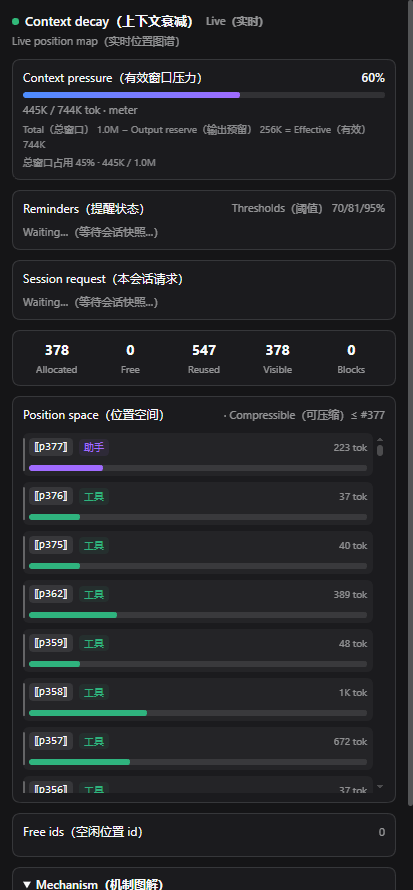
- Live panel + audit. A sidebar panel shows pressure, blocks, positions, request counts, and the reminder ledger. An optional JSONL audit records each request and compression.
Requirements
- DeepSeek Harness 0.2.1-rc.2 with the local host patch in
patches/dsh-model-message-decoration.patchapplied. Stock DSH does not expose the decoration seam; there is no runtime fallback. Installation alone is not enough: rebuild the host after patching. - Node.js >= 22.19.
- A web profile. The client half needs the sidebar/session/locale UI packages
listed in
package.json. - The bundle patch disables official automatic compaction
(
compaction-basic.auto: false), keeps the manual/compactcommand, and disables the in-place surface rewriters (tool-result-pruner,image-offload) when those rows exist./compactremains an emergency host fallback; its checkpoint is not a context-decay block.
Install
Manual patched install:
# 1. Apply the host patch to a DSH checkout and rebuild the host.
git -C /path/to/deepseek-harness apply /path/to/dsh-context-decay/patches/dsh-model-message-decoration.patch
pnpm -C /path/to/deepseek-harness install
pnpm -C /path/to/deepseek-harness build

# 2. Install this plugin into a profile (checkout or tarball).
dsh plugin --profile web add /path/to/dsh-context-decay
# or: dsh plugin --profile web add ./dsh-context-decay-0.1.0.tgz

# 3. Restart the web server and open the profile.
dsh web --profile web
See docs/INSTALL.md for the full patched-checkout workflow,
Windows commands, verification, updating, and rollback.
Tools
| Tool | Purpose |
|---|---|
compress({spans:[{from,to,summary,topic?}]}) | Replace one or more half-open ranges with self-written summaries. from/to are visible anchor texts such as "⟦p12⟧" (bare "p12" and integer 12 also work); to may also be "end". Several non-overlapping spans per call are allowed. Tool-group edges are rejected. |
drop({from,to}) | Remove exactly one live summary block. Use the block's printed anchor pair; "end" is allowed for a tail block. No tombstone, no recovery. |
A live summary block prints its pair inline as ⟦p<from>⟧ summary ⟦p<to>⟧; use that
pair for drop. The sidebar panel shows pressure and the block ledger, so no
extra status tool is needed.
Examples:
# one span
compress({spans:[{from:"⟦p4⟧", to:"⟦p9⟧", summary:"Read the three requirements files; constraints are ..."}]})

# two non-overlapping spans in one call
compress({spans:[
  {from:"⟦p4⟧", to:"⟦p9⟧", summary:"Read the requirements; constraints are ..."},
  {from:"⟦p9⟧", to:"end", summary:"Implemented the parser and tests; ..."}
]})

# drop one live summary block
drop({from:"⟦p4⟧", to:"⟦p9⟧"})
The anchor ids above are illustrative; use anchors visible in the current session.
Configuration
| Key | Default | Meaning |
|---|---|---|
enabled | true | Enable the plugin. |
contextWindowTokens | route value | Override the total context window. |
reservedOutputTokens | route value | Override the reserved output budget. |
defaultContextWindowTokens | 128000 | Fallback when the route has no window. |
growthTokens | 20000 | Periodic reminder step below the critical band. |
criticalGrowthTokens | 10000 | Shorter periodic reminder step while at the highest warning level. |
warnRatios | [0.70, 0.81, 0.95] | Warning levels as fractions of the effective window; the reminder level follows the current band. |
reminderCooldownTurns | 1 | Minimum turns between normal reminders; warnings are not delayed. |
maxSpansPerCall | 8 | Maximum spans in one compress call. |
minSummaryChars | 20 | Minimum summary length. |
maxSummaryChars | 8000 | Maximum summary length. |
maxMissTokens | null | Optional one-time miss guard. |
maxPaybackRequests | null | Optional payback guard. |
audit | false | Write request/compression audit JSONL. |
debug | false | Verbose plugin logging. |
The effective window is total window - reserved output. The model sees
pressure as a fraction of the effective window. The panel labels that percentage
as effective pressure, shows the total and reservation, and adds a total-window
occupancy line for direct comparison with the built-in context meter. Pressure,
reminder, and request facts are kept per session, so switching sessions updates
the panel.
How it works
The host patch adds a modelMessageDecoration service. The plugin registers a
decoration provider that prefixes the messages selected by the replay state;
the agent loop, token meter, and request payload all apply the same decoration.
Positions come from the replayed surface, not from message text. Compressions
append compaction/start, compaction/summary, a replacement user message, and
compaction/end; replay rebuilds blocks, tiers, and the free list.
See docs/ARCHITECTURE.md for the state model,
invariants, and failure modes.
See docs/PROMPTS.zh-CN.md for a Chinese translation of
the model-facing prompts, tool descriptions, reminders, and error copy.
Limitations and non-goals
- No recovery. There is no decompress, search, or spill archive. This is deliberate; it is also the main trade-off.
- Requires a patched host. The decoration seam is not upstream. Without it the plugin cannot safely present anchors or replay positions.
- No automatic compression. Reminders are advisory. A model may ignore them;
the budget stays protected by the request guard, not by silent compaction.
The official automatic policy is off; manual
/compactremains available. /compactis a manual fallback. It runs the official backend and writes an official checkpoint, not a context-decay tier block. Use it only when a session is already too large for a normal request.- Manual install, not a market bundle. A market index cannot express the
host-patch requirement, and
engines.dshcannot distinguish a patched host from a stock one. Distribute the checkout or tarball with the patch instructions until the seam is upstream. - One compression backend per profile. Do not run another compaction backend or an in-place surface rewriter alongside it.
- Replay depends on the current event format. Compression replay uses the
current
surfaceOpand compaction event shape.
Development
npm install          # if building outside a DSH checkout
npm run build        # src/ -> lib/ (JS + declarations), client/ -> lib/client.js
npm run check        # typecheck only
npm test             # node:test suite against lib/
Local development can reuse a DSH checkout's TypeScript: set
DSH_HARNESS_ROOT or place the checkout next to this package.
License
MIT. See LICENSE.
Comments
Loading…