

fast-compaction-dsh
Manifest valid★ 4Verdict-based context compaction for DeepSeek Harness — replaces lossy LLM summaries with fast keep/truncate/drop decisions from jev-latest; everything kept stays verbatim. Port of tamaratran/fast-jev-compaction.
fast-compaction-dsh
English | 中文
Verdict-based context compaction for DeepSeek Harness (DSH). Replaces the lossy compaction summary with fast per-call keep/truncate/drop decisions from jev-latest — everything kept stays verbatim, nothing is ever rewritten.
A DSH port of tamaratran/fast-jev-compaction (MIT), adapted to the DSH compaction capability seam.
What and why
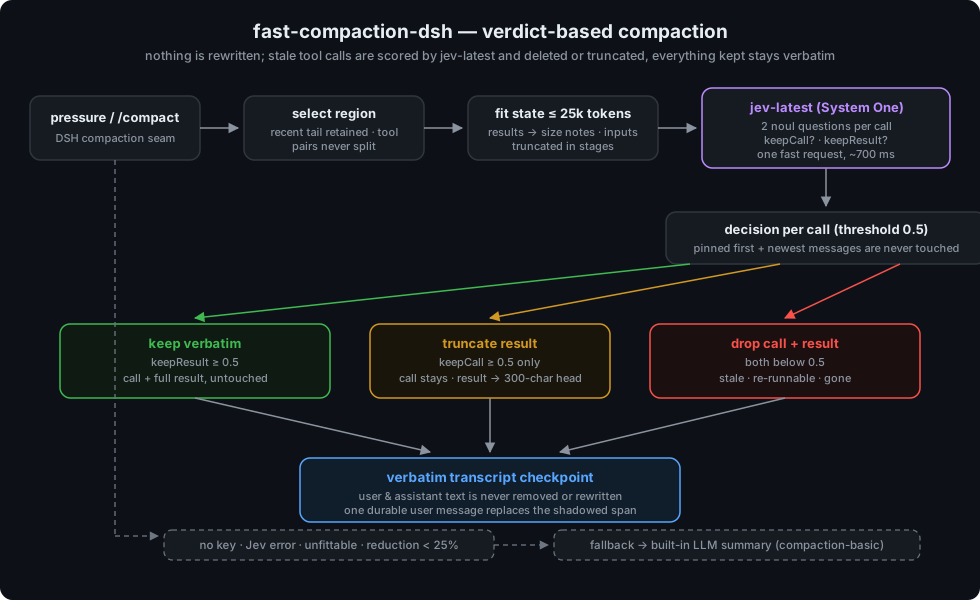
Most context compaction asks an LLM to summarize old turns. A summary is lossy: a file path, an exact error, a constraint, or a command can disappear even when it matters later. This plugin never rewrites anything. When compaction triggers, every tool call and tool result in the compacted region is scored by jev-latest through the TypeSafe System One endpoint; stale calls are deleted, half-stale results are truncated to a bounded head, and everything else stays byte-for-byte. User and assistant text is never removed.
On any failure — a missing TYPESAFE_API_KEY, a Jev error, malformed answers, an unfittable history, or an insufficient reduction — it falls back to the shipped compaction-basic summarizer, exactly like the original Claude Code hook falls back to Claude Code's built-in summary.
How it works
- Every
tool-callis paired with itstool-resultby call id. Calls in the first message and the newestpreserveRecentMessages(default 6) messages are pinned and never touched. - The state sent to Jev is the whole compacted region, oldest first, with every tool result replaced by a short note (
ok, 4213 chars (omitted)). Tool inputs and texts are included — nothing is summarized. - The state is fitted into
maxStateTokens(25k default) in stages: tool inputs truncated 1000 → 200 → 60 chars; long texts abridged to head + tail, oldest non-pinned first; old messages collapsed to a note; old calls reduced to one line each; old call-less messages left out; runs of call-only messages folded. If it still does not fit, the plugin falls back. - For every non-pinned call Jev gets two
noulquestions: should the call stay (knowing it was made, with its input, still matters), and should the result stay verbatim (its contents are still needed and re-running the tool would not do). - Questions are batched so state plus questions stays under
maxRequestTokens(30k default); batches run concurrently and answers are merged. - Decisions against
keepThreshold(default 0.5):keepResult≥ threshold → keep both verbatim; elsekeepCall≥ threshold → keep the call, truncate the result to its firsttruncateHeadChars(default 300) characters plus a note; else → drop the call together with its result. - The region is rebuilt as a verbatim transcript checkpoint (the DSH seam replaces the shadowed surface span with one durable user message), with role labels and the kept tool activity inline.
Measured on a real region: the Jev scoring round-trip takes ~700 ms.
How it plugs into DSH
DSH exposes compaction as a capability seam: ctx.compaction (service definition), an engine provider (compaction-basic), and the /compact consumer. The engine's single documented customization hook is summarize() — this plugin subclasses BasicCompactionEngine and overrides only that hook, so region selection, the durable transaction (lock, events, stability checks, shrink validation), checkpoint framing, and /compact keep working unchanged.
The shipped standard agent preset mounts compaction-basic inside an isolated compaction realm, so the engine row must be mounted from an agent preset patch — not from a profile-level cordis.patch.yml:
# ~/.dsh/.agent-presets/fast/agent.cordis.yml
- id: standard
  name: cordis:include
  config:
    path: 'file:///path/to/deepseek-harness/packages/preset/agent-presets/presets/standard/agent.cordis.yml'
    patches:
      - id: compaction-basic
        disabled: true
      - id: compaction
        insert:
          - id: fast-compaction
            name: 'file:///path/to/fast-compaction-dsh/src/index.ts'
            # config: { keepThreshold: 0.5, ... }   # all optional
Then point your default preset at it in ~/.dsh/cordis.patch.yml:
- id: agent-presets
  config:
    default: fast
Restart DSH. New sessions compact through jev-latest; watch the log for fast-compaction-dsh: kept N/M calls verbatim (…).
The same package also ships the Web settings card for that engine (the fast-compaction-dsh/web and fast-compaction-dsh/client entries under web/). To get the card, add the package to the web profile and enable the bundle, then restart:
// ~/.dsh/profiles/web/package.json
"dependencies": { "fast-compaction-dsh": "link:/path/to/fast-compaction-dsh" },
"dsh": { "profile": { "bundles": [ ..., "fast-compaction-dsh" ] } }
The bundle patch only mounts the settings-namespace entry in the web profile; the engine keeps being mounted by the agent preset above, and the web profile never loads src/index.ts.
Seeing the effect
No command line needed — the GUI has two layers, plus two optional channels:
-
Chat marker: after a compaction, the chat shows an expandable marker (
N items · M tokens); expanding it shows the verbatim transcript the model now sees, with[fast-compaction-dsh truncated …]notes where results were cut. -
Trajectory tab (the verdict details live here): switch the session view to the Trajectory tab → find the
Compactiongroup → click the compacted cell. The inspector has two tabs:- Summary: the rebuilt transcript (the context the model now sees), rendered as Markdown;
- Raw Output: block 1 is a readable verdict report this plugin emits (stats header + an aligned table of each tool call's
keepCall/keepResultprobabilities and final action), block 2 is the raw{decisions, stats, stateStage}JSON.
-
Inspector script (offline, read-only — handy for a cross-session overview):
pnpm run inspect:compaction          # sessions for the current directory
pnpm run inspect:compaction -- --all # every workspace
Renders each compaction's stats and per-call verdict table (parsed from the JSON block of the
compaction/summaryevent'srawOutput).--jsonfor machine-readable output. -
Service log:
journalctl -u deepseek-harness.service | grep fast-compaction— one summary line per verdict pass, plus fallback warnings.
No compaction yet? Run /compact in a session on the fast preset, or lower thresholdRatio in the preset config.
Requirements
- Node.js ≥ 22.19 (the plugin is TypeScript loaded directly by DSH's loader via type stripping).
- A DeepSeek Harness checkout (developer preview) — for development and for the
link:dev dependencies, clone it as a sibling directory of this repo (or adjust thelink:paths inpackage.json). - A TypeSafe API key:
export TYPESAFE_API_KEY=...in the DSH process environment (orapiKeyin the preset row'sconfig). Without a key the plugin behaves exactly likecompaction-basic.
Configuration
All fields are optional and stack in two layers:
- The settings.yaml user layer (the
fast-compaction:section of~/.dsh/settings.yaml) — wins per field and applies live to subsequent compactions: the engine watches the settings service's hot-publish and rebuilds the Jev transport in place whenapiKey/model/baseUrlchange, so no restart is needed. The friendly editor is this package's own Web settings card (web/, thefast-compaction-dsh/cliententry) on the Plugins page (apiKeyrides as asecretrole field — only a set/unset flag ever crosses the wire). - The preset patch
config:(composition layer) — the per-preset base values; changes require a DSH restart.
Per-field precedence: settings.yaml user layer > preset config: > environment (apiKey only, via TYPESAFE_API_KEY) > code defaults. Unlisted fields pass through to compaction-basic (thresholdRatio, retainRatio, retainTokens, summarizationProvider, summarizationModel, maxTokens, compactionRetries, maxOverflowRetries, modelPolicies, auto).
Note: a settings section whose values fail the schema (e.g. a string in keepThreshold) disables the whole settings layer and falls back to the composition layer, with a warning in the log; the layer retries on the next process start.
| Field | Default | Meaning |
|---|---|---|
apiKey | TYPESAFE_API_KEY | TypeSafe API key |
model | jev-latest | Jev model name |
baseUrl | https://api.typesafe.ai/v1/systemone | System One endpoint |
keepThreshold | 0.5 | Minimum keep probability for a call or result to stay |
preserveRecentMessages | 6 | Newest messages never touched (the first is always kept) |
maxStateTokens | 25000 | Estimated token ceiling for the state |
maxRequestTokens | 30000 | Estimated ceiling for state plus one batch of questions |
truncateHeadChars | 300 | Characters of a dropped tool result retained before its note |
minReduction | 0.25 | Fall back to the built-in summary below this reduction ratio |
disabled | false | Use only the built-in summarizer |
Differences from fast-jev-compaction
- The original rewrites Claude Code's message list in place. The DSH seam replaces the shadowed surface span with one user message, so the kept content is rebuilt as a verbatim transcript with role labels (
<user>/<assistant>/<tool-call>/<result>). Text is still byte-for-byte. - Assistant reasoning blocks are excluded from the transcript (intermediate thinking is not useful for resuming).
- Pinning is system-head aware: when
messages[0]is the system message, the first conversational message is pinned with it. - The Jev call does not go through DSH's
ctx.llmseam; the summary result is recorded as a remote (unmarked) variant withprovider: 'typesafe'and the Jev token usage.
Development
pnpm install        # link: deps expect ../deepseek-harness to exist
pnpm run typecheck
pnpm test           # 42 unit/integration tests, no network
TYPESAFE_API_KEY=... node scripts/e2e.ts   # live verdict-path check against the real endpoint
Layout: src/jev.ts (System One transport + noul protocol), src/state.ts (fitted state), src/pairing.ts (call/result pairing), src/rebuild.ts (decisions + verbatim transcript), src/index.ts (the engine).
License
MIT — see LICENSE. Ported from tamaratran/fast-jev-compaction (MIT); the noul question wording, state-fitting stages, and decision thresholds are carried over verbatim.
Comments
Loading…
Similar plugins
by YYTbit
Jev-scored context compaction for DeepSeek Harness. Score every message by relevance to the current task instead of dropping the oldest, pin the tracebacks and constraints, and fall back to stock beha
★ 1
MIT
TypeScript
Oct 3, 2026
dsh plugin --profile web add dsh-plugin-jev-compactionby yangyu666
Jev-judged context compaction for DeepSeek Harness: semantic tool-result pruning + deterministic receipt compaction
★ 4
MIT
JavaScript
Oct 5, 2026
dsh plugin --profile web add dsh-jev-pruneModel-driven context compaction for DeepSeek Harness. The agent decides when and what to compress, commits durable session-log replacements, and ships reversible tool-result compression with byte-exac
★ 0
dsh plugin --profile web add @internetnutzer/dsh-ascby chuxindd
Persistent task state and context-aware compaction for DeepSeek Harness coding sessions.
★ 0
MIT
TypeScript
Sep 20, 2026
dsh plugin --profile web add dsh-context-enhancementby BOWLUNA
Rapid-refill circuit breaker for DeepSeek Harness automatic compaction: stops the futile compact-refill-compact loop that burns a summarization call on every step, and reports the oversized read or to
★ 0
MIT
JavaScript
Sep 24, 2026
dsh plugin --profile web add dsh-zcode-breakerby yoza10635
Guarded context compaction for DeepSeek Harness (dsh): the LLM proposes, deterministic guards dispose — eager per-atom shrink (extract/summary/false under verbatim guards) + lazy reference-graph evict
★ 9
↓ 2k/wk
MIT
TypeScript
Sep 30, 2026
dsh plugin --profile web add dsh-argp