

s1cap
DiscoveredSystem-1 decision models (Jev/Laya/Kev-class) as the governance layer for an LLM agent context lifecycle: growing association graph over session segments, relevance-gated recall with Trace-as-State or
S1CAP
System-1 Context-Aware Planning



S1CAP: Context-Aware Planning via System-1 Models for Efficient LLM Agents
Authors: Yuanming Chen · LI Changzhe
Progress: M0 complete (packages, Laya runtime verified on this machine, the plugin activates in a real DSH
profile). M1 observation mode is live and verified in real sessions: the per-call pipeline runs
(SEGMENTER → RECALL → ASSEMBLER) with the prompt returned untouched, the system prompt is sourced from the
harness registry so the pinned block and the cache-stable prefix are non-zero (blocks.pinned = 684 in a real
round), association-graph upkeep is fed by real session/event traffic, and a replay harness reproduces the
control-plane records byte for byte. The settings panel that will hold the Jev key is next. Details, evidence
and per-item acceptance tests: docs/STATUS.md.
S1CAP puts a cheap System-1 decision model (Jev / Laya / Kev class, speaking the /v1/systemone protocol) in charge of an LLM agent harness's context lifecycle — instead of the expensive System-2 LLM. The S1CAP control layer intervenes at exactly two points. One bound on both, stated here because it decides how every measurement below is read: no cell delivers an assembled layout yet — the model-view write-back is a 🔜 row in docs/ARCHITECTURE.md (packages/proxy, not written) — so the ordering is recorded and what reaches the model today is recall selection plus one inserted block:
- Context Awareness (what the model sees, per LLM call) — every session segment (user turn, assistant message, reasoning trace, tool call/result) is a node in a growing association graph scored by the System-1 model. Each turn, bounded BFS + relevance threshold + token budget decide which segments make it in, assembled in Trace-as-State order:
[pinned prefix | state proxy T | recalled blocks | recent tail | current input]. Which half of that reaches the model today is stated in Evaluation design below: the selection does, the assembled order does not yet. - Plan Ordering (the context-aware part of planning) — the LLM's candidate plans go directly to a second System-1 backend that scores them as a choice question; PLAN GATE normalizes those scores, orders the plans and caps attempts, and execution follows that order under a verification oracle, with unexecuted alternatives discarded on first success. Designed and implemented, but not wired into any ablation cell as of 2026-10-02: round
20261002-2037recorded noplan_gateevent at all, because the model wrote no numbered plan and emitted notodo/write, so the knob was removed from the policy, the presets and the report rather than leftonand inert (packages/core/src/types.ts).
Everything is measured, not assumed: solve rate, token cost split by prompt-cache hit/miss (the dominant cost lever — cache-hit tokens are ~50× cheaper than misses on DeepSeek), and wall time excluding approval waits. The definitions are docs/FORMULAS.md, and scripts/cell-report.mjs is their one implementation.
Why now (September 2026)
| enabler | fact |
|---|---|
| Trace as State (arXiv:2609.02702) | placing the reasoning-trace state proxy before the long context beats trace-append in 26/27 model×task×metric combos — training-free, inference-time only |
| Decision models arrive | Jev (TypeSafe AI): $0.042/M input, output free, parallel question batches 12× cheaper than serial · open Laya (Apache-2.0) · EdgeJev local runtime: 322M INT8, 324 MB, 15.6 ms/decision on 4 vCPU |
| Cache economics | DeepSeek deepseek-flash: $0.006/M cache-hit vs $0.30/M cache-miss — context assembly is a cost decision, not just a quality decision |
Architecture
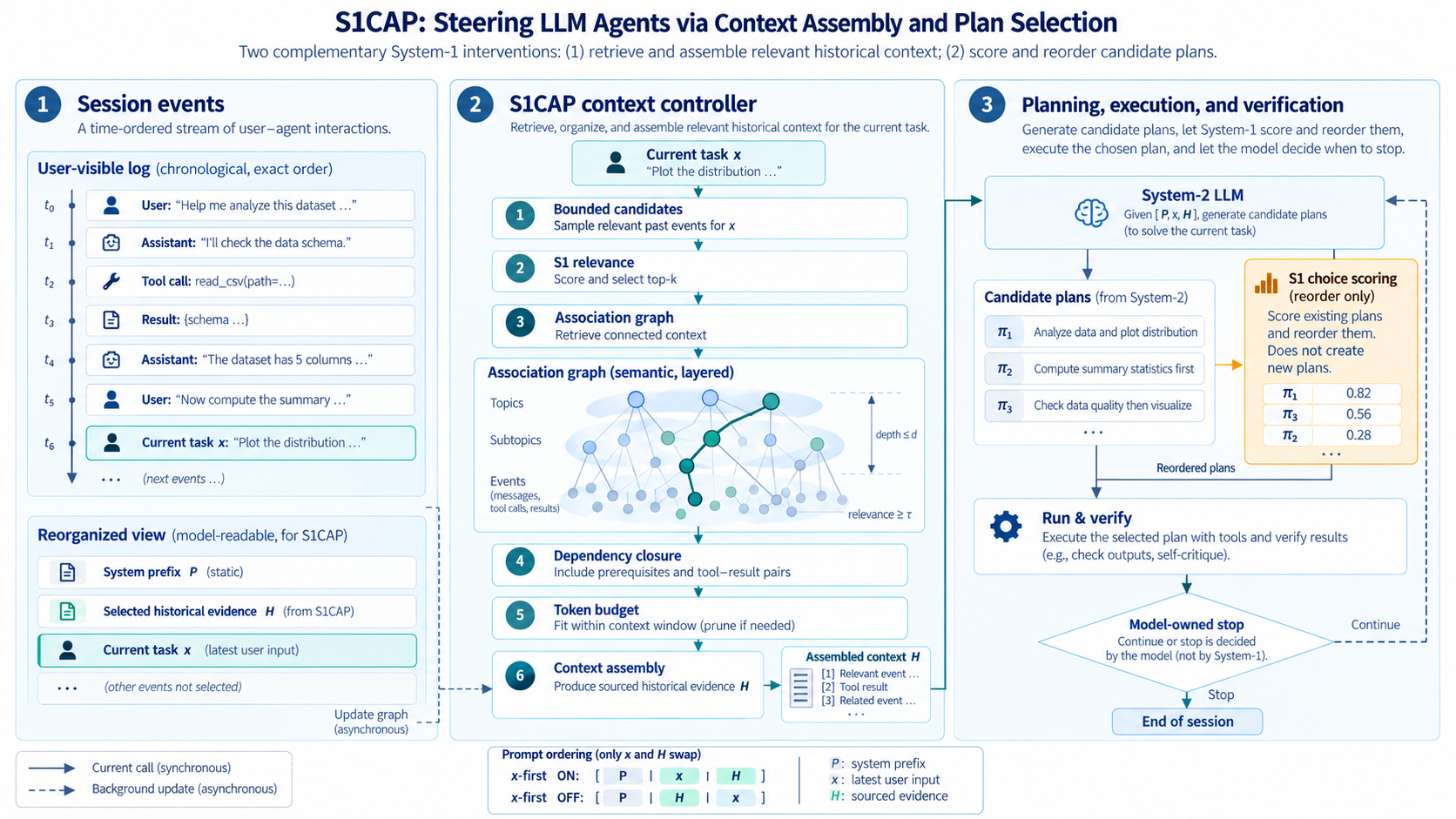
For exact control flow and asynchronous boundaries, see the detailed technical route (dark version).


The user-facing transcript stays strictly chronological; only the model view is reassembled — and that write-back is a 🔜 row in docs/ARCHITECTURE.md (packages/proxy, not written), so what the ordering half records is not yet what the model reads. The one live delivery channel inserts the recalled turns and nothing else, which is why the registered contrast measures the recall lane rather than TAS (docs/CELLS-RUN.md).
Evaluation design (three cells)
Three cells are run: two controls and one arm under test (the 2×2 crossing's fourth combination — governance without
ordering — measured worse than the baseline per step and has been dropped; bench/README.md records the quantities).
Which switches an arm carries is owned by the presets and the policy, not by this page: the arm definitions are
bench/cells/C0.json–C2.json plus cellPolicy()
(packages/core/src/types.ts), and a disagreement with this page is a reason to read those. What the three arms mean
is the rule this page keeps:
C0is the baseline andC2the full configuration;C1is a second control arm — delivery has one channel and itstier1: offleaves that channel empty by construction, so its model-visible input isC0's.tas.on/xFirstare recorded in every arm and reach the model in none: delivery inserts onerecalledblock and never the assembled order, so the ordering becomes measurable only with the model-view write-back, which does not exist (docs/ARCHITECTURE.md§5;packages/proxyis not written).- The registered contrast is therefore
C0vsC2, and what it measures today is recall selection and its insertion — the recall lane, not TAS. - Factor B is recall selection alone: the plan gate is designed and unit-tested but wired into no cell, so it is no part of any factor here.
Benchmarks (all automated scoring, no GUI, no LLM judges): SWE-bench Verified · Terminal-Bench 4.0 ·
τ²-bench. The pools and their sizes are
docs/AGENT_BRIEF.md §"Experiment design (three arms: two controls, one arm under test)",
and the per-round run set is docs/CELLS-RUN.md. Model: deepseek-flash
(DeepSeek-V4.1-Flash) with reasoningEffort pinned; no sampling parameter is claimed — not a temperature and not a seed — because DSH exposes none.
Success rule: solve-rate non-inferiority vs C0 (paired McNemar, one-sided α=0.05, margin −2 pp) AND ≥10% improvement in cost/task or time/task (paired bootstrap 95% CI excluding 0, Holm-corrected). Winning cost while losing >2 pp solve rate is not a win. The frozen rule is
docs/AGENT_BRIEF.md §"Metrics, hypotheses, success rule"; its pools, grid and budget are
docs/AGENT_BRIEF.md §"Experiment design (three arms: two controls, one arm under test)".
Status & roadmap
Pre-alpha — M0 scaffolding landed: monorepo, @s1cap/core (segmenter · association graph · assembler · plan gate · telemetry v1), @s1cap/s1-client, @s1cap/laya-runtime (Python discovery + laya-serve launcher), dsh-s1cap skeleton, three-cell presets (C0–C2); the offline suite is green (node --test, below), and a real laya-serve round trip verified (/health readiness + a noul decision over /v1/systemone). Remaining M0: live-backend smoke against Jev. Full spec: docs/AGENT_BRIEF.md.
| M | Scope |
|---|---|
| M0 | monorepo scaffold, core + s1-client, telemetry v1, DSH plugin skeleton — scaffold done, live-backend smoke pending |
| M1 | assembler/recall replay-correctness tests, proxy MVP, DSH hook wiring (agent/pre-step, surface ops) |
| M2 | plan gate wiring (a cell can only fire the gate once its model writes a plan the gate can read — none does today), degradation paths, settings UI, Terminal-Bench 10-task cost pilot |
| M3 | three-cell ablation on SWE-bench Verified + τ²-bench (+ TB), optional Laya fine-tune |
| M4 | Terminal-Bench cells, opencode transfer check, GLM model-swap check |
| M5 | paper: Pareto + cache-waterfall figures, case studies, LaTeX draft |
Development
node --test --experimental-strip-types "packages/*/test/*.test.ts"   # zero dependencies, offline
node scripts/check-diagram.mjs   # every node box inside its lane band, no overlapping nodes
node scripts/check-doc-pointers.mjs   # dead file/section pointers and stale value claims
The second command guards the hand-authored route diagram: it is drawn by hand, so nothing but this check stops a node from drifting out of its lane.
Local Laya backend: @s1cap/laya-runtime discovers the Python environment that can import laya
(conda environments are resolved through conda env list --json, never by guessing paths), launches
laya-serve and health-checks /v1/models. Install the serving extra once per environment with
<python> -m pip install "laya[serve]"; configuration keys and the DSH profile patch are documented in
docs/LAYA_RUNTIME.md.
Type-checking needs TypeScript ≥ 5.8 (erasableSyntaxOnly): npm i -D typescript@^5.8 && npm run typecheck.
pnpm is the intended workspace manager; on Windows PowerShell call pnpm.cmd (the .ps1 shim is blocked by
the default execution policy).
Repository layout
s1cap/
  packages/core        # segmenter, association graph, assembler, plan gate, telemetry v1
  packages/s1-client   # /v1/systemone client + provider matrix
  packages/proxy       # OpenAI-compatible middleware (M1)
  packages/dsh-plugin  # dsh-s1cap: first-class DeepSeek Harness plugin (skeleton)
  bench/               # cells/ presets; runners + stats land with M2
  docs/                # proposal, implementation brief, related-work dossier, formulas
  paper/               # LaTeX (M5)
Documentation
| doc | audience |
|---|---|
| docs/STATUS.md | start here — done/next checklist plus agent-ready detail for every open item |
| docs/PROPOSAL.md | research proposal — supervisor / cooperator |
| docs/ARCHITECTURE.md | module reference: route SVG + connection semantics, parameters, implementation status |
| docs/LAYA_RUNTIME.md | local Laya backend: Python environment discovery, launcher, configuration keys |
| docs/CONTROL_PLANE_LOGGING.md | control-plane isolation: two-log design and the invariants that keep System-1 from scoring its own output |
| docs/AGENT_BRIEF.md | implementation brief for coding agents — verified facts base, interfaces, algorithms, milestones |
| docs/FORMULAS.md | formal definitions and formula handbook (Markdown + LaTeX) |
| docs/RELATED_WORK.md | verified related-work dossier + novelty audit |
| docs/REPO_METADATA.md | canonical repo description, topics, keywords |
Environment
Verified on the dev machine (2026-09-28): Node v22.23.1 · npm 12.0.2 · git 2.45.2 · Python 3.13.13 (miniforge) · i7-12700H (AVX2 — EdgeJev-compatible) · DSH runtime bundles Node 24.18.1.
Requirements: Node ≥ 22.19 (DSH plugin engines contract) · pnpm for the monorepo (on Windows PowerShell, invoke pnpm.cmd or relax the execution policy) · Python ≥ 3.10 for local S1 runtimes (pip install "laya[serve]", pip install edgejev) · a System-1 backend: cloud Jev key, or local EdgeJev/Laya for weak CPUs (324 MB, offline).
Name
S1CAP = System-1 Context-Aware Planning — S1 is the System-1 decision model, C-A-P is the context-aware planning it performs for an LLM agent. The control layer intervenes at two points: ① Context Awareness (which segments the model sees) and ② Plan Ordering (the order its own plans run in).
Acknowledgments
TypeSafe AI (Jev) · Convai Innovations (Laya) · yzfly (EdgeJev) · jaredpalmer (Kev) · Benchmark Heaven (JevBench) · Xu Zou & Jie Tang (Trace as State, arXiv:2609.02702) · snailium (DSH plugin engineering template) · DeepSeek Harness
Citation
Paper in preparation. Authors: Yuanming Chen, LI Changzhe. Title: S1CAP: Context-Aware Planning via System-1 Models for Efficient LLM Agents (revised 2026-09-28 after the naming erratum: the acronym expands to System-1 Context-Aware Planning).
@misc{s1cap2026,
  title  = {S1CAP: Context-Aware Planning via System-1 Models for Efficient LLM Agents},
  author = {Chen, Yuanming and LI, Changzhe},
  year   = {2026},
  url    = {https://github.com/Jaffe2718/s1cap},
  note   = {Paper in preparation}
}
License
TBD (MIT proposed).
Comments
Loading…
Similar plugins
by AskTheWay
⚡ Millisecond System-1 judgement for every tool call in DeepSeek Harness — Jev-powered risk classification & evidence-gated auto-approval. Fail-closed by construction. dsh 生态第一个 System-1 决策插件
★ 23
↓ 373/wk
MIT
TypeScript
Oct 4, 2026
dsh plugin --profile agent add dsh-jev-interceptorby xienda
TypeSafe Jev (System One decision model) agent tools for DeepSeek Harness: jev_decision (choice/score/noul, parallel, typed answers + confidence), auto-guard (deterministic + Jev risk/loop checks), a
★ 1
↓ 957/wk
MIT
JavaScript
Oct 4, 2026
dsh plugin --profile web add dsh-jev-verifyby BetterZflyee
Use the Jev (System One) decision-model paradigm with any OpenAI-compatible LLM — no TypeSafe key required. Registers a jev_decide tool on DeepSeek Harness (dsh).
★ 4
MIT
JavaScript
Sep 21, 2026
dsh plugin --profile web add dsh-jev-adapterby Grivn
Long-term memory for AI agents on Jev. Keep raw records, judge them with a fast System 1 model and answer from under 4k tokens of context.
★ 4
↓ 13.8k/wk
MIT
TypeScript
Sep 30, 2026
dsh plugin --profile web add dsh-mnemonby nanami-0713
DSH plugin: register TypeSafe Jev (System One decision model) as an agent tool — jev_decide returns calibrated probabilities (noul/choice/score) for routing/triage/guardrail judgments, no text generation. 把 TypeSafe Jev 决策模型注册为 DSH agent 工具
★ 3
↓ 313/wk
MIT
JavaScript
Sep 30, 2026
dsh plugin --profile web add dsh-jev-decideby LuminariSoftwares
Compaction for local models that actually fires and never bricks the session. OpenAI-compatible proxy + DeepSeek Harness engine.
★ 1
MIT
Python
Oct 1, 2026
dsh plugin --profile web add dsh-context-guardian