

dsh-squeeze-command
Manifest valid★ 1Manual budget-targeted context compression for DeepSeek Harness: the conversation model picks ranges, a cheap flash-tier route writes the checkpoint summaries.
dsh-squeeze-command
Every turn of an expensive-model session re-sends its whole history. /squeeze shrinks it to a budget you pick.


A slash command for DeepSeek Harness that compresses a session's context on demand — with the summaries written by a cheap flash-tier route instead of the model you're paying for.
Before / after
/squeeze status
Surface: 331 messages, ~371,000 tokens — OVER budget by 271,000 (budget 100000).
Summarizer: ollama/deepseek-v4.1-flash:cloud. Read-only; nothing was changed.

/squeeze
Squeeze mode activated (target 100000 tokens, ~371,000 now; summaries via
ollama/deepseek-v4.1-flash:cloud). The model will pick ranges; the summarizer
writes the checkpoints.

  ... the model reviews its context, marks compressible ranges,
      flash summarizers write the checkpoints in parallel ...

Squeezed 3 span(s) (~74,963 tokens shadowed). Surface now 116 messages, ~97,445 tokens.

/squeeze status
Surface: 44 messages, ~45,780 tokens — under budget (100000 by 54,220).
What it does
- Cuts what you resend. One command on an idle session drops it under budget — and every summary is written by a cheap route you configure, not the frontier model running the conversation.
- Nothing is thrown away. Each squeeze leaves a checkpoint on the surface; the original messages stay in the append-only session log — and
/squeeze maplets you browse them. - Resists post-squeeze confusion. Every checkpoint summary ends with an explicit
Span end-state:line (COMPLETED/PENDING per task), and the squeeze result carries a trusted open-work digest computed from the uncompressed tail — so the model doesn't re-enter work a summary describes without its completion status. - Fires only when you ask. No thresholds, no auto-triggers, and it refuses to run while an agent turn is in flight.
- No agents to dispatch. The summary delegation is built in — you run one command, everything else happens inside it.
/squeeze           compress toward contextBudgetTokens (preset config)
/squeeze 60k       one-off token target (also plain: /squeeze 60000)
/squeeze status    read-only: message count, token estimate, budget, summarizer
/squeeze map       read-only: interactive HTML map of every checkpoint
/squeeze help      full usage guide
/squeeze map — see what compression did
/squeeze map replays the session log into a self-contained HTML page (written to your temp dir and opened in your browser; no LLM calls, nothing modified). On a squeezed session it shows:
- One timeline lane per
/squeezeinvocation (reconstructed from commit timestamps) — every checkpoint bar is clickable. - Event-density histogram — which stretches of history are still live on the surface vs shadowed inside checkpoints.
- Checkpoint table with per-checkpoint survival ratio (summary tokens vs shadowed tokens).
- Before / after — the original messages a checkpoint replaced, side by side with the summary that stands in for them.
- Surface time machine — buttons for
original,after squeeze N(one per invocation), andcurrent: exactly what the model's working set looked like at each point in time.
It also works on never-squeezed sessions (all-live histogram, full transcript — a useful preview of what a squeeze would chew on).
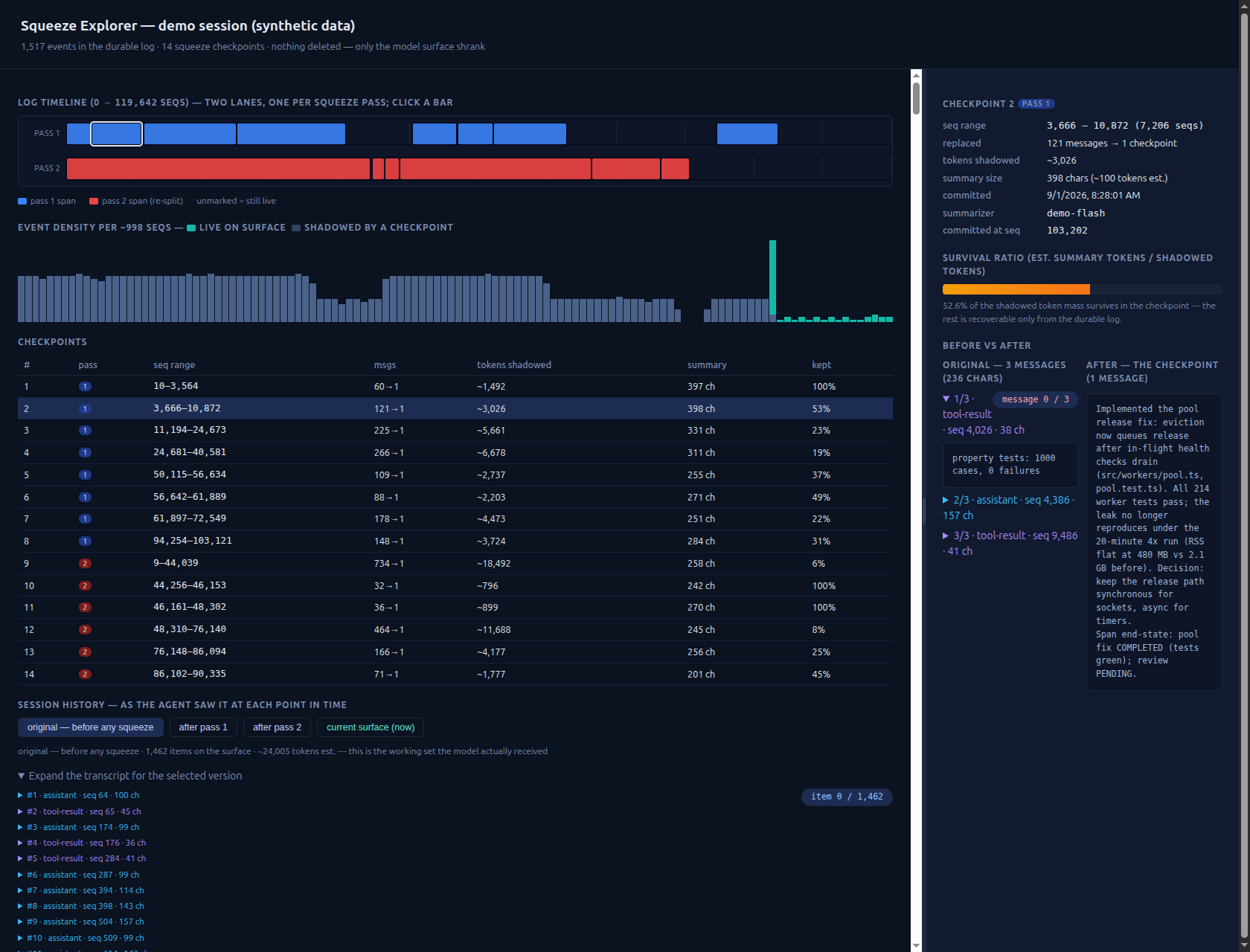
(Synthetic demo data — regenerate with node tools/squeeze-explorer.mjs --demo.)
The same view is available as a standalone script for any session log, without mounting the plugin:
node tools/squeeze-explorer.mjs ~/.dsh/sessions/<workspace>/session-<id>/session.jsonl.zstd
Installation
- Clone the package into your DSH commands directory:
git clone https://github.com/hardes11/dsh-squeeze-command.git ~/.dsh/commands/dsh-squeeze-command
- Register it in your profile's resolver manifest — DSH resolves bare plugin
names from the profile's
node_modules, so the manifest entry plus the symlink puts it there:
// e.g. ~/.dsh/profiles/web/package.json — substitute your profile
"dependencies": {
  "dsh-squeeze-command": "link:../../commands/dsh-squeeze-command"
}
ln -s ../../../commands/dsh-squeeze-command ~/.dsh/profiles/web/node_modules/dsh-squeeze-command
- Mount it in a preset's compaction group (
~/.dsh/presets/<name>/agent.cordis.yml):
- id: command-squeeze
  name: 'dsh-squeeze-command'
  config:
    contextBudgetTokens: 100000
    summarizerProvider: <your-provider>
    summarizerModel: <your-flash-model>
- Restart DSH, then run
/squeeze status. If it prints a budget line, the command is live. (Status works even unconfigured — it tells you what is missing.)
Configuration
| Field | Default | Meaning |
|---|---|---|
contextBudgetTokens | — (required for bare /squeeze) | target for bare invocation |
summarizerProvider | — (required) | provider key for the summary route |
summarizerModel | — (required) | model id for the summary route |
summarizerReasoningEffort | null | effort pin for summarizer calls; pin e.g. low only if the route's effort map declares it |
summarizerConcurrency | 5 | max parallel summarizer calls |
maxSpanInputTokens | 30000 | per-span summarizer input cap |
maxSummaryTokens | 2048 | per-summary output cap |
minSpanTokens | 200 | span floor worth a checkpoint |
maxSnapSteps | 5 | balanced-edge snap budget |
Invalid values (zero, negative, non-integer) fail at plugin load with a named-field error, not at squeeze time.
The summarizer route should be a cheap, fast model — a flash-tier model is the sweet spot: dense summarization is not reasoning-heavy work, and spans run in parallel. The plugin is provider-neutral; any route registered in your DSH settings works.
Compatibility
- DSH: peerDependencies are wildcards — the host provides
@deepseek-ai/dsh-compactionand@deepseek-ai/dsh-llm. Works across API generations: 0.1.1's eagersession.eventsarray and 0.1.2'ssnapshotEvents()are both handled, and the surface replacement emits whicheverSurfaceOpfield names the host validates (start/endbefore 0.1.5,startSeq/endSeqfrom 0.1.5). The shape is detected once per process, safely: an append rejected for its field names validates before it touches the session log, so the retry commits at the same position. - Standard DSH Bundle:
cordis.patch.yml(insert-only, own row) + adshmanifest block withcompatibility.dshReleases(0.1.1, 0.1.2-rc.1, and 0.1.5-rc.2 declared — each verified by live runs). - Node: >= 22 (
engines). - Summarizer route: provider-neutral — any provider registered in DSH settings.
Caveats worth knowing before installing:
- Manual-only. Nothing auto-fires, ever.
- Refuses while an agent turn or a compaction is active.
- A squeeze invalidates the prompt cache (it rewrites the context prefix) — run it on a session that has been idle long enough for the cache to have expired anyway.
- Squeezed spans are replaced on the surface by checkpoint messages — the visible transcript changes, though the session log keeps the originals.
Why
Long conversations with expensive models drown in input-token costs: every turn resends the whole history, and input cost dominates — not the thinking. A 300k-token conversation sent to a frontier model on every turn is the budget killer; the cached-prefix discounts providers offer (prompt caching) only soften it while the prefix stays stable.
/squeeze shrinks the context toward a budget you choose, with one deliberate division of labor: the conversation model (expensive or not) only picks which spans to compress — a small, cheap decision — while a configured summarizer route writes the checkpoint summaries, so compression never costs frontier prices.
How it works
/squeeze asks the model to mark compressible ranges (one tool call). A cheap route writes the summaries in parallel. Checkpoints commit sequentially, and the originals stay in the session log. After a successful squeeze, one extra cheap-route call digests the uncompressed tail into an open-work restatement appended to the tool result — historical summaries never outrank it.
Implementation notes
- Model-picked span edges snap outward to tool-pairing balanced cuts; spans that would overlap an already-planned neighbor are trimmed to the free sub-interval (fully covered or split spans drop with a message).
- Summarization runs with bounded parallelism (
summarizerConcurrency) holding no lock; each checkpoint then commits through its own tight synchronous bracket (compaction/start→compaction/summary→ surfacereplace→compaction/end), honoring the compaction capability's single-lock contract. No code path can leave a bracket dangling. - Summaries that hit the token cap fail closed — a truncated checkpoint is never accepted.
Development
npm ci           # .npmrc pins legacy-peer-deps for the rc-tagged peer closure
node smoke.mjs   # 59 behavior checks against real Session objects, no LLM needed
The harness resolves the message/tool-call helpers and the session log accessors per generation, so it runs unchanged against pre-rename and post-rename hosts (verified on the published rc.6 closure, the 0.1.2 fork line, and 0.1.5-rc.2).
/squeeze -h and --help work as aliases for help.
License
Versions
| Latest version | Published | Size |
|---|---|---|
| 0.1.0 | — | — |
| 0.1.1 | — | — |
| 0.1.2 | — | — |
| 0.1.3 | — | — |
| 0.1.4 | — | — |
Comments
Loading…
From the same category
by tt-a1i
Agent skill for beautiful, verifiable architecture, workflow, sequence, data-flow, and lifecycle diagrams—self-contained HTML with motion and crisp export.
★ 72k
↓ 3.5k/wk
MIT
JavaScript
Sep 25, 2026
dsh plugin --profile agent add @tt-a1i/archify-dshDeepSeek Harness plugin for Reactive Resume: bridges your resumes and job applications into a Harness session over MCP.
★ 41.7k
↓ 236/wk
MIT
Aug 24, 2026
dsh plugin --profile web add dsh-plugin-reactive-resumeby Tencent
Open-source LLM knowledge platform: turn raw documents into a queryable RAG, an autonomous reasoning agent, and a self-maintaining Wiki.
★ 30.2k
↓ 838/wk
NOASSERTION
Go
Sep 26, 2026
dsh plugin --profile web add @wxg-prc-cpg/dsh-weknoraby anywhere-labs
为 DeepSeek Harness (DSH) 插件生态打造的现代化桌面端解决方案。万物皆「插件」,桌面本身也是「插件」。
★ 29k
↓ 167/wk
MIT
TypeScript
Sep 25, 2026
dsh plugin --profile web add dsh-plugin-desktopdeepseek-harness-desktop is a interface plugin for DeepSeek Harness. See the repository documentation for its documented capabilities.
★ 28.6k
MIT
by titanwings
Distilly — Distill how they think into reusable Skills for any Agent or Bot. Formerly Colleague Skill(原同事 Skill).
★ 25k
MIT
TypeScript
Sep 22, 2026