
kubemd
IdentifiedKubeMD — The Kubernetes Surge Doctor
Evidence-first runtime diagnosis for Kubernetes failures — with case memory.
A DSH (DeepSeek Harness) skill that diagnoses live, broken clusters, not manifests. When a pod is CrashLooping, a node goes NotReady, or a Service stops answering, KubeMD runs a disciplined loop: capture context → build a red-capable feedback loop → collect signals → rank falsifiable hypotheses → fix with dry-run semantics → record the case for instant recall next time.
Different from KubeShark-style skills: they prevent hallucinations while writing YAML. KubeMD finds out why your running workload is broken — and never forgets a fix.






Install (30 seconds)
git clone https://github.com/guiyi-labs/kubemd ~/.dsh/skills/dsh-k8s-diagnosis
That's it. DSH auto-discovers skills in ~/.dsh/skills/. No restart needed.
DSH (DeepSeek Harness) — everything is a plugin. Skills are instruction bundles + scripts that agents load on demand.
💡 Install as a skill directory: the repo layout we ship is exactly a DSH skill bundle. Or copy the folder and rename to
dsh-k8s-diagnosisunder~/.dsh/skills/.
Demo
CLI running against a real fault-injected kind cluster (diagnose → 4 findings → case recall):
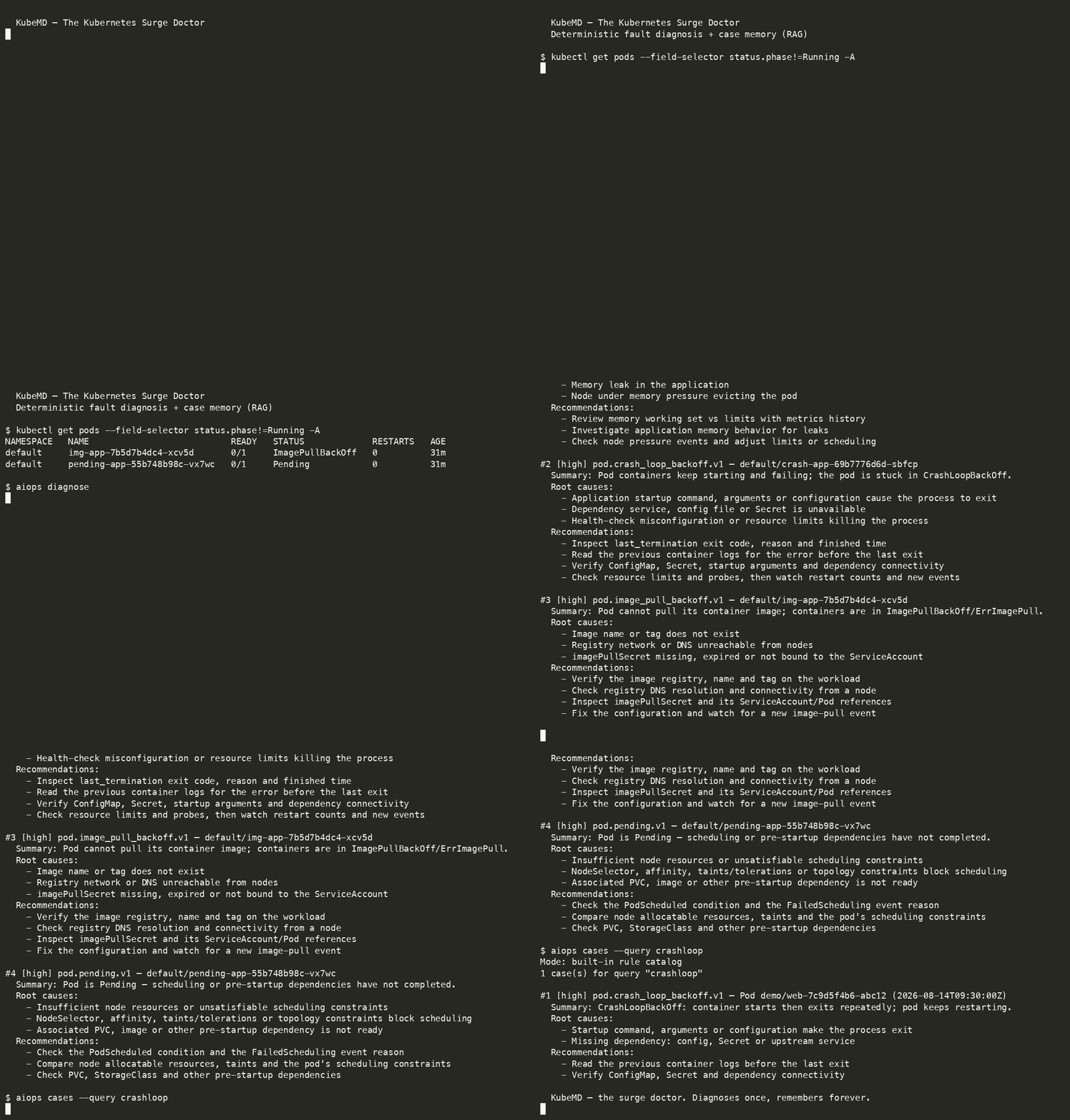
Reproduce it yourself in ~60s (needs Docker, kind, and the aiops CLI — or just the skill):
# 1) a real broken cluster
kind create cluster --name kubemd-demo
kubectl run crash-app --image=nginx:1.25 --command -- sleep 10   # crashes on purpose
kubectl rollout status deployment/crash-app 2>/dev/null || true

# 2) diagnose it (CLI twin of the skill, same deterministic engine)
go install github.com/guiyi-labs/aiops-platform/cmd/aiops@latest
aiops diagnose --namespace default --pod crash-app --period 5   # signals → root cause

# 3) recall the case next time
aiops cases --query crash-loop
Same loop the skill runs: signals first, hypotheses ranked, fix suggested dry-run.
What it does
Symptom: "pod CrashLoopBackOff after image update to :latest"
   │
   ├─ Phase 1  capture context      (cluster, scope, recent changes)
   ├─ Phase 2  build feedback loop  (kubectl events/logs → 10s red-capable signal)
   ├─ Phase 3  collect signals      (events → status → --previous logs → node)
   ├─ Phase 4  rank 3-5 falsifiable hypotheses  (predictions, not vibes)
   ├─ Phase 5  verify, dry-run      (kubectl diff / rollout undo)
   ├─ Phase 6  record the case      (cases.yaml → recall next time)
   └─ Phase 7  output contract      (ROOT_CAUSE / EVIDENCE / FIX / CASE_RECORDED)
Included
| Path | Purpose |
|---|---|
SKILL.md | The 7-phase procedure (short, token-efficient) |
references/signal-map.md | Symptom → signal → command cheatsheet |
references/playbooks/ | Deep playbooks: crashloop, oom, network, pending, node-not-ready |
scripts/collect-signals.sh | One-shot signal collection for Phase 3 |
scripts/record-case.sh | Append a resolved diagnosis to cases.yaml |
cases.yaml | Your growing case library (starts with examples; grows with your fleet) |
Case memory (the differentiator)
Every resolved diagnosis becomes a record. Next time the same symptom appears, search first:
grep -i "crashloop" ~/.dsh/skills/dsh-k8s-diagnosis/cases.yaml
A recalled past case is the fastest diagnosis: reproduction loop + remembered fix + re-verify. This is a local MVP of a broader AIOps knowledge loop — the same "distill resolved diagnoses into a searchable library" idea that powers LLM-assisted root-cause analysis at platform scale.
Also: the aiops CLI
Prefer a terminal? The same deterministic diagnosis rules ship as a go install-able CLI:
go install github.com/guiyi-labs/aiops-platform/cmd/aiops@latest
aiops diagnose --namespace demo --pod web-0     # rule-based root cause
aiops cases --query "crashloop"                 # historical case recall
No server. No database. One binary. Same engine, two doors: KubeMD (agent guidance) ↔ aiops CLI (terminal automation).
Design principles (borrowed from the best)
- Feedback loop first (mattpocock/diagnosing-bugs): no hypothesis before a red-capable loop exists
- Token-efficient progressive disclosure (KubeShark): SKILL.md stays short; playbooks load on demand
- Truthfulness: every step marks verified vs unverified; never claim what you didn't run
- Dry-run semantics:
kubectl diffbefore apply,rollout undoover live edits
Roadmap
- SKILL.md + signal-map + 5 playbooks + scripts
- cases.yaml examples + LICENSE + branding
- Verified against kind cluster (real fault injection: crashloop / oom / netpol deny)
- MCP tooling for DSH diagnosis hints
- Sync cases.yaml ↔ aiops-platform knowledge base (RAG)
License
Apache-2.0
Comments
Loading…
From the same category
DeepSeek Harness plugin for Reactive Resume: bridges your resumes and job applications into a Harness session over MCP.
★ 41.7k
↓ 156/wk
MIT
Aug 24, 2026
dsh plugin --profile web add dsh-plugin-reactive-resumeby Tencent
Let AI agents use your real, logged-in browser without interrupting your work. CLI + extension for browser automation across any shell-capable AI agent.
★ 8.6k
↓ 6.1k/wk
MIT
TypeScript
Oct 10, 2026
dsh plugin --profile terminal add @wxg-prc-cpg/browser-skill-dsh-pluginby yjh051108
dsh-routing-suite — injector + router-standard kit: install the runtime injector first, then the task-aware reasoning-mode router preset (measured P1-P23).
★ 7k
MIT
JavaScript
Sep 18, 2026
dsh plugin --profile web add @dsh-external/dsh-super-injectorby Q00
Agent OS: the agent gets smarter on its own. We just hold the line: Interview-gated, staged evaluation, budgeted evolution loop. MCP server, 14 runtimes: Claude Code, Codex CLI, Gemini CLI, OpenCode,
★ 6.2k
MIT
Python
Oct 7, 2026
by dsh-market
The plugin market inside DeepSeek Harness — browse, search, one-click install · DSH 可视化插件市场
★ 6.1k
↓ 112.4k/wk
MIT
TypeScript
Oct 10, 2026
dsh plugin --profile web add dshmarketby superdesigndev
OpenRouter for agent tools. Join community here: https://discord.gg/6mQYYfFMAn
★ 5k
NOASSERTION
Python
Oct 11, 2026
dsh plugin --profile web add treg-dsh