

dsh-remote-agents
Manifest validUnified DSH workspaces for Claude Code, Codex and OMP, with local and SSH conversations, tool approvals and persistent history.
DSH Remote Agents
Unified DSH workspaces for Claude Code, Codex and OMP, with local and SSH conversations, tool approvals and persistent history. Native DSH sessions share the same sidebar and retain their original conversation interface.
Unofficial community plugin, independently developed and maintained; not affiliated with DeepSeek. User messages and provider output are never translated or rewritten.
0.5.0 moves the backend to Rust. Every backend operation now runs in a bundled Rust sidecar while the DSH interface and state files stay the same. Install
dsh-remote-agents@latest, ordsh-remote-agents@0.4.1for the previous, frozen JavaScript release preserved on thelegacy-jsbranch. See native architecture and builds.
Highlights
- Rust-owned
/commands in Claude Code, Codex and OMP conversations: searchable keyboard completion, status/help, model/effort/permissions, rename/pin/archive, fresh conversations, interruption and Markdown/JSON export. Commands retain drafts on failure and never become model prompts. See conversation commands. - Per-conversation Models tab for OMP built-in/custom role assignments, project overrides, presets, provider connections and custom model definitions, scoped to that conversation's machine and workspace. Requires OMP 18.18.x for configuration management. See OMP model configuration.
- Full tool archives for new local and SSH turns: browse 16-call pages, search complete inputs/results, read long values in UTF-8-safe pages and export a turn's full tools as JSONL. Older local OMP turns can recover from their original session files. See tool history.
- Automatic titles from the first prompt, with manual rename protection and an explicit Use automatic title action.
- DSH-native conversation tabs tailored to each agent: Claude Chat / Tools / To-dos, Codex Chat / Plan / Changes, OMP Chat / Tasks / Tools / Models.
- Structured file diffs, tool filters, OMP task phases and agent-specific settings labels. The composer, drafts, approvals and interruption remain available across views.
- OMP semantic color accents for tools, phases, Markdown and thinking levels, following DSH's light/dark appearance.
See agent views and automatic titles for behavior and limits.
Screenshots
Captured in an isolated demonstration profile from the interface as of 0.4.1; 0.5.0 keeps this layout and adds the per-conversation Models tab, which is not yet shown here. Conversations, project paths, and CLI/SSH responses use fixtures; the images contain no production conversations, credentials, personal paths or real server identities. They illustrate the interface, not live-server verification.
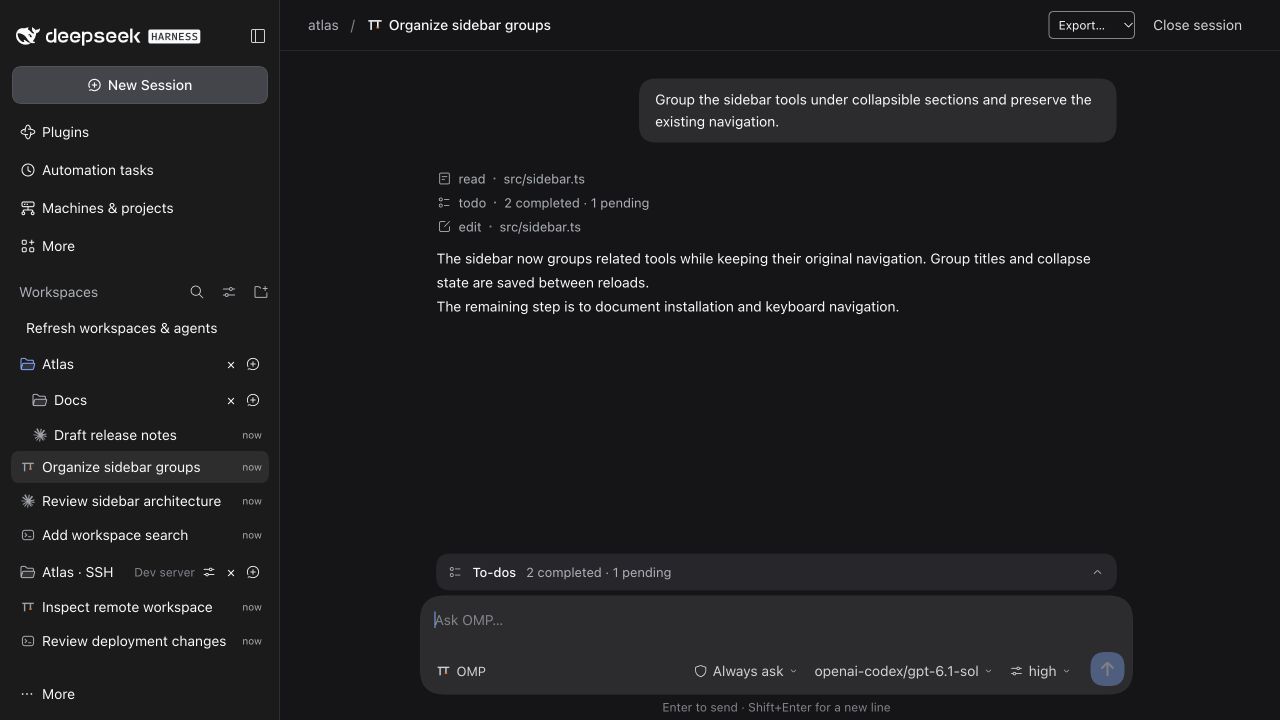
Unified workspace sessions — browse Claude Code, Codex and OMP conversations together, with nested local workspaces and a separate SSH workspace.
| OMP to-dos and tool calls | SSH workspace |
|---|---|
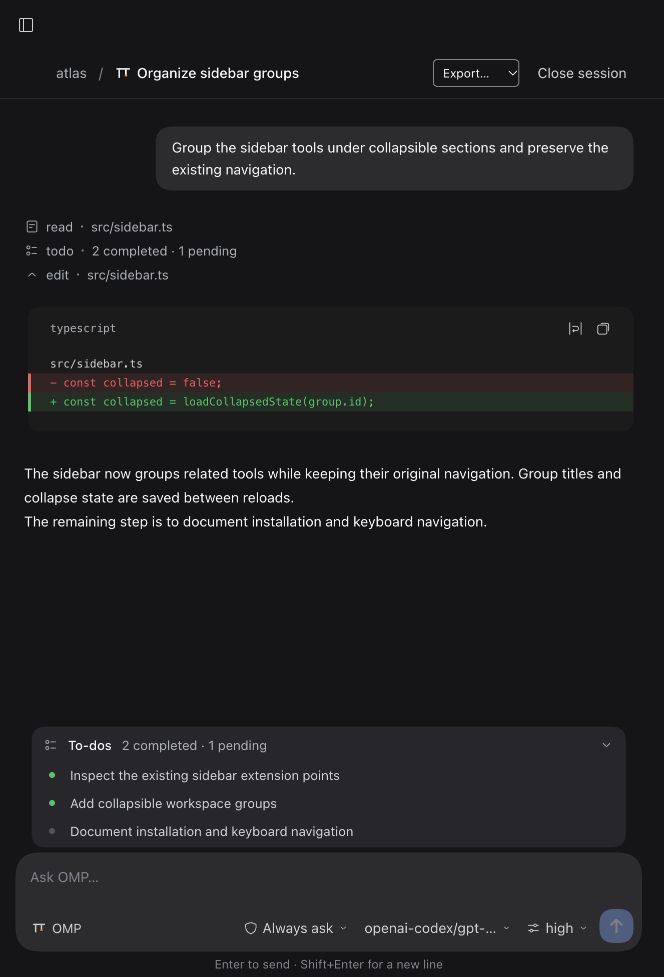 | 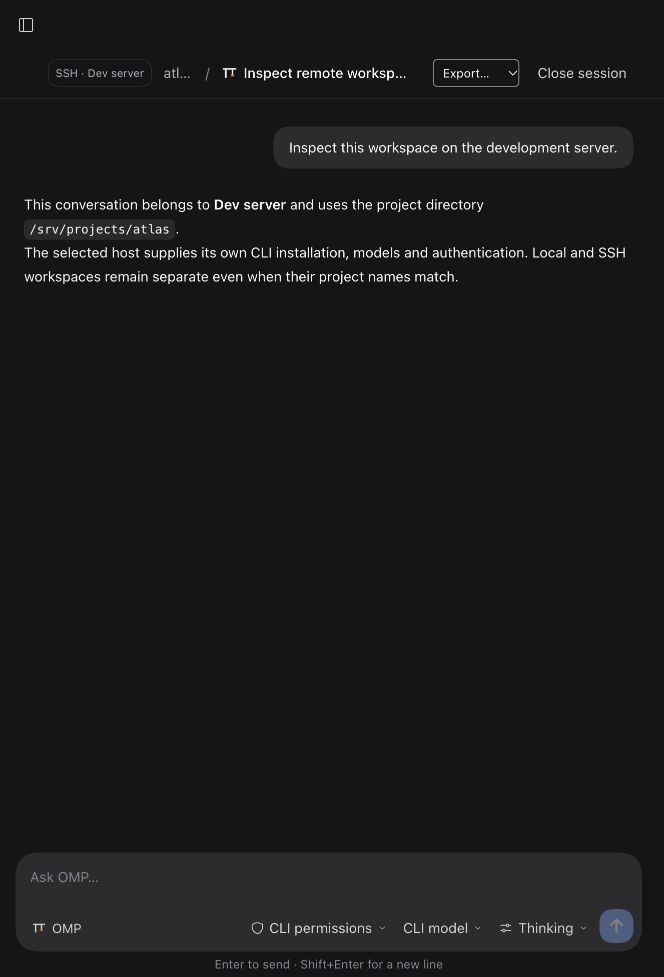 |
| Phased tasks and structured tool results stay beside the composer. | The host badge and remote directory identify where the conversation runs. |
Install
Use dsh-remote-agents@latest in the plugin manager for your running DSH profile, or pin dsh-remote-agents@0.5.0. For an explicitly selected web profile:
dsh plugin --profile web add dsh-remote-agents@latest
For the desktop app, install into its existing profile through its plugin manager; the command above does not update the desktop profile.
latest now resolves to this Rust release. The package ships macOS and Linux executables for arm64 and x64, and npm verifies each build with a signed provenance attestation from this repository's release workflow. See also Build and install.
Legacy JavaScript version
Versions up to 0.4.1 are the JavaScript-backed implementation. 0.4.1 remains installable from npm by exact version, and its source is preserved, frozen, on the legacy-js branch. That line receives no new features. Installing 0.4.1 over 0.5.0 downgrades the plugin; conversations and workspace registrations use a compatible state format, so they remain readable.
What's new in 0.5.0
- The backend is now a Rust sidecar. Session and fleet storage, CLI discovery and configuration, SSH/tmux terminals, provider events, approvals, imports, search/export and original OMP history run in a bundled executable that speaks bounded JSONL on stdio. Only the Host shim and the Claude SDK helper stay in JavaScript. Existing state files keep their format, so upgrading from 0.4.1 preserves conversations, workspaces and machines.
- Conversation commands:
/help,/status,/model,/effort,/permissions,/rename,/pin,/archive,/new,/stopand/exportwith keyboard completion, executed by the backend and never sent to the model. - Per-conversation Models tab for OMP roles, presets, provider connections and custom models, scoped to that conversation's machine and workspace.
- Complete tool archives with 16-call paging, full-value search, UTF-8-safe reads and per-turn JSONL export.
- Automatic titles, agent-specific conversation tabs, structured OMP task phases and OMP semantic color accents.
- SSH destinations (
alias,user@host,host:port,ssh://…) are tested before saving, with per-machine connection results and safe rename/removal. - macOS (arm64/x64) and Linux (arm64/x64, static musl) executables ship in the package; npm publishes each build with a signed provenance attestation.
What's new in 0.4.1 (legacy JavaScript)
- Fix an OMP conversation black screen caused by phased
todorecords (op/listinput anddetails.phasesoutput). - Show normalized OMP tasks and their current statuses, including result-only updates and empty lists. Unknown/truncated todo formats fall back to structured data.
- Isolate tool-card rendering failures so one bad card cannot remove the conversation, composer or stop control. Existing affected history can be reopened without deleting it.
Changes in 0.4.0
- Workspace discovery retries after startup/connection failures, retains known hosts during outages, and offers an explicit refresh. A host/interface version mismatch asks for an application restart.
- Settings save as partial, revision-checked changes with visible save status and last-turn effective values. Concurrent stale saves fail instead of silently overriding another choice.
- Remote updates show the installation source, exact tested target and command. Recognized npm, pnpm, Bun and Claude native installations use version-pinned updates; standalone/unknown installations get manual guidance. No automatic downgrade of a compatible CLI.
- Quota, authentication, compatibility and network failures include recovery guidance and the original error details. Errors never cause an automatic prompt resend.
- Idle chat polling slows to 5 seconds, idle catalogs to 10 seconds, and hidden-window polling to at least 30 seconds. Active chat stays at 700ms; reconnect/foreground wakes polling without overlapping requests.
- External sessions support rename, pin, archive/restore, retained-message text search and Markdown/JSON export. Removing a workspace removes only its registration; files and conversations remain. New-session controls are always discoverable.
- Installation regression coverage exercises the packed host and client, a real isolated CLI protocol process, startup failure/reconnect, settings, approvals, history and interruption. CI runs on Linux/macOS with Node.js 22/24.
Conversation capabilities
- Under each Workspace, use the compact new-session icon → DSH / Claude Code / Codex / OMP. The session inherits that workspace's directory and opens immediately; no separate Session Workbench or second creation form.
- Agent logos distinguish sessions in the shared list and conversation header. DSH keeps its original conversation renderer and model configuration; Claude Code / Codex / OMP use structured chat with streaming text, tool calls/results, permission decisions and interruption—not terminal output disguised as chat.
- Composer model search/custom IDs, per-model reasoning levels and native permission modes (including explicit YOLO), with Follow CLI defaults. Changes are session-scoped, persisted and applied on the next turn; running turns lock the controls.
- Add workspace → Machine → Directory supports saved SSH hosts and new SSH destinations (tested before saving),
~/expansion, directory suggestions, Tab completion and arrow-key selection. Remote sessions use the selected host's CLI, models and authentication. - Remote workspace CLI versions & updates exposes explicit per-agent update buttons, asynchronous progress, duplicate-update protection and post-update version/compatibility checks. No updates run on discovery or reconnect.
- Native DSH semantic theme tokens, including light/dark mode, typography, compact controls and layout clearances.
- Native DSH rows keep live approval/question/plan-review warnings and unread-completion markers. Pending interaction takes precedence over running, and running takes precedence over completion reminders.
- Claude Agent SDK 0.3.318 and OMP RPC v2 adapters. Unavailable/incompatible CLIs are disabled, with no silent terminal fallback.
- Codex 0.167.x app-server v2: streamed messages, command output, file patches, live plans, one-call command/file approvals, interruption and persisted thread continuation. Claude/Codex can copy a terminal resume command.
- Creating an external session does not start a process. Its first explicit message does. Backend identity is fixed per session; native drafts are preserved.
- Persistent transcripts, idempotent sends, explicit continuation after interruption, live-only approvals and bounded output.
- Pure-plugin integration replaces the Workspace browsing seat, without modifying DSH core. Workspace Tree is the default: workspaces nest under their nearest registered path ancestor, child groups precede parent sessions, and collapsing a parent hides its descendants. Grouping and collapse choices persist across reloads; Workspaces switches to sibling groups. Metadata and retained external-message search, history filters and native session rename/fork/pin/archive actions are included. Native single-session-list view, native message-content search, drag ordering and workspace renaming are not mirrored.
- Tree search temporarily reveals matching branches without changing saved collapse state. Only registered workspaces can parent another group; unregistered History directories cannot adopt registered workspaces.
Current scope: Claude, Codex and OMP structured chat supports local and registered SSH hosts with compatible CLIs. Attachments, rich questions and cross-engine migration are not implemented. Native DSH sessions remain local to the DSH Host. Unsupported dialogs are cancelled/denied rather than guessed. Native DSH conversation capabilities are unchanged; the replacement sidebar's limits are listed above.
See the architecture, protocol references and capability boundaries.
Existing fleet features
Open Machines & projects for:
- Local machines and SSH destinations (alias,
user@host,host:portorssh://user@host:port) that are tested before saving, with an explicit Save without testing override. Destination fields suggest theHostaliases of~/.ssh/configthat are not machines yet. They are read without running ssh. - Explicit connection tests that check SSH, tmux and Claude/Codex/OMP separately, explain SSH failures (unknown or changed host key, authentication, DNS, refused, timeout) and keep the last result on each machine.
- Machine rename and address changes that keep conversations and workspaces; removal that names what blocks it and keeps a restorable tombstone while conversations reference the machine.
- Project grouping, registration removal and forgetting terminal records on machines that are gone.
- Codex, Claude Code, DSH TUI and shell processes in isolated tmux sessions.
- Bounded terminal snapshots, literal input, interrupt and confirmed stop.
- Persistent tmux sessions across SSH disconnects and plugin/Host restarts.
- Static Herdr machine/project import with preview and explicit confirmation, offline import CLI and the bundled
herdr-importSkill. See the import guide and Skill.
This is not a full Herdr/T3 clone. There is no terminal emulation, live Herdr takeover, existing terminal discovery, Git worktree orchestration or inferred agent task status. In the legacy terminal view, running means the process is alive—not that an LLM task is finished.
Requirements
- DSH 0.2.x, at least
0.2.2-rc.1(verified on0.2.2-rc.1). Other DSH minor versions require revalidation. - Node.js 22+ on the plugin Host.
- Structured Claude: installed and authenticated Claude Code ≥2.1.318 and <3.
- Structured Codex: installed and authenticated Codex CLI 0.167.x; other versions require protocol revalidation.
- Structured OMP: installed and authenticated OMP ≥18.17 and <19; source-verified protocol version is 18.17.0 with RPC v2 negotiation.
- Legacy terminals additionally require tmux and, for remote machines, OpenSSH. Target machines must be macOS/Linux with tmux and the selected CLI.
- Absolute project paths on the respective host; remote tmux must be on its noninteractive SSH PATH.
The plugin uses owner-only exact Fetch routes on DSH's existing authenticated /api HTTP/IPC carrier. It does not start another Web server.
Build and install
Building the Rust implementation requires a stable Rust toolchain in addition to Node.js. Packaged installations use the bundled executable and do not compile Rust. A local build includes only the current platform; use the native distribution workflow for a package containing all four macOS/Linux architectures.
npm ci --ignore-scripts
npm run check       # builds Rust + JS, then runs regression and native tests
npm run test:package
npm pack
Install the resulting package through the plugin manager of the same profile as your running GUI. For an explicitly selected web profile:
dsh plugin --profile web add /absolute/path/dsh-remote-agents-0.5.0.tgz
For the desktop application, use its plugin management entry rather than installing into an unrelated web profile. Restart the desktop application after the update; no automatic HMR is promised without a matching dev:web watcher.
A locally packed tarball contains only the current platform's executable. The release artifact and the npm package contain all four macOS/Linux builds. Repacking an older tarball at its existing installed path can retain pnpm's old file integrity/cache; a new version and filename avoid that ambiguity.
The historical v0.2.0 release does not include unified chat.
Build artifacts contain a Host ESM entry and a DSH lazy client factory. React is shared with the Host. The pinned Claude SDK remains an ordinary runtime dependency rather than being embedded into the browser bundle.
SSH setup
Use existing OpenSSH configuration for keys and jump hosts:
Host dev-box
  HostName 192.0.2.10
  User developer
  Port 22
  IdentityFile ~/.ssh/id_ed25519
  IdentitiesOnly yes
Verify the host key and authentication yourself first:
ssh dev-box
ssh -o BatchMode=yes -o StrictHostKeyChecking=yes dev-box 'tmux -V'
Then add the alias and use an absolute remote project path. The plugin uses BatchMode=yes and StrictHostKeyChecking=yes; it never accepts an unknown fingerprint, stores SSH passwords/private keys, or automatically installs/updates remote software. Remote discovery runs only when you browse a directory, open a remote session/agent menu, or explicitly refresh versions. Herdr imports can preserve safe separate user/port fields.
Security and persistence
All operations require the DSH owner. Tool/terminal access is not an OS sandbox and can have the privileges of the corresponding local/SSH account. Do not share owner access with untrusted users.
Structured conversations
See permissions and storage for precise CLI policy semantics and limits. Conversation messages/tool data are stored in mode-0600 files next to the fleet state. Live processes and approval callbacks are not serialized. Closing the browser does not stop them; closing a session or unloading the plugin denies pending approvals and stops its structured subprocesses. An interrupted turn is never automatically resent.
Only one live ChatManager may own a chat state directory; configure separate state paths for simultaneous profiles. Existing CLI policy grants can permit tools without a new dialog; the UI only answers actual live requests and never selects remembered approvals automatically.
Legacy tmux terminals
- Dedicated tmux socket, random session IDs and ownership checks; no inspection or shutdown of unrelated default tmux sessions.
- Local argv execution and individually shell-quoted SSH parameters, with input validation and bounded operations.
- Terminal input is an execution interface, not a safe chat-only text field.
- Default fleet state:
~/.dsh/remote-agents/fleet.json, respectingDSH_HOME. Override withDSH_REMOTE_AGENTS_STATEor Host optionstatePath. - Fleet state uses atomic mode-0600 writes and a cross-instance advisory lock that is released if a process crashes. SSH work never holds it, so one slow machine does not delay others.
- Optional SSH connection reuse (
sshMultiplexing: trueHost option orDSH_REMOTE_AGENTS_SSH_MULTIPLEX=1) shares one connection per destination for the plugin's own SSH commands. On a local OpenSSH 10.5 server, a two-command directory listing dropped from about 105 ms to about 25 ms. It is off by default; see the Fleet API for its trade-offs. It stores machine/project metadata and launch arguments, not terminal transcripts. Never put secrets in launch arguments. - Legacy tmux sessions intentionally survive plugin unload/restart. Stop is an explicit destructive operation.
- Failed startup/input is not automatically retried. If a process was created before a failure, inspect its recovery record before trying again.
Verification
npm test
npm run build
npm run test:package
# Optional real isolated tmux test; creates and cleans up only its own test session:
DSH_FLEET_SMOKE=1 node --test test/local-smoke.test.js
Unit and component tests cover protocol framing, completion correlation, permissions/cancellation, persistence, duplicate admission, workspace grouping, settings conflicts, stale reads, reconnects, search and management. The installed-package test uses the actual packed host and client with a real deterministic CLI subprocess and fixture DSH UI primitives. It verifies tools, approval denial, interrupt/resume, process restart, settings and metadata persistence, export, and startup failure/reconnect. The tmux smoke test uses a real isolated terminal session. Live desktop checks have exercised local Codex and OMP replies and Netcup SSH directory browsing; provider authentication/quota and remote CLI versions remain environment-specific. Remote updater execution is tested with controlled commands; existing servers are not upgraded by verification.
Source map
- Chat contract and Rust session manager.
- Rust provider runtimes, CLI discovery and updates, and Claude SDK transport bridge.
- Workspace browser, conversation content and native entry integration.
- Fleet API, Rust fleet implementation, Host entry and RPC route names.
- Architecture and upstream references.
Comments
Loading…
Similar plugins
by wanwulizhi
Requires Claude Code installed and signed in on this machine. Delegates a self-contained coding task to the local Claude Code agent through the Claude Agent SDK, prepends the current DSH conversation
★ 0
MIT
JavaScript
Oct 26, 2026
dsh plugin --profile web add dsh-claude-code-sdkby Norman-else
Run Claude Code as a first-class DSH conversation while preserving its native agent loop, tools, skills, hooks, and MCP integrations in DSH.
★ 24
↓ 564/wk
MIT
TypeScript
Oct 24, 2026
dsh plugin --profile web add @norman-else/dsh-claudeby ZSeven-W
DeepSeek Harness (DSH) plugin: dispatch work to DSH agents from Claude Code / Codex — native subagent progress, in-host worker sessions with per-tier presets, and a multimodal bridge that lends the te
★ 217
↓ 893/wk
MIT
JavaScript
Nov 10, 2026
dsh plugin --profile web add @zseven-w/dsh-crewby lcestou
Claude Code CLI as an LLM provider for dsh: live model list, per-session resume, approval relay, images, a memory/rewind/changes panel, and workspaces on remote SSH boxes.
★ 40
↓ 1.8k/wk
MIT
TypeScript
Nov 17, 2026
dsh plugin --profile web add dsh-oh-my-claudePersonal coding assistant that schedules, follows up on and verifies local Codex or Claude Code tasks from DSH, with WeChat, WeCom and Feishu remote channels.
★ 1
MIT
TypeScript
dsh plugin --profile web add dsh-nexusImport local Codex CLI/Desktop, Claude Code CLI, and Claude Desktop conversations into DSH with project grouping, semantic history, and tool activity; bind an existing or replacement workspace and con
★ 0
dsh plugin --profile web add dsh-assembly.resume