

rolebox
Manifest valid★ 3Agent plugin for major harnesses — DeepSeek Harness (DSH), OpenCode, Pi and Codex: define custom AI agent roles with per-role prompts, models, skills, permissions, memory and multi-agent orchestration
rolebox
An agent-harness plugin — for opencode, pi, dsh, and Codex — with persistent memory, multi-agent dispatch, LSP integration, and engineering-team workflows.



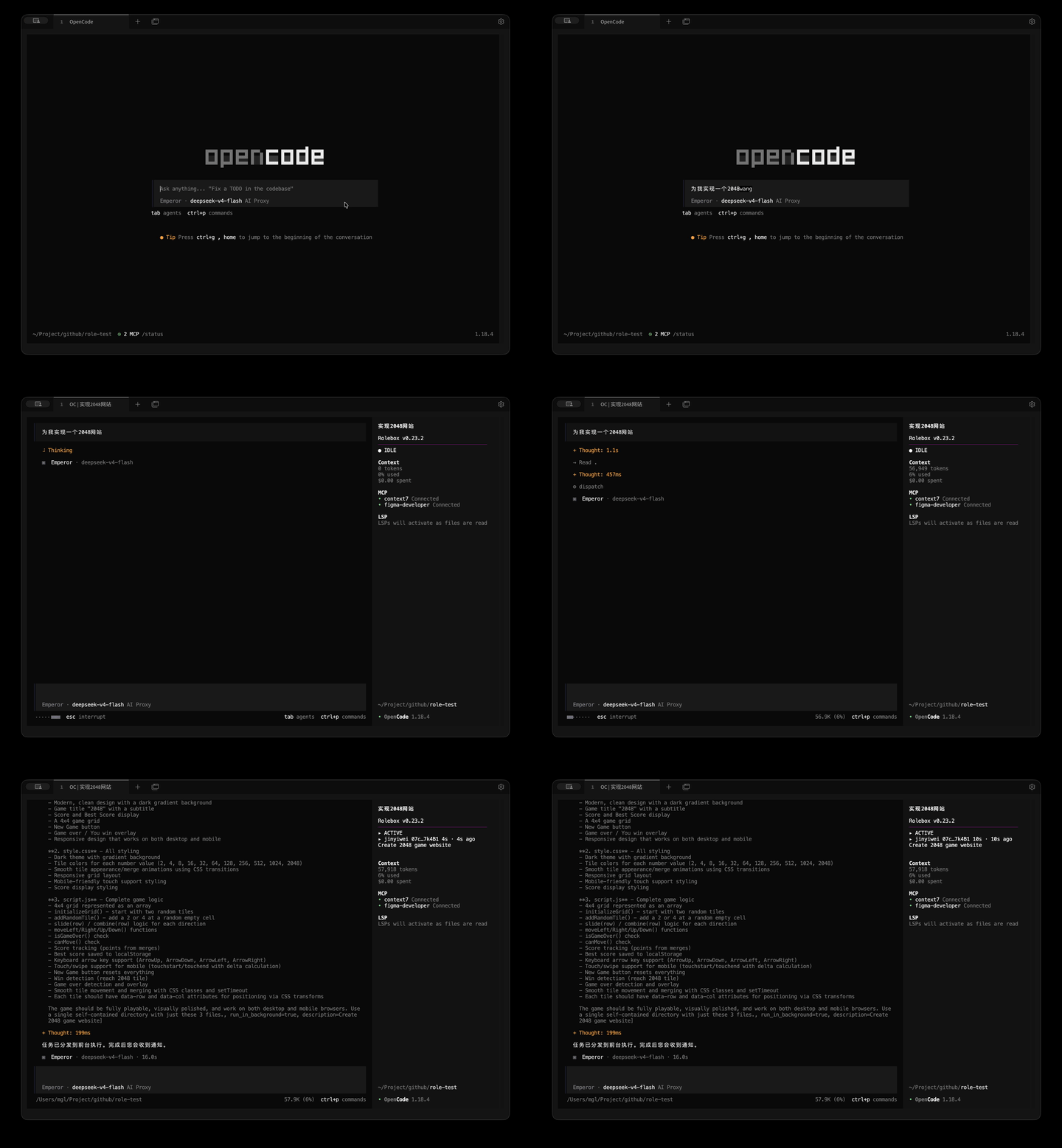
The Emperor orchestrator plans, dispatches to specialists, and validates the result — no code written by the orchestrator itself.
What it is / why you'd want it
A general coding agent is one agent with one prompt. rolebox turns it into your configured team: specialist roles you define in YAML, each with its own prompts, model, skills, and permissions, working the same task together. What they learn survives the session — decisions, conventions, and lessons persist in memory — and a graph execution engine actually runs the team: dispatching each role, carrying results and outcomes between them along declared edges, and enforcing declared loop caps.
The pitch, concretely
- It remembers your project. Decisions, conventions, and lessons persist in memory and auto-inject at session start (
<available_memory>) — you stop re-explaining yourself. - Your team, defined by you. Every specialist is a YAML role with its own prompt, model, skills, and permissions — install one from the registry or write your own.
- Real concurrency with a ceiling. Parallel multi-agent dispatch with engine-managed concurrency, per-node budgets, and retries — the team scales without runaway spend.
- Autonomy on declared rails. Workflows run as an explicit graph with bounded loops, and a node advances only when its worker submits one of the outcomes the declaration allows — a free-form report is never interpreted as progress.
- Edits that never drift. 30+ language-server tools (go-to-definition, diagnostics, references, rename) plus content-hash-anchored editing that survives concurrent file changes.
The graph engine is how the team runs: graph_declare writes a version-3 declaration — each node's agent, prompt and the outcomes it may report, plus the edges that route an accepted outcome — and reports persistence separately from the host’s initial start decision. The host dispatches the entry nodes, and a worker settles its node with graph_submit_outcome, which commits the node's state and arms the next node; graph_control applies the trusted lifecycle commands (failure, timeout, cancel, retry, budget-stop, and approval requests with their decisions); graph_status reads the recorded state back and graph_audit inventories the persisted store. Architecture and the full toolset: docs/graph-outcome-protocol.md.
Supported harnesses
| Harness | Config directory | Roles directory | Global skills | Env override |
|---|---|---|---|---|
| opencode | ~/.config/opencode | ~/.config/opencode/rolebox | ~/.config/opencode/skills | XDG_CONFIG_HOME |
| pi | ~/.pi/agent | ~/.pi/agent/rolebox | ~/.pi/agent/skills | PI_CODING_AGENT_DIR |
| dsh | ~/.dsh | ~/.dsh/rolebox | ~/.dsh/skills | DSH_HOME |
| Codex | ~/.codex | ~/.codex/rolebox | ~/.codex/skills | CODEX_HOME |
On every harness a rolebox/ directory in the current working directory takes precedence over the global roles directory; registry roles install with rolebox install <name> and deploy with rolebox sync <opencode|pi|dsh|codex>. Jump to setup: opencode · pi · dsh · codex
60-second install
opencode
cd ~/.config/opencode && npm install rolebox
mkdir -p ~/.config/opencode/rolebox && cd ~/.config/opencode/rolebox && rolebox init my-agent -y
// ~/.config/opencode/opencode.jsonc
{ "plugin": ["rolebox"] }
opencode 1.x loads the package root ({ id, server }); opencode v2 resolves the same installed package through its plugin entrypoint rolebox/server ({ id, setup }, src/entries/opencode2.ts) instead, so no second package or extra install step is needed. What v2 registers — and every surface where it degrades — is listed in compatibility.md.
pi
pi install npm:rolebox     # project-local instead: pi install -l npm:rolebox
mkdir -p ~/.pi/agent/rolebox && cd ~/.pi/agent/rolebox && rolebox init my-agent -y
# from a checkout instead: add "extensions": ["/path/to/rolebox/dist/entries/pi.js"] to ~/.pi/agent/settings.json
dsh
dsh plugin --profile <name> add rolebox    # installs the bundle into that profile
mkdir -p ~/.dsh/rolebox && cd ~/.dsh/rolebox && rolebox init my-agent -y   # $DSH_HOME/rolebox if set
Restart the harness. A non-bundle dsh install instead needs one - insert: row naming the profile-relative ./node_modules/rolebox/dist/entries/dsh.js in the profile's cordis.patch.yml — see examples/dsh/cordis.patch.yml. Profile patch semantics, the web role-switch dock, and the /rolebox REST surface are documented in docs/dsh-plugin-contract.md.
codex
npm install -g rolebox     # or run from a checkout built with `bun run build`
rolebox sync codex
rolebox sync codex writes the local plugin bundle under $CODEX_HOME/rolebox-marketplace (~/.codex/rolebox-marketplace by default), registers it in the Codex config.toml, and deploys installed roles to $CODEX_HOME/rolebox. The bundle starts the rolebox MCP server (rolebox mcp), which exposes rolebox's canonical tools over stdio. Restart Codex afterwards. Details: docs/codex.md.
Deprecated entry paths. The former
dist/index.js,dist/pi-extension.js, anddist/dsh-plugin.jsartifacts still resolve as generated re-export aliases, but they are deprecated — new checkouts and profile rows should use the canonicaldist/entries/*.jspaths instead.
Comparison: opencode vs + rolebox
| Capability | Raw opencode | + rolebox |
|---|---|---|
| Persistent memory | ❌ Sessions start blank | ✅ SQLite + FTS5, auto-inject past decisions |
| Multi-agent teams | ❌ Single agent | ✅ YAML-defined specialists, parallel dispatch |
| LSP integration | ❌ No language server access | ✅ 30+ tools (go-to-def, references, rename, diagnostics…) |
| Hashline editing | ❌ Line-number based | ✅ Content-hash anchored — edits never drift |
| Background dispatch | ❌ Sequential | ✅ Real concurrency with budget tracking |
| Hot-reload assets | ❌ Restart required | ✅ Edit YAML, reload instantly |
See it work
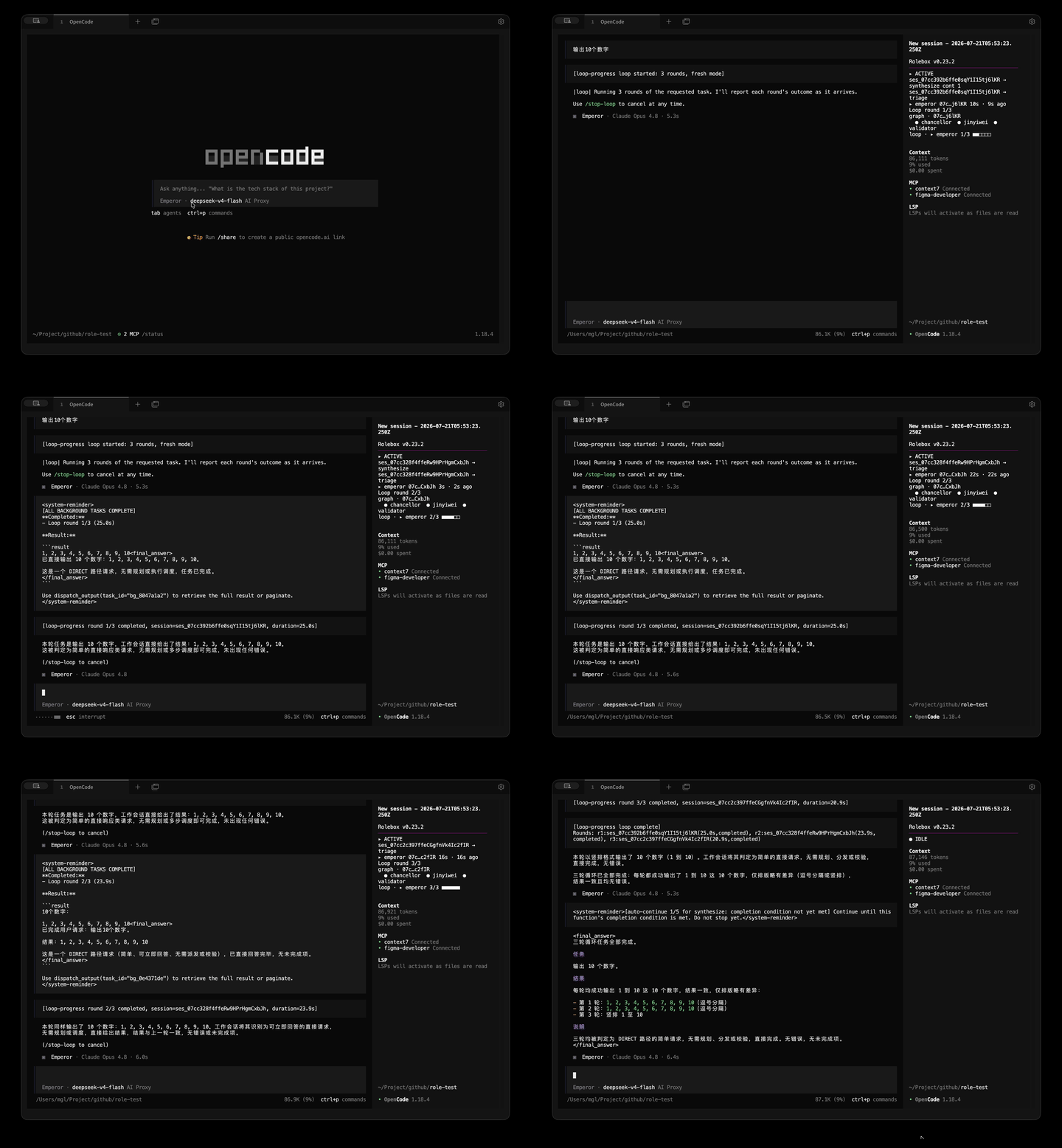
Loop mode runs the same task across N fresh sessions: |loop:N| executes real multi-round iterations, each round dispatching the task to a fresh worker session and reporting its own outcome — useful for refinement passes, batch fixes, and self-correcting workflows.
Role gallery
| Role | What it does |
|---|---|
| emperor | Top-level orchestrator — plans, delegates, validates complex work across a specialist team |
| software-architect | System design, trade-off analysis, ADRs, C4 models, and architecture reviews |
| react-frontend | React/Next.js component design, state management, and frontend architecture |
| ai-designer | AI application design with humane UX gates, interaction modeling, and design system creation |
| tauri | Desktop app development with Tauri v2 — IPC, plugins, window management, system tray |
| dart-flutter | Cross-platform mobile and desktop Flutter development with full gate review pipeline |
Install any role from the oh-my-role registry with rolebox install <name> and restart your harness.
CLI reference
| Command | Description |
|---|---|
rolebox init <name> | Scaffold a new role directory |
rolebox install [name] | Install a role from the registry (picker when omitted) |
rolebox status | List installed roles and their status |
rolebox info [name] | Inspect one role in detail (picker when omitted) |
rolebox sync <target> | Deploy installed roles to opencode / pi / dsh / codex |
rolebox mcp | Run the rolebox MCP server on stdio (Codex integration) |
rolebox config [name] | Configure a role's models (--target selects the harness) |
rolebox monitor | Runtime dashboard (TUI): loops, graph workflows, dispatch |
rolebox memory search <query> | Full-text search across persistent memory |
rolebox --version | Show version |
Model Alias Configuration
Registry roles often ship placeholder model names; map them once in role_config.yaml — ~/.config/opencode/role_config.yaml, ~/.pi/agent/role_config.yaml, ~/.dsh/role_config.yaml, or ~/.codex/role_config.yaml (the harness config directory). Unrecognized values pass through unchanged with a warning. Full resolution chain, error handling, and hot-reload: docs/model-aliases.md.
Upgrading from 0.x.x? rolebox 1.x replaced the 0.x execution model. Workflows are now declared to the graph outcome protocol with
graph_declareinstead of being declared inrole.yaml, and a node advances only through an outcome its worker submits withgraph_submit_outcome. See docs/graph-outcome-protocol.md.
Docs index
| Topic | Docs | Topic | Docs | Topic | Docs |
|---|---|---|---|---|---|
| Create a Role | create-a-role.md | role.yaml Reference | role-yaml.md | Directory Structure | directory-structure.md |
| Functions | functions.md | Copilot (Turn-End) | copilot.md | Skills | skills.md |
| References | references.md | Subagents | subagents.md | Graph Engine | graph-outcome-protocol.md |
| Memory Strategy | memory-strategy.md | Model Aliases | model-aliases.md | CLI | cli.md |
| Session Tools | session-tools-strategy.md | Dispatch Config | dispatch-config.md | Custom Hooks | hooks.md |
| Extensions | extensions.md | Registry | registry.md | Error Handling | error-handling.md |
| Limitations | limitations.md | Compatibility | compatibility.md | dsh Plugin Contract | dsh-plugin-contract.md |
| dsh Provider Notes | dsh-provider-notes.md | Install/Update Audit | audit-install-update-platform.md | CLI Output Audit | audit-progress-ui.md |
| Codex | codex.md | Compatibility | compatibility.md | Limitations | limitations.md |
Contributing
Contributions welcome — see CONTRIBUTING.md.
License
MIT — see the LICENSE file.
Comments
Loading…