

dsh-deep-dive
Manifest valid★ 3Deep Dive research mode: plan, parallel retrieval, citation checks against saved sources, cited report; plus a report reviewer panel.
Deep Dive (dsh-deep-dive)
一个 DSH 插件包,包含:
- 深度研究模式:澄清 → 计划 → 后台并行检索 → 来源多样性 gate → 引文核验 → 带来源报告;
- Deep Dive 报告页:划词评论、亮黄高亮、Follow up、评论状态、实时流式回复;
- 独立 Deep Dive URL:不依赖当前 DSH 会话,多人可共享同一个 workspace 的评论;
- 开发服务器:改 Web UI 不需要重启 DSH。
使用文档:docs/Deep-Dive-Guide.md(基础功能 + 专业设计说明,含截图)
安装
从 npm 安装:
dsh plugin --profile <profile> add dsh-deep-dive
或直接从 GitHub 安装(等价,跳过 npm):
dsh plugin --profile <profile> add github:chibslee/dsh-deep-dive
安装后在插件/Profile 里启用 dsh-deep-dive bundle,并重启一次 DSH。
启用后:
- 新建会话时选择 深度研究 模式;
- 报告 preview 的文档操作里打开 Dive;
- 也可以直接访问 /deep-dive/?cwd=
&slug= 。
界面
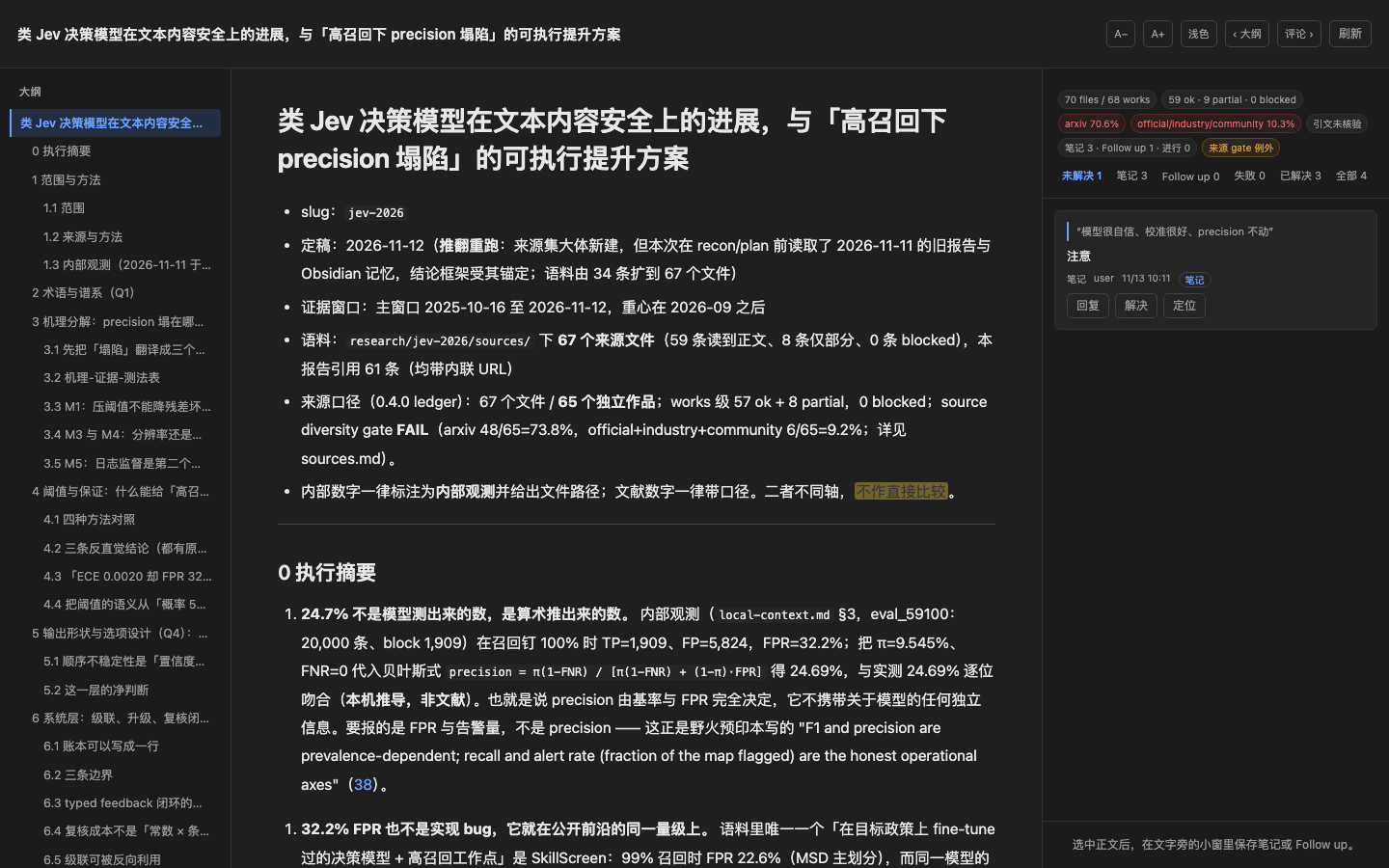
- 三栏:大纲 / 报告 / 评论,左右栏可折叠;
- 正文可调字号;
- 笔记为亮黄色,Follow up 在黄底上加红边框;
- 划词选择锚定浮窗,滚动时跟随;
- Follow up 默认基于已有材料回答,只有用户明确要求继续检索时才搜索新材料;
- 报告写作要求使用领域常用术语,不造新词、不堆黑话。
直接分发 tgz 试用
把 dsh-deep-dive-2.0.0.tgz 发给同事,对方在本机安装:
dsh plugin --profile <profile> add ./dsh-deep-dive-2.0.0.tgz
然后在 profile 的 dsh.profile.bundles 里启用:
dsh-deep-dive
完全退出 DSH 后重启。Desktop 的 profile 由应用管理,如果命令行拒绝直接写
desktop profile,就在插件页面启用,或按 profile 的 package.json 手动加入
dependency 与 bundle(只安装这一个包;2.0 起包名与 preset id 从
dsh-deep-research-review / research-review 改为 dsh-deep-dive / deep-dive,
两者不要并存)。
这是标准 npm 包 tarball,没有 postinstall 脚本,也不需要编译;但对方需要 相同或兼容的 DSH(本包在 DSH 0.2.2-rc.5 上验证)。tarball 不会自动更新, 换版本需要重新安装。
开发
要求 Node.js 22+。
node --watch scripts/dev-server.mjs --cwd /path/to/workspace --port 48123
打开:
http://127.0.0.1:48123/deep-dive/?cwd=/path/to/workspace&slug=<slug>&stream=0
- 修改 client.js、standalone/ 后刷新浏览器即可;
- 修改 store.js 只会重启 dev server;
- 不重启 DSH,不影响主 DSH 的其他会话。
DSH 内嵌面板是启动时加载的 client bundle;如果要在面板里看到 UI 改动,需要重启一次。独立页面和 dev server 是热更新的。
发布
npm login
npm publish --access public
发布前:
npm pack --dry-run
npm view dsh-deep-dive version
版本号遵循 semver;已发布的版本不能覆盖,改动后先 bump version。
许可
MIT
Failed Follow up retry
- A Follow up card in failed state has a 重试 button. It rebinds the comment to the producer session and queues it again.
- The dev server now refuses to create Follow ups instead of writing a fake dev-producer session into review/meta.json.
Fixed-height comment cards
- Comment cards in the right rail have a fixed 250 px collapsed height. Long quotes, notes and agent replies are clipped with a fade and an ellipsis-style "… 展开全文" control.
- Expanding a card shows its full content; opening the reply editor also expands it automatically. The action row stays visible at all times.
Page margins
The header has 边距− / 边距+ buttons next to A−/A+. They change the report's horizontal reading margin from 16 px to 96 px and persist in localStorage.
Source quality gate
Deep research now has a central quality gate between evidence collection and synthesis:
- scouts record raw metadata (publication date, DOI/venue, GitHub repo, citation/GitHub signals when observed) but do not assign the final score;
- one central gate normalizes every source on a shared 0-4 rubric for authority, freshness, evidence, independence and consensus;
- it flags duplicates, stale/missing dates, blocked/partial sources, low authority and unresolved contradictions;
- high-stakes claims need one high-stakes-eligible primary source, or two independent passing sources with authority >= 3 and at least one fresh source;
- citation counts and GitHub stars are impact signals only; they never raise authority;
- the workflow emits research/
/quality.json and the report includes a source-quality table plus every claim that failed the gate in coverage & limitations.
The deterministic baseline is skills/deep-dive/scripts/source_quality.py; the central gate agent applies the shared rubric in skills/deep-dive/references/source-quality.md. The gate is not delegated to individual scouts, so different scouts cannot invent different scales. Unknown sentinels (unknown/none/null) are never treated as real DOIs or arxiv IDs.
Technical topics default to English-first search (60-80% English queries, Chinese supplemental), while the report language remains user-selected. The workflow exposes searchLanguagePolicy, maxGapItems and gapRounds as explicit args.
Follow ups run in a subagent
-
A Follow up is answered by a forked subagent, not by a user message injected into the main conversation.
-
The child inherits the producer session's completed turns and receives the report path, selected quote and question. It is instructed to read the report, sources, notes and brief before answering.
-
The host captures the child's final answer and writes it to the review comment. The subagent is told not to edit the report or call the review CLI itself.
-
The child appears in the subagent/Fleet view, but there is no new user/assistant turn in the main chat.
-
If no local subagent provider is available, the Follow up fails clearly instead of falling back to the main conversation.
-
The child prompt also includes the text before/after the quote and the existing review-thread replies, so a later question that refers to earlier discussion does not lose that context.
1.2.2: client module id
The package was renamed from dsh-dsh-deep-dive to dsh-deep-dive, but the client factory id was still the old name. DSH keys its client boot graph by package name, so the host routes loaded while the panel/action client registration did not. The client id now matches the package.
Draft popover outside-click
- Clicking outside the new-note / Follow up popover closes it only when the textarea is empty (or whitespace-only).
- If the user has typed something, an outside click leaves the draft open so it cannot be lost accidentally.
- Clicking inside the popover, or using its close/cancel buttons, still works as before.
Subagent fallback
A Follow up now tries the fork subagent first (best context) and falls back to a spawn subagent if fork activation fails. The spawn child still has the report path, selected text, surrounding context and review thread, and can read sources/notes/brief; it does not post into the main conversation.
Subagent service scope
The follow-up now obtains the subagent service from the producer agent's scoped context (parent.ctx.get("subagents")) instead of the host-level proxy. The activation payload contains a live Agent object; routing it through the host proxy can drop the parent and fail with "Cannot read properties of undefined (reading 'id')". The host-level service remains only as a fallback.
Isolated reviewer fallback
If both fork and spawn activation fail, the host creates a short-lived isolated review agent session, sends it the report/quote/thread prompt, captures its streamed answer, and disposes it. This does not append to the main conversation; the temporary review session may appear in the session history.
Follow ups are child sessions, not new top-level sessions
Follow ups no longer call the subagent activation manager and no longer create a top-level reviewer session. The host creates a child agent directly with parentSession = producer session and origin = subagent, sends the report/quote/thread prompt there, captures its streamed answer, writes the comment, and disposes it. The child belongs to the producer's subagent lineage (visible in Fleet), not the normal session list, and there is no message in the main conversation.
One child per Follow up thread
Each Follow up thread keeps its child agent session (origin=subagent) and stores its id on the comment. A user reply inside the thread now enqueues a continuation to that same child, so the child sees its previous answer instead of starting over. The child is disposed when the thread is resolved or deleted.
Existing unanswered replies
When a report is opened, a Follow up whose last reply is from the user is enqueued automatically. Queued/running/failed threads are not re-enqueued by polling.
Visible streaming
Follow up answers use the child agent's assistant stream. The review card auto-expands while running, shows partial text, and displays tool activity such as “正在调用 bash…”. Status is broadcast before child creation, so the page acknowledges the request immediately; final text is persisted when the child becomes idle.
1.8.0 quality gate semantics
- must_fix is a disclosure list, not a blocking gate; failed claims are written into coverage/limitations. Only blocking entries stop synthesis.
- source_quality.py has a separate blocking array (no sources / no source passes).
- --require-pass is a smoke check for zero passing sources, not a percentage gate.
- stage=full is disabled; the supported path is collect -> gate/review -> synthesize.
- searchLanguagePolicy is explicit; no topic regex is used to guess it.
- verify_citations checks every report link against sources and strict mode fails when no quote pairs exist.
1.9.0 routing and disclosure cleanup
- stage is a two-value contract: collect -> synthesize; full and any unknown stage are blocked. The old fallback pipeline is deleted.
- must_fix is disclosure; blocking is the hard stop. source_quality emits blocking for no_sources/no_source_passes.
- orphan assemble_citations/facts.json path removed rather than left as a dead promise; mechanical fact assembly is deferred until a producer exists.
- angle discovery outcome is recorded in coverage.angle_discovery.
- verify_citations checks all report links and SKILL calls --strict.
1.9.1 live thread placement
Streaming text used to render before the persisted replies, so a second agent answer appeared as a live block near the card header. Live output now renders after the existing replies, only while running, and clears when a new run is queued. Persisted replies stay in thread order.
1.9.2 research library homepage
The Deep Dive panel now lands on a report library instead of an empty current
workspace error. It aggregates research/
Comments
Loading…
Similar plugins
by wxxb789
Source-grounded deep research, writing, and learning plugin for DeepSeek Harness (dsh): steerable checkpoints, mid-run steering, and citations verified against retrieved sources.
★ 0
MIT
TypeScript
Oct 6, 2026
dsh plugin --profile web add dsh-raven-researchby houdinicc
Deep research for DeepSeek Harness: multi-query search, source fetching, evidence extraction and a cited evidence report, through the host ctx.web service. · DSH 深度研究插件:多查询检索、正文取证、交叉印证,产出可引用的证据报告。
★ 0
MIT
JavaScript
Oct 21, 2026
dsh plugin --profile web add dsh-deep-researchby NigelYao
view modes for deepseek harness, including Verbose, Normal, Summary Mode
★ 3
MIT
JavaScript
Aug 13, 2026
dsh plugin --profile web add dsh-view-modesby gwsbhqt
洞察 — read-only insight panel for a DeepSeek Harness profile: where every plugin, service, tool and model came from, which config layer inserted or disabled it, and what is running right now.
★ 3
↓ 161/wk
MIT
TypeScript
Sep 26, 2026
dsh plugin --profile web add @gwsbhqt/dsh-insightby MCJF28
Channel-aware web search routing for DeepSeek Harness: official DeepSeek search or your own Parallel-compatible endpoint, with readable failure reasons.
★ 0
MIT
JavaScript
Oct 18, 2026
dsh plugin --profile web add dsh-web-search-routerby improveTheWorld
Quorum mode for DeepSeek Harness: multi-agent deep reasoning with role-isolated subagents, adversarial verification, persistent return channel, and context budget management
★ 0
NOASSERTION
JavaScript
Oct 13, 2026
dsh plugin --profile web add @local/dsh-boost